tax-saving-investment-tips-for-self-employed

Tax-Saving Investment Tips for Self-Employed Individuals

Self-employed individuals can reduce tax liability by choosing the right tax-saving investments and planning deductions around irregular income.

Written by : Knowledge Centre Team

2025-11-07

1010 Views

12 minutes read

It may sound surprising, but self-employed people outnumber salaried individuals in the country. In 2013, over half of the 473 million workers in the country were self-employed. A large number of self-employed people have made India the a country with one of the largest gig economies in the world. However, self-employment is a broad term and encompasses a wide variety of workers ranging from casual labourers to freelance writers and graphic designers. There is a significant difference in the functioning and payment schedules of self-employed and salaried individuals. Most self-employed workers have irregular payment schedules and need tax saving investment options in sync with their payment timetable.

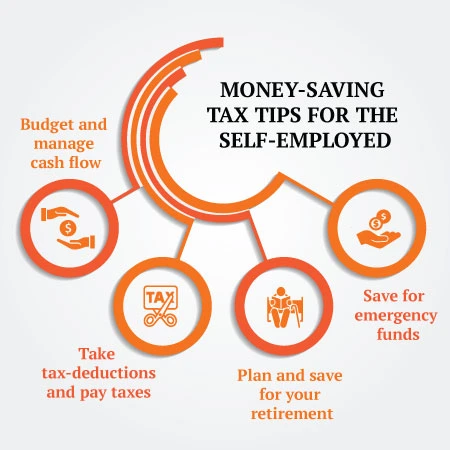
While opting for an investment, a self-employed individual should not just look at the initial tax saving but also seek tax-free returns. There are three phases to an investment - investment phase, accumulation phase and withdrawal phase. Many instruments help in tax saving in the investment and the accumulation phase, but are taxed in the withdrawal phase. Self-employed people should invest in a mix of instruments with different tax saving capabilities. Here are a few tax-saving tips for self-employed people.
  1. Bank fixed deposits: Bank fixed deposits are not fully tax-free, but are a good  short-term investment option. One has to remain invested in a bank fixed    deposit qualifies for a certain number of years. Investment in five-year bank fixed    deposits qualify for tax deduction under Section 80C of the Income Tax Act, 1961. Fixed deposits are also suitable for self-employed people as they    require a lump-sum payment. The returns of fixed deposits vary but hover    around 7-8%. Fixed deposits help save tax in tax saving in the investment phase but    the interest earned is taxable, which may diminish returns in the long run.
  2. Unit-linked insurance plans: ULIPs are a mix of insurance and investment and can be an ideal tax-saving instrument for self-employed workers. While investing, one should also consider the rate of return and liquidity, along with saving taxes. The contributions made to a unit-linked plan are eligible for tax deduction under Section 80C of the Income Tax Act, 1961. With an array of investment funds ranging from debt to equity offered by ULIPs, one can invest according to his/her risk profile. Many ULIPs allow partial withdrawals to take care of urgent liquidity needs. ULIPs being long-term instruments, can help build a considerable corpus to fulfil life goals. ULIPs are essentially insurance products, which allow them to escape the purview of long-term capital gains even though a part of the contribution is invested in market-linked instruments
  3. Equity-linked savings scheme: Self-employed people can consider ELSS as an ideal option for tax saving as well as capital appreciation. ELSS are diversified equity mutual funds that have a minimum lock-in period of three years for investment. Investment in ELSS is eligible for a tax deduction of up to Rs 1.5 lakhs under Section 80C of the Income Tax Act. The accumulation and withdrawal were earlier completely tax-free, but after the Budget 2025, gains made over ₹ 1.25 lakh per year attract long term capital gains tax at the rate of 12.5%. Beyond tax saving, ELSS can deliver decent returns as the entire corpus is invested in equity instruments.
  4. National Pension Scheme: The NPS is a government-backed scheme open to all, introduced to promote retirement planning among people. The defining feature of NPS is that it allows exposure to equities at a very low cost when compared to mutual funds. Contributions to NPS qualify for a deduction of up to Rs 1.5 lakhs per year under Section 80C of the income tax laws. Individuals can claim an additional deduction of Rs 50,000 under Section 80CCD (1B) for investing in NPS. You are allowed to withdraw 60% of the accumulated corpus, but the balance 40% has to be used to buy an annuity plan. The lump-sum amount allowed to be withdrawn is tax-free, but the regular annuity payments will be taxed as per the income slab.

Self-employed individuals can use a mix of tax-free investment options for tax savings along with optimising returns. Fixed deposits and ELSS can be used for short-term goals, while NPS and ULIP can be used to fulfil long-term goals such as retirement planning and child's education.

Save Taxes While Building Long-Term Wealth

Please enter correct name Please enter the Full name
Please enter valid mobile number Please enter Mobile Number
Please enter valid email Please enter Email

Enter OTP

An OTP has been sent to your mobile number

Didn’t receive OTP?

Application Status

Name

Date of Birth

Plan Name

Status

Unclaimed Amount of the Policyholder as on

Name of the policy holder

Policy Holder Name

Policy No.

Policy Number

Address of the Policyholder as per records

Address

Unclaimed Amount

Unclaimed Amount
Error

Sorry ! No records Found

.  Please use this ID for all future communications regarding this concern.

Request Registered

Thank You for submitting the response, will get back with you.

Disclaimer - This article is issued in the general public interest and meant for general information purposes only. The views expressed in this blog are solely those of the writer and do not necessarily reflect the official policy or position of Canara HSBC Life Insurance Company Limited or any affiliated entity. We make no representations or warranties of any kind, express or implied, about the completeness, accuracy, reliability, suitability, or availability with respect to the blog or the information, products, services, or related graphics contained in the blog for any purpose. Any reliance you place on such information is therefore strictly at your own risk. You should consult with a qualified professional regarding your specific circumstances before taking any action based on the content provided herein.

Recent Blogs

What Is an Employee Salary Slip? Format, Components & Tax Benefits
19 Mar '26
4079 Views
13 minute read
Learn what a salary slip is, why it matters, and how it impacts your tax-saving strategies. Includes downloadable format and latest rules.
Read More
Tax Saving
What is TDS and TCS? Difference Between TDS and TCS
18 Mar '26
8050 Views
9 minute read
Understand the key differences between TDS (Tax Deducted at Source) and TCS (Tax Collected at Source) for smarter tax savings. Explore the Canara HSBC Life Insurance blog for insights.
Read More
Tax Saving
What Is Tax Liability? Meaning, Calculation & Examples
05 Mar '26
2001 Views
7 minute read
Tax liability is the total tax payable after deductions and exemptions. Learn its meaning, how to calculate tax liability and how it affects ITR filing in India with examples for individuals.
Read More
Tax Saving
FATCA Declaration: Meaning, Eligibility & Filing Guide
25 Feb '26
72 Views
6 minute read
Understand FATCA declaration requirements, who must submit it, reporting rules for foreign financial assets, and why compliance is important for Indian taxpayers.
Read More
Tax Saving
Income Tax Rates in India: Latest Slabs & Comparison Guide
25 Feb '26
82 Views
6 minute read
Explore current income tax rates under old and new regimes, slab-wise comparisons, and practical tips to select the most suitable tax regime for your income profile.
Read More
Tax Saving
Short Term Capital Gains Tax & Calculation | STCG Tax India
23 Feb '26
10716 Views
11 minute read
Understand short term capital gains tax in India. Know how STCG is taxed, rates, and calculation for different assets under current tax rules.
Read More
Tax Saving
What Is TAN? How to Apply for TAN in India
23 Feb '26
1962 Views
10 minute read
What is TAN? Understand its structure, importance, and how to apply for a Tax Deduction and Collection Account Number (TAN) easily in 2026.
Read More
Tax Saving
What is EPF Form 10C? Meaning, Benefits, Eligibility
23 Feb '26
1421 Views
6 minute read
Learn about EPF Form 10C. Its meaning, benefits, and eligibility. Find out how submit form 10C online and how can help you with your Employee Provident Fund.
Read More
Tax Saving
Import Tax in India: Why Imports Are Heavily Taxed?
23 Feb '26
1972 Views
6 minute read
Understand why imports are heavily taxed in India, how import tax works, and the economic and policy reasons behind high import duties.
Read More
Tax Saving

Tax Savings - Top Selling Plans

We bring you a collection of popular Canara HSBC life insurance plans. Forget the dusty brochures and endless offline visits! Dive into the features of our top-selling online insurance plans and buy the one that meets your goals and requirements. You and your wallet will be thankful in the future as we brighten up your financial future with these plans.