

How Can the TDS Calculator Help Calculate TDS on Rent?
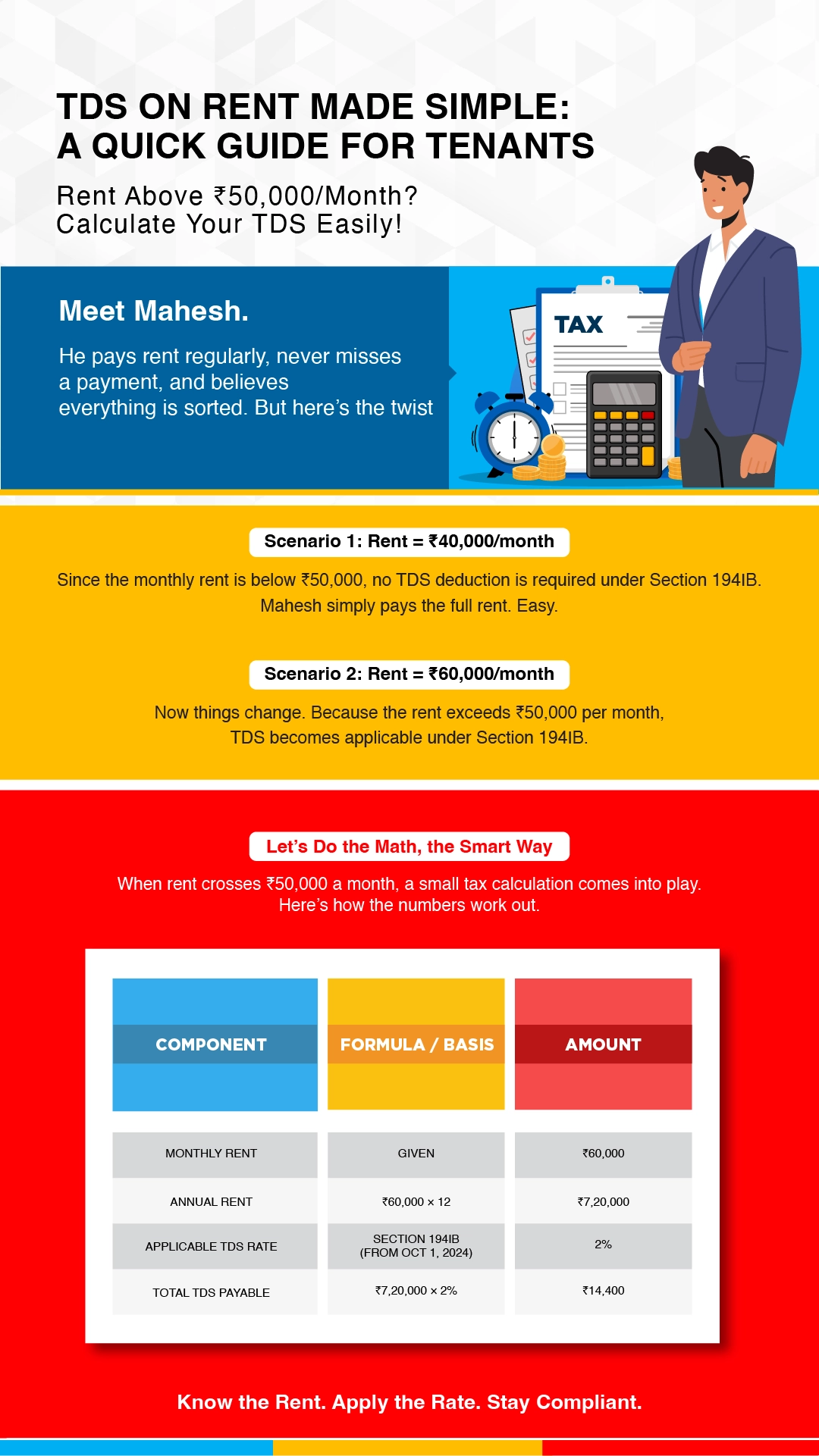
To make TDS calculations clearer, here’s a quick example involving monthly rent.
Mahesh pays a monthly rent of ₹40,000 to his landlord. Since the rent does not exceed ₹50,000 per month, Mahesh is not required to deduct TDS under Section 194IB. However, If the rent were ₹60,000 per month, Mahesh would be liable to deduct TDS under Section 194IB.
Calculation (assuming rent = ₹60,000 per month):
Annual rent = ₹60,000 × 12 = ₹7,20,000
Applicable TDS rate = 2% (effective Oct 1, 2024, reduced from 5%)
TDS amount = ₹7,20,000 × 2% = ₹14,400
Deduction Timing:
Mahesh will deduct this ₹14,400 once in the financial year, at the time of paying rent for March (last month of the FY) or the last month of tenancy, whichever is earlier.
With this new revision, you too will be able to save money during the crisis. In addition to the government’s relief on TDS, you can also look for other tax-saving instruments that can help you save your money legally.
Effect of TDS on Tenant & Owner:
TDS deduction on rent payments simply reflects on the owner's ITR, and a deduction on total tax liability follows. So, TDS deducted by the tenant reduces your overall income tax liability.
As a tenant, you need to be careful with the deducted money and ensure that you can deposit this money into the revenue department. This deduction does not add to your taxable income, so there is no change in your usual tax liability.
Tax Saving Options:
TDS deduction doesn’t affect your tax liability. So, you will still need traditional modes of saving taxes. With proper tax planning, you can also reduce the burden of taxes while maximising savings. There are plenty of tax-saving instruments that ensure liquidity and better returns.
Here are some options for tax savings under the Income Tax Act:
Section 80C: It is by far the most popular section to save tax and has plenty of investment options to use. The section offers to reduce your taxable income by up to ₹1.5 lakh. Some of the most useful tax-saving instruments include:
Unit Linked Insurance Plans: Great for long-term tax-free wealth creation, providing safety to your child’s education goals, and boosting your retirement corpus
Public Provident Fund (PPF) & Sukanya Samriddhi Yojana (SSY): One of the safest long-term investment options
National Pension Scheme (NPS): Geared for retirement goals, offers equity exposure and dynamic asset allocation. But only works for retirement, as the lock-in period ends only when you are 60.
Equity Linked Savings Scheme (ELSS): Pure equity mutual funds with a 3-year lock-in and tax exemption.
Section 24: Interest paid on a home loan up to ₹200,000. It helps reduce your tax on house property. So, this is an important section if you are the owner of the let-out property.
Section 80E: Section 80E allows individuals to claim a deduction on the interest paid toward an education loan. The deduction covers 100% of the interest amount with no upper limit, though it applies only to the interest portion and not the principal.
Section 80G: As per this section, you are eligible for a tax deduction on the amounts given as donations to social organisations and NGOs