3-important-financial-goals-you-can-meet-with-tax-saving-investments

Minimum Alternate Tax (MAT): Meaning, Rates & Calculation

Companies with low taxable income are required to pay MAT, which is calculated at 15% of their book profits, to ensure a minimum tax contribution.

Written by : Knowledge Centre Team

2025-12-17

19176 Views

7 minutes read

The Minimum Alternate Tax (MAT), commonly known as MAT, was created to prevent companies from avoiding tax by using excessive exemptions or incentives. It ensures that all companies pay at least a minimum level of tax each year, regardless of their regular taxable income.

Knowing how MAT works, who it applies to, and how it is calculated is essential for accurate tax planning and smooth financial reporting. In this blog, let us understand its meaning, current rates, and computation in simple terms.

Key Takeaways
 

  • MAT ensures that companies with high book profits do not avoid taxes entirely through exemptions and deductions
  • If a companys tax liability under regular tax is lower than MAT, then MAT becomes applicable
  • Companies paying MAT can carry forward MAT Credit and set it off against regular tax in future years
  • Foreign companies with a Permanent Establishment (PE) in India may be liable to pay MAT under Section 115JB
  • The book profit for MAT calculation is determined by adjusting the net profit as per Section 115JB of the Income Tax Act

What is MAT?

MAT is a provision in the IT Act to limit the exemptions and rebates availed by companies. With MAT, companies have to necessarily pay a minimum amount of tax to the government.

Which Companies Must PayMAT?

As per section 115JB, every company has to pay MAT if the tax (including surcharge and cess) on the total income for the financial year is less than 15% of its book-profit + surcharge (SC) + health & education cess. As per Section 115JB, all companies must pay corporate tax at least equal to the higher of the following:

  1. Normal Liability:  Tax computation on the taxable income by using the tax rates applicable to the company. Tax computed using this method is termed normal tax liability.
  2. MAT: Tax computed @ 15% (plus surcharge and cess as applicable) on book profit. The tax computed using this method is called MAT.

How to Calculate MAT in Income Tax?

MAT calculations are done based on 15% of the book profit. It is calculated in line with the provisions of Section 115JB of the Income Tax Act, 1961. However, the final taxable amount is determined by whichever is higher, the tax liability or MAT.

For example, the taxable income of AB Services Pvt Ltd. is ₹28,40,000. The book profit of AB Services Pvt Ltd, calculated as per the provisions of section 115JB, is ₹18,40,000. What will be the tax liability of AB Services Pvt Ltd?

  • Normal tax for AB Services Pvt Ltd: Tax @ 30% on ₹28,40,000 = ₹8,52,000
  • MAT on book profit of AB Services Pvt Ltd: Tax @15% of ₹18,40,000 = ₹2,76,000.

The tax liability of a company is the higher of:

  1. Normal tax liability and
  2. Minimum Alternate Tax

Thus, AB Services Pvt Ltd's tax liability will be ₹8,52,000, higher than the MAT.

What is the Book Profit Under MAT?

As per section 115JB(2), the meaning, of book profit is the net profit as shown in the profit and loss statement prepared in accordance with Schedule III to the Companies Act, 2013. Some costs/income is considered along with the profit and loss statement when calculating the book profit.

Some major costs are listed below:

  1. Income tax paid/payable and the provision for the same
  2. Amounts moved to any reserves except those specified under Section 33AC
  3. Provisions for unascertained liabilities
  4. Provisions for losses incurred in subsidiary companies
  5. Dividends paid/proposed
  6. Expenditure related to incomes that are exempt under sections 10 [except section 10(38), 11 and 12]
  7. The amount of expenditure related to income, on which no income tax is payable, and is in line with the provisions of section 86

Major deductions to book profit:

  1. Amount withdrawn from reserves or provisions
  2. Incomes that are exempt under sections 10, 11 and12 [except those under section10(38)]
  3. Depreciation debited to the profit and loss statement (excluding the depreciation on revaluation of assets)
  4. Amount withdrawn from revaluation reserve such that it does not exceed the depreciation on revaluation of assets

What is the Meaning of MAT Credit?

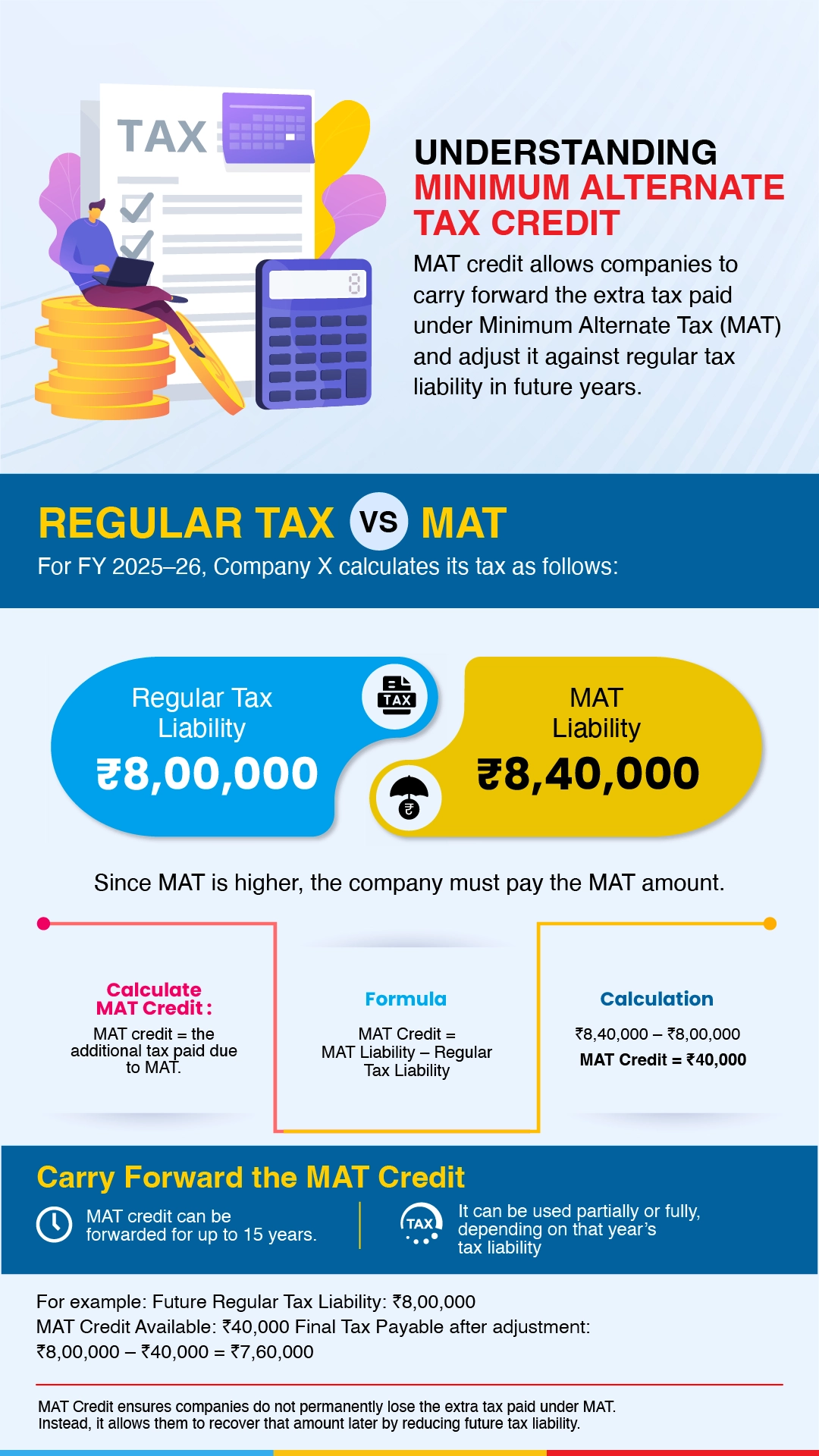
MAT credit is the difference between MAT and the regular tax. It enables a company to carry forward the “extra” tax it pays under MAT (as against the regular tax liability) in a given financial year, to be utilised in future as a credit to offset its regular tax liability then.

Carry Forward of MAT Credit

You can opt for the carry-forward option in the assessment year in which the regular tax liability is greater than the MAT liability. The maximum MAT credit that you can claim cannot be greater than the difference between the regular tax and MAT. Unutilized MAT credit can be piled up for 15 years. If the company pays regular tax in a financial year, in future, it can utilise the MAT credit either partially or fully.

For example:

The regular tax liability of a company for FY 2018-19 is ₹8 lakhs while the liability under MAT is ₹8.4 lakhs. In this case, MAT is higher than the regular tax. Therefore, the company is eligible for MAT Credit in line with the provision in Section 115JAA.

MAT Credit = MAT – Regular Tax
= ₹8.4 lakh – ₹8lakh
= ₹40,000

The MAT operates with a “MAT credit” carry forward mechanism that allows a company to carry forward the “excess” tax paid due to MAT (as against its regular tax liability) in a financial year, to be utilised in future as a credit to offset its regular tax liability.

trivia-img

Did You Know?

Special Economic Zones were initially exempt from MAT, but this exemption was removed in 2011, making them liable to pay Minimum Alternate Tax.


Source: PIB

ytp 1.5 cr life cover

How Does MAT Apply to Foreign Companies and NRIs?

Minimum Alternate Tax (MAT), governed under Section 115JB of the Income Tax Act, was introduced to ensure that companies claiming numerous deductions still pay a minimum level of tax on their book profits. For foreign companies, the application of MAT under section 115JB depends on whether they operate through a Permanent Establishment (PE) in India and whether their income falls under the provisions of a Double Taxation Avoidance Agreement (DTAA).

While MAT is mainly applicable to companies, its treatment differs for foreign companies and Non-Resident Indians (NRIs). 

Do Foreign Companies Need to Pay MAT in India?

The Minimum Alternate Tax (MAT) is designed to ensure that companies, including foreign entities, pay a minimum amount of tax on their book profits in India. The applicability of MAT to foreign companies depends on their presence and operations within India.

  • Foreign Companies with a Permanent Establishment (PE) in India: If a foreign company has a PE or a place of business in India, MAT provisions under Section 115JB of the Income Tax Act may apply. This means such companies are required to pay MAT on their book profits. 

  • Foreign Companies without a Permanent Establishment (PE) in India: Foreign companies without a Permanent Establishment (PE) or business presence in India are typically not subject to MAT provisions under Indian tax laws. This exemption is particularly relevant for companies operating from countries with which India has a Double Taxation Avoidance Agreement (DTAA).

It's important for foreign companies to assess their business operations in India to determine the existence of a PE. This significantly influences their tax obligations, including the applicability of MAT.

Are NRIs Liable to Pay MAT?

No, NRIs (Non-Resident Indians) are not liable to pay MAT unless they are running a business in India through a company structure. MAT is specifically applicable to companies and does not extend to individuals. Therefore, income earned by NRIs from sources such as rent from property, capital gains from shares or mutual funds, or interest on NRO or savings accounts is taxed under the normal provisions of the Income Tax Act, not under MAT.

However, if an NRI has incorporated a company in India (for example, a private limited company), then MAT can be applicable on the book profits of that company, just like for any other domestic company.


MAT vs. Regular Corporate Tax– What’s the Difference?

When it comes to taxing companies in India, there are two main systems under the Income Tax Act: Regular. They are Corporate Tax and Minimum Alternate Tax (MAT). While both apply to companies, they work in different ways and are intended to ensure that all companies contribute a fair share of the taxes to the government.

The table below will further simplify the differences between the two:

Aspect

Regular Corporate Tax

Minimum Alternate Tax (MAT)

Governing Provision

General Provisions of the Income Tax Act

Section 115JB of the Income Tax Act

Applicability

All domestic and foreign companies earning taxable income in India

Companies (including some foreign ones) whose tax liability is lower than 15% of book profits

Tax Base

Taxable income (after deductions, exemptions, depreciation)

Book profits as per the profit & loss account, adjusted as per Section 115JB

Current Tax Rate (FY 2025-26)

  • 22% (Domestic Companies)
  • 15% (for new manufacturing companies) + surcharge & cess

15% of book profits + applicable surcharge & cess

Purpose

To tax companies on their actual income

To ensure companies with high book profits but low/no tax liability still pay a minimum tax.

Deductions Allowed

Various deductions under Chapter VI-A (e.g. 80C, 80D), depreciation, etc., are mostly available only under the old tax regime

Limited adjustments; most deductions/exemptions not allowed

Set-Off and Carry Forward

Normal losses and depreciation can be carried forward

Companies can carry forward MAT credit for 15 years and set it off against regular tax

Applicability to Individuals/NRIs

Not applicable

Only applies to companies, not individuals or NRIs (unless NRI owns a company in India)

Conclusion

Understanding MAT and its implications under Section 115JB of the Income Tax Act is crucial for businesses operating in India. While MAT ensures that even profit-making companies with significant deductions pay a fair share of tax, it is not a blanket rule for all. Its application depends on the company structure, the presence of a permanent establishment, and the type of income earned. 

Glossary

  • Book Profit: Net profit calculated per the Companies Act, with specific additions and deductions under Section 115JB for MAT
  • MAT Credit: The difference between MAT and regular tax can be carried forward for 15 years to reduce future income tax payments
  • Permanent Establishment (PE): A fixed place of business in India through which a foreign company operates; key to MAT applicability
  • DTAA: This helps prevent the same income from being taxed in both India and another country for individuals or companies
glossary-img
Uncertain About Insurance

FAQs

Book profit refers to the net profit shown in a company’s profit and loss account, adjusted as per the rules in Section 115JB. Certain incomes are reduced, and some expenses are added back to arrive at the book profit for MAT purposes.

In income tax, book profit is the profit computed after making specific additions and deductions mandated under Section 115JB. This adjusted figure is used to determine the company’s Minimum Alternate Tax liability.

MAT ensures that companies with substantial book profits pay a minimum level of tax even if they claim multiple deductions under regular provisions. For investors, MAT affects the company’s distributable profits and overall tax outflow.

A company is relieved from MAT if its normal tax liability (computed under standard income tax rules) becomes higher than the MAT payable. Once that happens, the regular tax applies instead of MAT.

Companies can legally reduce MAT by optimising book profit components, claiming eligible deductions, planning depreciation, and using available MAT Credit from earlier years. Proper timing of deductions and recognising exempt income correctly also supports MAT efficiency.

MAT credit can be claimed when the normal tax liability exceeds the MAT payable in a future year. The difference between the regular tax and MAT is adjusted by using the MAT credit carried forward, reducing the tax payable in that year.

If MAT is higher than the regular tax, the company must pay MAT for that year. The excess amount paid becomes MAT Credit, which can be carried forward and set off in future years when the regular tax exceeds MAT.

MAT is a minimum tax that companies must pay if their normal income tax liability is low due to exemptions or deductions. It ensures that companies with significant book profits contribute a basic level of tax.

All companies, including foreign companies with income taxable in India and a Permanent Establishment (PE), are liable to pay MAT unless specifically exempt under law.

MAT is calculated at a prescribed percentage of book profit. Book profit is computed by taking the net profit as per the company’s profit and loss account and making adjustments specified in Section 115JB.

MAT Credit is the difference between the MAT paid and the regular income tax. This credit can be carried forward and used in future years when regular tax liability exceeds MAT, helping reduce overall tax outflow.

Yes, companies without a permanent establishment in India are exempt from MAT.

Disclaimer - This article is issued in the general public interest and meant for general information purposes only. The views expressed in this blog are solely those of the writer and do not necessarily reflect the official policy or position of Canara HSBC Life Insurance Company Limited or any affiliated entity. We make no representations or warranties of any kind, express or implied, about the completeness, accuracy, reliability, suitability, or availability with respect to the blog or the information, products, services, or related graphics contained in the blog for any purpose. Any reliance you place on such information is therefore strictly at your own risk. You should consult with a qualified professional regarding your specific circumstances before taking any action based on the content provided herein.

Recent Blogs

Will Budget 2026 Allow Joint Taxation for Married Couples?
29 Jan '26
7 Views
8 minute read
Find out what Budget 2026 may introduce on joint taxation for married couples, expected benefits, policy outlook, and how it may impact taxpayers in India.
Read More
Tax Saving
What is Income Tax Return (ITR)? Meaning & Filing Process of Filing ITR
21 Jan '26
4897 Views
10 minute read
Learn what an Income Tax Return (ITR) is, why filing your income tax return is important, and how to file your ITR online via the Income Tax Department. Documents, forms, steps, and FY 2026-27 details included.
Read More
Tax Saving
What Is Advance Tax? How to Calculate Advance Tax and Pay It Online
20 Jan '26
2512 Views
9 minute read
Understand advance tax under income tax, who should pay it, how advance tax is calculated, due dates, and online payment steps to avoid penalties.
Read More
Tax Saving
Importance of Taxes in India: Why Taxes Matter?
15 Jan '26
1608 Views
7 minute read
Understand the importance of taxes in India, how they support public services, economic growth, welfare schemes, and national development.
Read More
Tax Saving
What Is SGST? Meaning, Rates & Applicability Explained
15 Jan '26
626 Views
5 minute read
Learn what SGST means, its full form, tax rates, applicability, and how it works under the GST system for intra-state transactions.
Read More
Tax Saving
What is the GST Council? Role, Members & How It Works
14 Jan '26
537 Views
5 minute read
Understand what the GST Council is, its structure, powers, and how it decides GST rates, laws, and policies across India.
Read More
Tax Saving
Why is Your ITR Refund Delayed and What Can You Do?
13 Jan '26
534 Views
5 minute read
ITR refund delayed? Know the common reasons, timelines, and step-by-step actions to track, raise grievances, and speed up your income tax refund.
Read More
Tax Saving
80CCC: What is Deduction Under Section 80CCC?
11 Jan '26
1179 Views
6 minute read
What is Section 80CCC? How can you claim deductions under section 80CCC? Learn the eligibility criteria to claim a deduction under section 80CCC with a life insurance policy.
Read More
Tax Planning
How to Save Tax on Salary Above ₹15 Lakhs? | Tax Saving Guide 2026
10 Jan '26
4812 Views
14 minute read
Learn how to save tax on salary above ₹15 lakhs using effective tax saving options, deductions, exemptions, and smart income tax planning strategies
Read More
Tax Saving

Tax Savings - Top Selling Plans

We bring you a collection of popular Canara HSBC life insurance plans. Forget the dusty brochures and endless offline visits! Dive into the features of our top-selling online insurance plans and buy the one that meets your goals and requirements. You and your wallet will be thankful in the future as we brighten up your financial future with these plans.