


What Is Income Tax Return

What is an Income Tax Return?

Filing your Income Tax Return (ITR) ensures you contribute your fair share towards public services like roads, schools, and healthcare. File today!

Written by : Knowledge Center Team

2026-01-21

4900 Views

10 minutes read

Every citizen of India has to pay tax on their income to the Government of India as per the Income Tax rules and regulations. Income for each financial year is taxed by Income Tax laws, even if you are an individual, an association, a firm, an LLP, a local authority, or a Hindu Undivided Family. Hence, filing your Income Tax return (ITR) annually is essential. You can file an income tax return online or offline at your convenience.

Key Takeaways
 

  • There are 7 types of ITR forms, each catering to different taxpayer categories
  • Filing ITR online involves logging into the Income Tax portal, selecting the correct form, entering income details, verifying information, and submitting the return
  • Late filing can result in penalties of up to ₹5,000, along with interest on unpaid taxes. Filing on time also allows taxpayers to claim refunds if excess tax has been paid
  • Filing on time also allows taxpayers to claim refunds if excess tax has been paid
  • Filing ITR provides proof of income for loan applications, allows carry-forward of losses for tax benefits, ensures compliance with tax laws, and helps in visa applications and other financial transactions
  • Essential documents include Form 16 (issued by employers), Form 26AS (tax credit statement), bank interest certificates, investment proofs for deductions, Aadhaar number, and bank details for refunds

What is an Income Tax Return (ITR)? Meaning with Example

An Income Tax Return (ITR) is a form that an individual submits to the Income Tax Department of India to file information about their income and taxes payable during that year. Information filed in an ITR should be applicable for a particular financial year between 1st April to 31st March of the next year.

The income you earn can be from sources such as salary, profit in business, sale of house or property, dividend or capital gains, and interest received among others. If you have paid tax in excess during a year, you will get a refund from the Income Tax Department.

Example:

  • Name: Rohan
  • Financial Year: 1 April 2024 - 31 March 2025
  • Income Sources:
    • Salary: ₹6,00,000
    • Bank Interest: ₹10,000
  • Tax Already Paid (TDS by employer): ₹25,000 (example figure)

What happens when Rohan files his ITR?

He reports:

Total income = ₹6,10,000

Tax calculated on this income = ₹22,000 (example figure)

Since his employer already deducted ₹25,000 as TDS, and his actual tax liability is ₹22,000:

Rohan paid ₹3,000 extra.

After filing the ITR:

He becomes eligible for a ₹3,000 refund from the Income Tax Department.

Who is Required to File ITR? 

Now that you know what an income tax return is, let us take a look at the list of people as well as enterprises that are mandated by law to file income tax returns every financial year.

  • Any individual who is less than 60 years old and has an annual income of more than ₹2.5 Lakhs should file an ITR. The exemption limit for senior citizens between 60 to 70 years of age is ₹3 Lakhs. For super senior citizens (80 years and above), the limit is ₹5 Lakhs. Income calculation should be done without allowing deductions specified under Section 10 of the Income Tax Act.

  • A registered company with yearly income, even if it has not made any profit during the period

  • An individual who wants to claim a refund on surplus income tax or tax that was deducted from their annual income.

  • An individual having an asset or any other financial interest outside the country.

  • A company out of India with treaty benefits on transactions made within the country.

  • NRIs who earn above the basic yearly exemption limit of ₹ 2.5 lakh.

Maximize Your Tax Savings - Talk to an Expert

Please enter correct name Please enter the Full name
Please enter valid mobile number Please enter Mobile Number
Please enter valid email Please enter Email

Enter OTP

An OTP has been sent to your mobile number

Didn’t receive OTP?

Application Status

Name

Date of Birth

Plan Name

Status

Unclaimed Amount of the Policyholder as on

Name of the policy holder

Policy Holder Name

Policy No.

Policy Number

Address of the Policyholder as per records

Address

Unclaimed Amount

Unclaimed Amount
Error

Sorry ! No records Found

.  Please use this ID for all future communications regarding this concern.

Request Registered

Thank You for submitting the response, will get back with you.

What Documents Do You Need to File ITR? 

When you start the process of filing your income tax return, apart from your salary slips, bank savings account passbook, Aadhar card, and PAN card, there are a few other documents that you will require to ease your tax filing process:

  • Form 16: It is provided by your employer and contains details of the salary they paid you and the Tax deducted at source (TDS).

  • Form 16A: It contains details on TDS deducted on interest received from deposits, such as fixed or recurring bank deposits.

  • Form 16B: If you sell a property, TDS applies to the amount received from you by the buyer, the details of which are present in this form.

  • Form 16C: TDS details of the rent paid by your tenant to you are recorded here.

  • Form 26AS: This form represents your comprehensive statement of taxes against the PAN number. It includes TDS by your employer, bank, or any other organisation that has paid you. Advance taxes or self-assessment taxes paid, as well as proof of tax-saving investments such as deductions as prescribed from Section 80C to 80U, including a life insurance policy or a term plan, are also listed.

  • Form 16 and Other TDS Certificates: Issued by your employer, it summarises your salary and TDS deductions.

  • Bank/Post Office Interest Certificates: Details of interest earned on savings or fixed deposits.

  • Form 26AS and Annual Information Statement: A consolidated tax statement showing all taxes deposited against your PAN.

  • Proof of Investment and Expenditure: Evidence for deductions under Section 80C, 80D, and others.

  • Aadhaar Number and Bank Details: Mandatory for e-filing and receiving refunds.

How to File ITR Online? 

You can now submit your income tax return online. This has been made possible by e-filing, which uses pre-approved tax preparation software by the Income Tax Department. More and more taxpayers are increasingly filing their returns online given its benefits such as:

  • Getting Refund: If tax has been deducted at source from the payment you received and you want to claim a refund of the amount, you need to furnish your ITR for the financial year for the refund to be processed.

  • Verification Proof: When you apply for a loan, your eligibility is measured using your yearly income as the yardstick. An income tax return filing form with details of your earnings gives the borrower a clear picture of your previous income, lending credibility to your application. Similarly, visa applications also require income proofs, for which tax returns are the most accepted documents.

  • Proof of Income: When you buy a term plan, your insurer might require your ITR to decide the compensatory amount to be paid to your nominees in the event of death or disability. The ITR is considered officially verifiable proof of income for this purpose.

trivia-img

Did You Know?

Filing your income tax return early can be financially beneficial, as it allows you to deploy that money sooner for savings or investments.


Source:
Investopedia

Guaranteed Return 34K

Step-by-Step Online Filing Process

To file your Income Tax Return (ITR) online, follow these detailed steps:

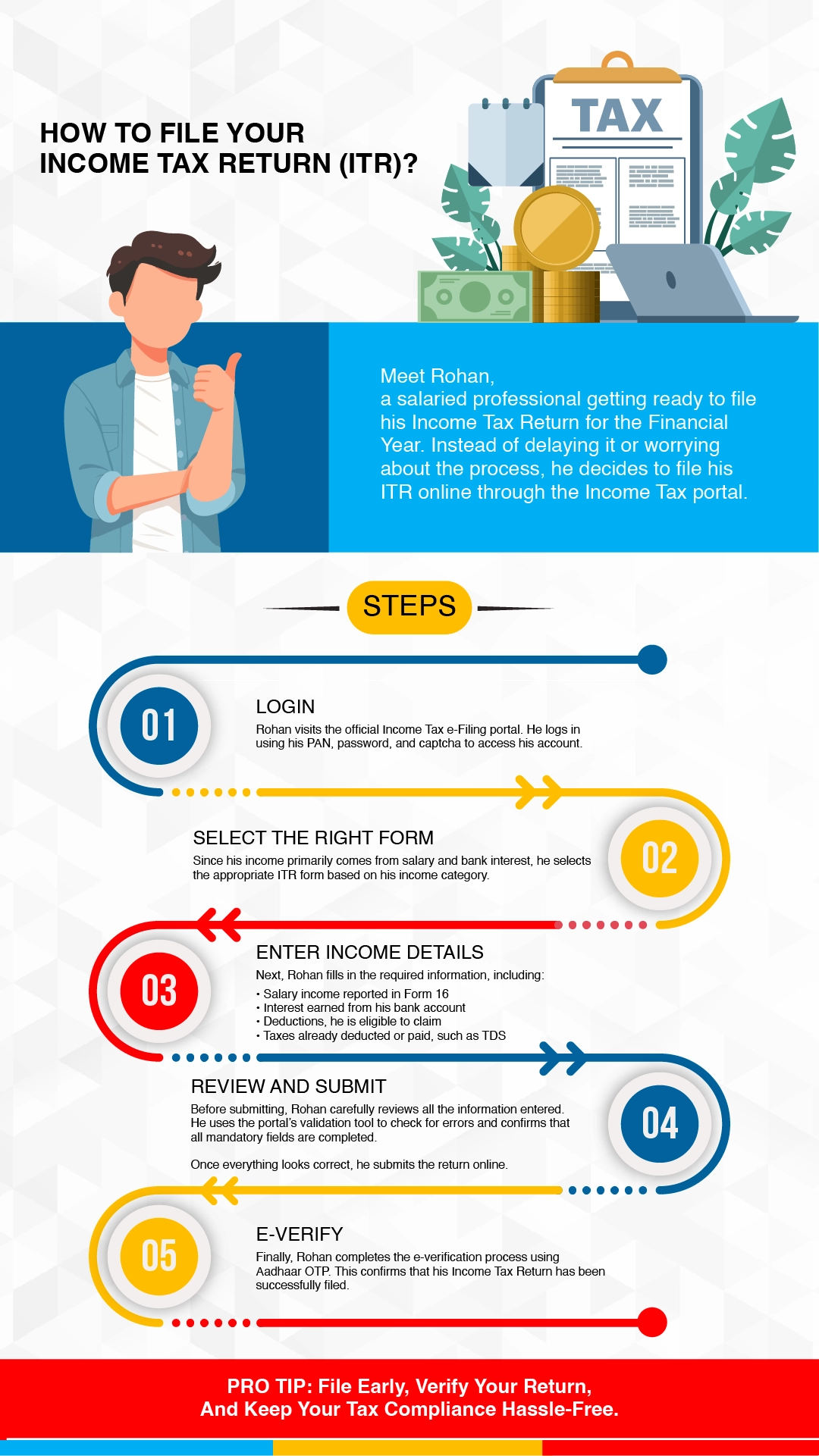
  • Visit the Income Tax Portal: Go to the official Income Tax Department website. If you already have an account, log in using your PAN number, password, and captcha. If you're a new user, register by providing your basic details, including your PAN, mobile number, and email ID.

  • Select the Correct ITR Form: Depending on your income sources and category (individual, business, etc.), choose the relevant ITR form. For assistance, refer to the ITR form guide on the portal.

  • Fill in the Details: Once you’ve selected the appropriate form, enter your personal details (name, PAN, address), income details (salary, business income, capital gains, etc.), deductions, and any taxes already paid (advance tax, TDS, etc.).

  • Validate and Submit: After entering the information, carefully review all the entered details to ensure there are no mistakes. Use the portal's validation tool to verify that all the mandatory fields are completed. Once confirmed, submit your ITR online.

  • E-Verify the ITR: You can e-verify your ITR using methods like OTP (via an Aadhaar-linked mobile number), net banking, or by generating a physical verification code. E-verification ensures that your ITR is successfully filed without needing to send a physical copy to the tax department.
     

Offline ITR Filing Option

If you prefer manual filing or need assistance in filing your return offline, the Income Tax Department also provides utility software that can be downloaded and used to file your return.

  • Download the ITR Utility Software: Visit the Income Tax e-Filing portal and download the ITR preparation software that corresponds to the form you need to file. The software is available in JSON format and can be used on your computer.

  • Fill in the Details Offline: Open the downloaded software and enter your income details, deductions, and tax payments manually. The software will automatically calculate your tax liability and validate the information entered.

  • Generate and Upload the JSON File: After completing the form, generate JSON file. This JSON file needs to be uploaded to the Income Tax portal for submission.

  • Submit and E-Verify: Once you’ve uploaded the JSON file, follow the same e-verification process as online filing to confirm your return submission.

Both methods ensure that your ITR is filed correctly and on time, with the online method being faster and more convenient.

Types of Income Tax Return (ITR) to File

There are seven different types of ITR forms for different categories of individuals and sources of income. The Income Tax Department has different forms for each taxpayer depending on the category of income generation:

  • ITR - 1: This form is applicable only for resident individuals (not applicable to NRIs/HUF/any other entity) having total income up to ₹50 lakh and who have income under the following heads:

  • ITR - 2: ITR-2 form applies to all individuals / HUFs who are not eligible to file ITR-1 and who have income from any source other than income from Business or Profession.

  • ITR - 3: This form is applicable for individuals and HUFs who have income from profits and gains from business or profession.

  • ITR - 4: This form applies to all resident individuals / HUF / Firms (other than LLP) having total income up to ₹50 lacs & having income under the following heads:

    • Income from business or profession computed on a presumptive basis under section 44AD, 44AE, or 44ADA.

    • Income from Salary/Pension

    • Income from One House Property

    • Income from other sources

  • ITR - 5: ITR-5 form applies to persons other than Individuals, HUF, Companies & persons filing form ITR 7. Ideally, this form covers all partnership firms, LLP, AOP, BOI, Artificial Judicial Person, Co-Operative Societies, and Local Authorities. The form is also used by investment funds, business trusts, and the estates of the deceased and insolvent.

  • ITR - 6: This form applies to all Companies other than companies claiming exemption under section 11. Section 11 pertains to charitable trusts / religious trusts for which ITR 7 is applicable.

  • ITR - 7: This form applies to persons, including companies, required to furnish a return u/s 139(4A), 139(4B), 139(4C), 139(4D), 13,9(4E) or 139(4F). This includes religious & charitable trusts, political parties, scientific research associations, universities & colleges.

  • ITR-U: Introduced for filing updated returns under section 139(8A), allowing taxpayers to rectify or update their income tax returns within four years from the end of the relevant assessment year. This form is applicable from April 1, 2025, as per the Finance Act, 2025.

Due Dates for Filing ITR (AY 2025-26)
 

Category of TaxpayerDue Date for Filing Taxes
Individual / HUF/ AOP/ BOI30th Sep 
Businesses (Requiring Audit)30th Nov
Businesses (Requiring TP Report)31st December

Revised Returns

31st December 2025

Belated/ Late Return

31st December 2025

Updated Return

31 March 2030 (4 years from the end of the relevant Assessment Year)

How to Check Your ITR Status Online? 

After you have submitted your tax return, you can check its status online easily on the e-filing website of the Government of India. Depending on whether or not you have created a login account on the website, here are a few simple steps to check your ITR status:

  1. Without login details: Click on the ITR status link displayed on the left of the website. It will direct you to a page wherein you need to fill in the details of your PAN number, ITR acknowledgement number, and captcha code. Your tax filing status appears once you have keyed in.

  2. With login details: Log in to the website using your username and password. Then, click on the ‘View Returns or Forms’ option. Select the assessment year and income tax returns from the dropdown menu. Post this, you can see whether your ITR has been verified or processed.

How to Download the ITR V Form Online? 

After you have duly submitted your tax return, the Income Tax Department generates a verification form that lets you authenticate the e-filing of your taxes done online. This is allowed only for those who file their returns without a digital signature. Let us take a look at how to download the income tax return filing V form online:

  • Visit the Income Tax Department of India website at  https://eportal.incometax.gov.in/iec/foservices/#/login

  • Click on 'View Returns/ Forms' to view your e-filed return

  • Then select income tax returns from the available options

  • This will display the returns filed for all years by you

  • Download ITR V by clicking on the acknowledgement number and selecting 'ITR-V Acknowledgement.'

  • When asked for your password, enter your PAN number in lowercase and your date of birth to open the document

  • Take a printout of the document and sign it. Send it by post to CPC Bangalore within 120 days of having e-filed your tax return. The other option is to generate an Aadhar OTP via net banking, ATM, etc., and complete the e-verification of your ITR. File your ITR on time and avoid missing the due dates to stay on the safer side. If you somehow miss the due date for filing your ITR, you can file your ITR on a later date, on or before 31st March of the next year. That means either you can file your ITR before the completion of the assessment year or by the end of the assessment year.

Penalty for Late Filing of ITR

Filing your Income Tax Return (ITR) after the deadline can result in a penalty of up to ₹5,000, if you file your ITR after the due date but on or before 31st December along with interest on any unpaid taxes. Meanwhile, if you file your ITR after 31st December but before 31st March of the assessment year, the penalty is ₹10,000. For those whose total income does not exceed ₹5 lakh, the penalty for late filing is restricted to ₹1,000 only. To avoid unnecessary expenses and complications, it’s essential to file your ITR on time.

How to Claim an ITR Refund?

To claim an ITR refund, follow these steps:

  • File Your Income Tax Return: Ensure that you accurately fill out and submit your ITR, reporting all your income and tax payments.

  • Provide Bank Details: When filing your return, make sure to include your correct bank account details, such as your bank account number, IFSC code, and bank name. This is crucial for the refund to be credited directly to your account.

  • Verify Information: Double-check all your details, especially your bank account information, to avoid any errors that could delay the refund.

  • Track the Refund: After submission, you can track the status of your refund through the Income Tax Department’s portal or by checking with your bank once the refund process starts.

By ensuring your details are accurate, you can smoothly receive your ITR refund without delays or complications.

Common Mistakes to Avoid When Filing ITR

When filing your Income Tax Return (ITR), it's important to avoid common mistakes that can delay processing or lead to penalties, such as: 

  • Double-check your personal details, such as your name, address, and PAN number, to ensure accuracy. 

  • Make sure your income data is consistent across documents, and verify that no income sources are missed. 

  • Additionally, be sure to claim all eligible deductions to reduce your tax liability. 

As for FY 2025-26 (AY 2026-27), the standard deduction was increased to ₹75,000 for salaried individuals under the new tax regime, while it remains the same. Taking extra care with these details will help ensure a smooth and error-free filing process.

Advantages of Filing Income Tax Return

  1. Proof of Income for Loans and Credit: Filing your Income Tax Return (ITR) provides documented proof of your income, which is crucial when applying for loans or credit cards. Lenders and financial institutions typically require your ITR as part of the application process to assess your financial stability and repayment capacity. Having a well-filed ITR can improve your chances of getting loan approvals or credit extensions with better terms.

  2. Carry Forward of Losses: Filing ITR allows you to carry forward any financial losses, such as capital losses or business losses, to offset future gains. This can reduce your tax liability in future years, as the losses will be deducted from your taxable income. This provision helps you manage your finances better, especially during unprofitable years, by minimising the tax burden in subsequent profitable periods.

  3. Compliance with Law: By filing your ITR, you ensure compliance with tax laws, fulfilling your legal obligation as a taxpayer. Filing on time helps you avoid penalties, interest charges, or legal consequences for non-compliance. It also reflects responsible financial behaviour, which is important for maintaining a good relationship with tax authorities and ensuring that you are on the right side of the law.

Summing Up

An income tax return is like a financial report you submit to the government each year. It shows how much money you earn and how much tax you owe based on that income. Think of it as a way for the government to keep track of everyone's earnings and ensure everyone pays their fair share to fund public services.


Glossary

  1. Assessment Year (AY): The year following the financial year, during which your income is assessed and taxed.
  2. E-Filing: Filing your Income Tax Return online through the Income Tax portal.
  3. Form 16: A certificate issued by an employer showing your salary details and TDS deducted.
  4. Annual Information Statement (AIS): A detailed record of your financial transactions available on the tax portal.
  5. Digital Signature: An electronic authentication used by certain taxpayers to sign and validate their ITR.
glossary-img
Uncertain About Insurance?

Faqs Related to Income Tax Return ( ITR)

You should file your taxes annually as a responsible citizen. For all Indians who work, this is a moral obligation. It also benefits you in the following ways:

  • It acts as a legal document

  • Can help you claim deductions

  • An important document while applying for loans 

  • Avoid penalty and punishment

A person under 60 years of age is required to file tax returns if any portion of their income is taxable, as per the Income Tax Act of 1961. You must also file an ITR if your taxable income in a given financial year exceeds ₹5 lakh or if you have paid advance tax.

As per Indian tax rules, you are required to file an Income Tax Return only when your total income crosses the basic exemption limit, which differs based on whether you opt for the old or the new tax regime.

Minimum income criteria for filing ITR

Old Tax Regime:

  • Individuals below 60 years: ₹2.5 lakh

  • Senior citizens (60-80 years): ₹3 lakh

  • Super senior citizens (80+ years): ₹5 lakh

New Tax Regime:

  • The basic exemption limit is ₹3 lakh for all taxpayers.

  • Under the Union Budget 2025, this limit has been increased to ₹4 lakh in the revised new tax regime slabs.

Salaried employees are advised to have Form 16 to file their yearly ITR. However, they can still file their taxes without a Form 16.

It is possible to file a delayed income tax return if you miss the deadline for filing one. On the other hand, late submission of returns will result in a penalty of up to ₹5,000.

You need to file an ITR in India in 2025 if your income exceeds the basic exemption limit, which depends on whether you choose the old or new tax regime:

  • Old regime: exemption limit is ₹2.5 lakh for people under 60, ₹3 lakh for 60–80 years, and ₹ 5 lakh for 80+ years. 

  • New regime: exemption limit is ₹3 lakh for FY 2024-25.

  • ITR-1 (Sahaj): For salary/pension + 1 house property + interest + LTCG (up to ₹1.25 lakh).

  • ITR-2: For capital gains, multiple house properties, or foreign assets- but no business income.

  • ITR-3: For business or professional income (books of accounts maintained.

  • ITR-4 (Sugam): For presumptive business or profession income (under sections like 44AD / 44ADA), plus salary, one house, etc. 

Filing your ITR allows you to claim a refund if you’ve paid more tax than you owe.

It also lets you carry forward eligible capital or business losses, but only if the return is filed on time.

Disclaimer - This article is issued in the general public interest and meant for general information purposes only. The views expressed in this blog are solely those of the writer and do not necessarily reflect the official policy or position of Canara HSBC Life Insurance Company Limited or any affiliated entity. We make no representations or warranties of any kind, express or implied, about the completeness, accuracy, reliability, suitability, or availability with respect to the blog or the information, products, services, or related graphics contained in the blog for any purpose. Any reliance you place on such information is therefore strictly at your own risk. You should consult with a qualified professional regarding your specific circumstances before taking any action based on the content provided herein.

Recent Blogs

How to e-Verify your Income Tax Return Using AADHAR Card?
17 Feb '26
966 Views
5 minute read
Simplify your income tax return verification process. Learn how to e-verify ITR using Aadhaar Card or EVC with our step-by-step guide.
Read More
Tax Saving
Income Tax Act 1961: Overview, Key Provisions and Applicability
17 Feb '26
1178 Views
12 minute read
Learn about the Income Tax Act 1961, its purpose, key provisions, applicability, and how it governs income tax laws in India.
Read More
Tax Saving
Types of Allowances in Salary: Definition, and Taxation Rules
11 Feb '26
1206 Views
6 minute read
Learn about various allowances like HRA, travel, medical, and special allowances, and understand their tax treatment and exemptions to optimise salary taxation.
Read More
Tax Saving
Penalty for Late Filing of Income Tax Returns (ITR) in 2026
11 Feb '26
1135 Views
7 minute read
Avoid penalties for late ITR filing! Learn about the financial and legal implications of missing deadlines and how to file on time.
Read More
Tax Saving
HUF Taxation Explained: Benefits, Rules & How to Save Tax
11 Feb '26
112 Views
7 minute read
Learn how HUF taxation works in India, eligibility rules, tax benefits, deductions, and how Hindu Undivided Families can save income tax legally.
Read More
Tax Saving
What is IGST? Meaning, Rates and Calculation Explained
11 Feb '26
210 Views
7 minute read
Understand IGST, its full form, when it applies, current rates, and how to calculate Integrated GST for inter-state transactions in India.
Read More
Tax Saving
What is CGST? Meaning, Rates & Features Explained
11 Feb '26
161 Views
7 minute read
Learn what CGST means, its full form, key features, tax rates, and how Central GST is applied under India’s GST framework.
Read More
Tax Saving
Income Tax Rebate in India: Rules, Limits and Eligibility
10 Feb '26
1940 Views
8 minute read
Get money back with Income Tax Rebate! Learn what an income tax rebate is, who is eligible, applicable sections, limits, and how taxpayers in India can claim the rebate.
Read More
Tax Saving
Tax Collected at Source (TCS): Payment, Exemption & Rates
10 Feb '26
1061 Views
7 minute read
Learn about Tax Collected at Source (TCS), payment exemptions, and rates. Explore key details with Canara HSBC Life Insurance for smarter tax planning insights.
Read More
Tax Saving

Tax Savings - Top Selling Plans

We bring you a collection of popular Canara HSBC life insurance plans. Forget the dusty brochures and endless offline visits! Dive into the features of our top-selling online insurance plans and buy the one that meets your goals and requirements. You and your wallet will be thankful in the future as we brighten up your financial future with these plans.