


3-important-financial-goals-you-can-meet-with-tax-saving-investments

How is Income from Other Sources Taxed in India?

Understand income tax deductions and exemptions for various income sources, and learn how taxes are calculated based on these sources.

Written by : Knowledge Center Team

2025-12-15

3019 Views

6 minutes read

"Income from Other Sources" in income tax is one of the five heads of income subject to taxation under the Income Tax Act, 1961. Any income that is not covered in the other four heads of income (salary, house property, profits/ gains from business and profession, capital gains, and other sources) is taxed under income from other sources. It is referred to as the residuary head of income. In this blog, we explain what qualifies as Income from other sources, how it is taxed, and the deductions available in section 56, section 57 and section 58. We also highlight common errors taxpayers should avoid while filing returns. With the right understanding and compliance approach, you can optimise tax efficiency, minimise liabilities, and ensure accurate and stress-free ITR filing.

Key Takeaways 

  • Lottery, gambling, and race winnings are taxed at a flat rate without deductions.

  • Gifts from non-relatives above the limit are taxable.

  • Use the correct ITR form to avoid penalties or rejection of your tax return.

  • Reconcile ITR with Form 26AS & AIS to prevent mismatches and scrutiny.

  • Claim all eligible deductions under Sections 80C, 80D, and exemptions to reduce tax liability.

Meaning of Income from Other Sources 

Income from Other Sources is a category of income defined under the Indian Income Tax Act. It includes income that does not fall under salary, house property, business or profession, or capital gains. Common examples include interest earned on savings accounts, fixed deposits, and recurring deposits, dividends, family pension, lottery and gambling winnings, gifts exceeding specified limits, and rental income from machinery or plant not related to business. This head ensures all miscellaneous income is appropriately taxed. Taxpayers must disclose such income under Schedule OS while filing their Income Tax Return, and only specific expenses under Section 57 are deductible against it.

Maximize Your Tax Savings - Talk to an Expert

Please enter correct name Please enter the Full name
Please enter valid mobile number Please enter Mobile Number
Please enter valid email Please enter Email

Enter OTP

An OTP has been sent to your mobile number

Didn’t receive OTP?

Application Status

Name

Date of Birth

Plan Name

Status

Unclaimed Amount of the Policyholder as on

Name of the policy holder

Policy Holder Name

Policy No.

Policy Number

Address of the Policyholder as per records

Address

Unclaimed Amount

Unclaimed Amount
Error

Sorry ! No records Found

.  Please use this ID for all future communications regarding this concern.

Request Registered

Thank You for submitting the response, will get back with you.

Section 56: Incomes Taxable Only in Income from Other Sources – Criteria

Under Section 56 of the Act, the following three conditions must be satisfied for a receipt of earnings to come under the ‘income from other sources’ head:

  • You have an income
  • Such income is not tax-exempt under any other Sections of the Income Tax Act 1961
  • Such income cannot be categorised as salary, profits, and gains from business or profession, income from house property, or capital gains

What Does ‘Income from Other Sources’ Include?

The following types of receipts of income fall under the Income from Other Sources’ category:

  • Dividend from an Indian Company: If any company has paid Dividend Distribution Tax (or DDT) on this receipt of income, the dividend is exempted from tax. Under Section 115BBDA of the Act, however, if a resident individual, firm, or HUF receives dividends over ₹10 lakhs from an Indian company, then the excess amount over ₹10 lakhs is subject to taxation at 10%.
  • Dividend from a Foreign Company: Dividends received from any foreign company are subject to taxation under ‘Income from Other Sources.’
  • One-time Income: These are incomes such as winnings from lotteries, horse races, crossword puzzles, card games, gambling or betting of any form are categorized under ‘Income from Other Sources.’
  • Interest on Compensation: Interest received by you (as assesse) on the amount of reimbursement or compensation paid out in situations (compulsory acquisition) is subject to taxation under ‘Income from Other Sources’ head.
  • Gifts: Gifts received in the form of any sum of money, movable or immovable property, are also taxable.

Then, there are the following receipts of income, which can only be classified under ‘Income from Other Sources’ if they are not chargeable as ‘Profits and Gains of Profession or Business

  • Employees’ contribution to any welfare scheme
  • Interest on securities such as debentures or government bonds
  • Rental income received from letting out the plant, furniture, or machinery owned by the assessee
  • Rental income received from letting out the plant, furniture, or machinery along with a building (here, these two cases of letting out are inseparable)
  • Receipts of income under a Keyman Insurance Policy

Examples of Receipts That are Chargeable Under ‘Income From Other Sources’

The following are some of the examples of income from other sources that automatically fall under the ‘Income from Other Sources’ category:

  • Income received from subletting a house property by a tenant

  • Insurance commissions received by you (i.e., assesse)

  • Casual income

  • Family pension payments received by the lawful heirs of dead employees

  • Interest earned on deposits with companies and bank deposits

  • Interest on loans

  • Remuneration received by the Members of Parliament (MPsMP)

  • Rental income earned from a vacant plot of land

  • Agricultural income received from an agricultural land situated outside of India

  • Interest paid out by the Government on excess payment of advance tax

Section 57- Expenditures Allowed as Deductions

Section 57 of the Income Tax Act lists the specific expenses you are allowed to deduct from income taxed under “Income from Other Sources.”

These deductions are governed by specific conditions and limits as defined in the Income Tax Act.

For example, if you earn interest on securities or receive rental income from machinery, you may claim deductions only for expenses that are directly attributable to earning that income.

SectionNature of IncomeDeductions Allowed

57(i)

Dividend or interest earned on securities

Any reasonable commission or remuneration paid to a banker or any person for realising interest or dividend

57(ia)

Employee’s contribution towards the PF, SF or ESI Fund

Allowed if the employee’s contribution is deposited into the respective fund on or before the due date

57(ii)

Rental income from letting out plant, machinery, furniture or building

Rent, taxes, rates, repairs, depreciation, insurance and similar expenses

57(iia)

Family pension

One-third of the family pension, subject to a maximum of ₹15,000

57(iii)

Any other income

Any expenditure (other than capital expenditure) incurred exclusively for earning such income

57(iv)

Interest on compensation / enhanced compensation

50% of such interest received (subject to conditions)

58(4) – Proviso

Income from maintaining or owning racehorses

All expenses related to the activity

Section 58- Expenses not Deductible While Calculating Income Tax

Section 58 lists the expenses that are strictly not allowed when computing income under the head “Income from Other Sources.

These amounts are not deductible u/s Section 58 to ensure accurate reporting and avoid ineligible claims.

Section

Nature of Income / Expense Not Allowed as Deduction

58(1)(a)(i)

Personal expenses

58(1)(a)(ii)

Interest payable outside India on which tax has not been deducted or paid

58(1)(a)(iii)

Salary payable outside India, on which no TDS has been deducted or paid

58(1A)

Wealth tax

58(2)

Expenditures disallowed under Section 40A

58(4)

Expenses related to winnings from lotteries, races, crossword puzzles, gambling, or betting


trivia-img

Did You Know?

India’s corporate bond market touched ₹3.44 lakh crore in Q2 2025, showing strong momentum despite shifting yield conditions

Source: Financial Express

Young Term Plan - 1.5 Crore

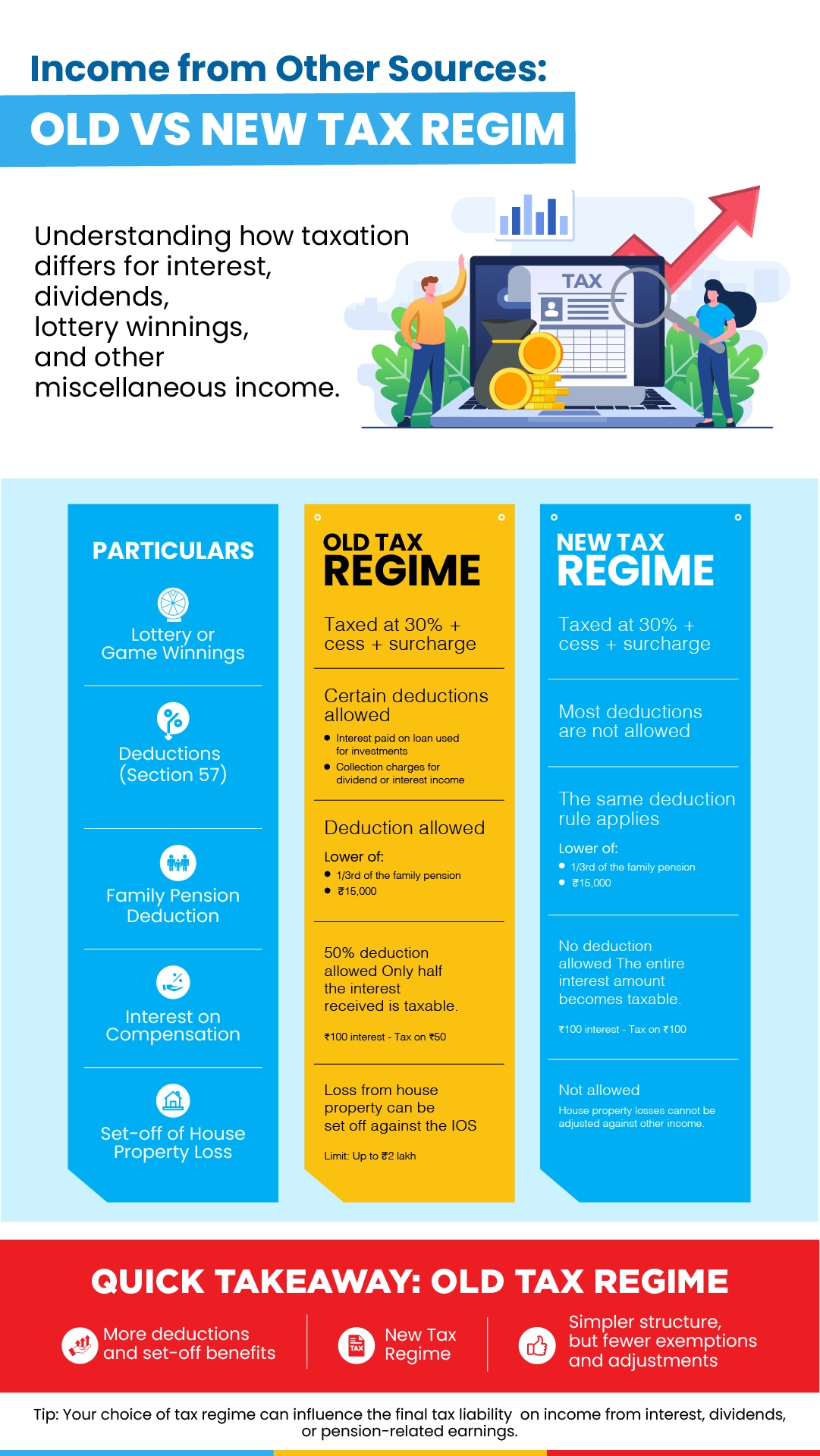
Comparing Taxation of ‘Income from Other Sources’ Under Old vs. New Tax Regime.

For income from sources such as interest, dividends, or lottery winnings, taxation rules can vary based on the chosen tax regime. The old tax regime allows certain deductions and set-offs, while the income from other sources new tax regime offers simplified rates but limits exemptions. Here’s a quick comparison:

Feature/Aspect

Old Tax Regime 

New Tax Regime 

Tax Rates 

IOS taxed as per old slab rates; lottery winnings at 30% (+cess +surcharge)

IOS taxed as per the new slab; lottery winnings at 30% ( cess + surcharge)

Dedications (sec 57)

Allowed (e.g interest on loans for investment, collection charges

Mostly not allowed (no deduction for investment loan, interest, etc.)

Family Pension Deduction

Allowed: 1/3rd of the pension or ₹15000 (whichever is lower)

Allowed: 1/3rd of pension or ₹15000 ( whichever is lower)

Interest on compensation deduction

Allowed: 50% of interest received on compensation.

Not allowed- full interest amount taxable

Set off from the house property 

Allowed: Up to ₹2 lakh loss can be set off against the IOS.

Not allowed - cannot adjust the house property losses against IOS or any other income. 

Common Mistakes to Avoid in ITR Filing

Some of the common mistakes to avoid while filing the ITR return are as follows:

  • Using the Wrong ITR Form: Choosing the correct Income Tax Return (ITR) form is crucial, as it depends on your income sources. Filing the wrong form can render your return invalid, leading to unnecessary complications. Always verify the form before filing.

  • Not Reconciling with Form 26AS & AIS: Form 26AS and the Annual Information Statement (AIS) provide details of your Tax Deducted at Source (TDS) and major financial transactions. If your ITR doesn’t match these records, it may trigger tax scrutiny. Ensure all figures align to avoid unnecessary issues.

  • Overlooking Deductions & Exemptions: Many taxpayers miss out on valuable tax benefits by not claiming deductions under Section 80C, 80D, and exemptions like House Rent Allowance (HRA) and Leave Travel Allowance (LTA). Failing to claim these can lead to a higher tax liability.

  • Errors in Personal & Bank Details: Providing incorrect details like name, PAN, or bank account information can cause refund failures or processing delays. Always double-check these details to ensure smooth processing of your tax return.

  • Not Disclosing Income from a Previous Job: If you switched jobs during the financial year, you must report income from all employers in your ITR. A mismatch between Form 16 and Form 26AS can result in tax notices. The new Form 16 format includes a section to disclose past employment income, ensuring accurate tax calculations. Always consolidate your income details before filing.

Conclusion

Income from other sources plays an important role in your overall tax calculation, especially when you earn income outside of salary, house property, business, or capital gains. Understanding what qualifies under this head, the deductions available under Section 57, and the expenses disallowed under Section 58 helps you file an accurate return and avoid penalties. Choosing the right tax regime, reconciling your return with Form 26AS and AIS, and claiming all eligible deductions ensure a smooth filing experience and prevent scrutiny. Stay informed, follow the rules carefully, and review all income streams to optimise your tax liability and file your ITR with confidence.

Glossary

  1. ITR: A form you file with the Income Tax Department to report income and calculate your tax liability or refund
  2. Dividend: A payout that a company gives its shareholders from its profits
  3. House Rent Allowance: A salary component that helps you claim a tax benefit on the rent you pay
  4. Remuneration: Payment received for services or work, including salary, fees, or commissions
  5. Capital Gains: Profit earned from selling assets like property, stocks, or gold
glossary-img
Uncertain About Insurance

FAQ

Income like interest, dividends, family pension, gifts, lottery, race winnings, machinery rent, etc., is not taxed under other heads.

Yes, interest from savings, FDs, RDs, and most bank/post office deposits is taxable as “Income from Other Sources”.

Yes. 80TTA: savings interest up to ₹10,000; 80TTB: senior citizens’ interest (including FDs) up to ₹50,000 yearly.

Lottery, gambling winnings taxed at 30% without deductions; gifts above ₹50,000 are generally fully taxable for the recipient.​

Report “other income” under “Income from Other Sources” in applicable ITR forms: ITR-1 (simple cases), ITR-2/3/4 (complex). Use Schedule OS to enter details like interest, dividends, gifts; claim Section 57 deductions. Verify on the e-Filing portal​.

Deductions allowed under Section 57 are commission, interest, collection charges, and standard deduction from the family pension of 1/3rd of such pension or ₹15,000, whichever is lower, where applicable.​

Disclaimer - This article is issued in the general public interest and meant for general information purposes only. The views expressed in this blog are solely those of the writer and do not necessarily reflect the official policy or position of Canara HSBC Life Insurance Company Limited or any affiliated entity. We make no representations or warranties of any kind, express or implied, about the completeness, accuracy, reliability, suitability, or availability with respect to the blog or the information, products, services, or related graphics contained in the blog for any purpose. Any reliance you place on such information is therefore strictly at your own risk. You should consult with a qualified professional regarding your specific circumstances before taking any action based on the content provided herein.

Recent Blogs

Will Budget 2026 Allow Joint Taxation for Married Couples?
29 Jan '26
7 Views
8 minute read
Find out what Budget 2026 may introduce on joint taxation for married couples, expected benefits, policy outlook, and how it may impact taxpayers in India.
Read More
Tax Saving
What is Income Tax Return (ITR)? Meaning & Filing Process of Filing ITR
21 Jan '26
4897 Views
10 minute read
Learn what an Income Tax Return (ITR) is, why filing your income tax return is important, and how to file your ITR online via the Income Tax Department. Documents, forms, steps, and FY 2026-27 details included.
Read More
Tax Saving
What Is Advance Tax? How to Calculate Advance Tax and Pay It Online
20 Jan '26
2512 Views
9 minute read
Understand advance tax under income tax, who should pay it, how advance tax is calculated, due dates, and online payment steps to avoid penalties.
Read More
Tax Saving
Importance of Taxes in India: Why Taxes Matter?
15 Jan '26
1608 Views
7 minute read
Understand the importance of taxes in India, how they support public services, economic growth, welfare schemes, and national development.
Read More
Tax Saving
What Is SGST? Meaning, Rates & Applicability Explained
15 Jan '26
626 Views
5 minute read
Learn what SGST means, its full form, tax rates, applicability, and how it works under the GST system for intra-state transactions.
Read More
Tax Saving
What is the GST Council? Role, Members & How It Works
14 Jan '26
537 Views
5 minute read
Understand what the GST Council is, its structure, powers, and how it decides GST rates, laws, and policies across India.
Read More
Tax Saving

Tax Savings - Top Selling Plans

We bring you a collection of popular Canara HSBC life insurance plans. Forget the dusty brochures and endless offline visits! Dive into the features of our top-selling online insurance plans and buy the one that meets your goals and requirements. You and your wallet will be thankful in the future as we brighten up your financial future with these plans.