What Is Income Tax Surcharge And Marginal Relief

What is Income Tax Surcharge and Marginal Relief?

The term "income tax surcharge" refers to the additional tax that high-income taxpayerss are required to pay in addition to their income tax.


Written by : Knowledge Centre Team

2025-12-18

4410 Views

9 minutes read

Does your income come under one of the higher tax brackets? If that is the case, you are liable to pay a surcharge on your income tax. In simpler terms, a surcharge on income tax is an additional tax payable by taxpayers earning higher incomes, beyond a certain limit set by the government. It is to ensure that the rich contribute more to income taxes than the poor. However, to ensure balance, marginal relief is also provided to taxpayers on surcharges.
 

Key Takeaways

  • A surcharge is an additional tax imposed on individuals and companies whose income exceeds specific thresholds
  • The surcharge is calculated on the total income tax payable before adding the health and education cess
  • Marginal relief prevents an excessive tax burden when income slightly exceeds the surcharge threshold
  • Individuals face surcharge rates ranging from 10% to 37% based on income brackets, while domestic and foreign companies have different rates, with domestic companies paying up to 12% and foreign companies up to 5%
  • Taxpayers can legally reduce surcharge liability by investing in tax-saving instruments, structuring income to stay below surcharge thresholds, and choosing between the old and new tax regimes based on benefits

What is Surcharge on Income Tax?

Surcharge meaning in income tax is very simple. It is an extra tax applied to high-income earners in India. It is calculated on the total tax payable, not on the income itself. The surcharge rate depends on the taxpayer type ( individual and company), the income slab, and the selected tax regime.

Wondering when is surcharge applicable on income tax?

A surcharge on income tax is levied if Income is more than ₹50 Lakhs in the case of Individuals and ₹1 Crores in the case of companies.

Budget 2025 Update

The Union Budget 2025 introduced key updates to taxation, including changes to the surcharge on income tax. While the surcharge rates remain unchanged, revisions in income tax slabs offer relief to middle-class taxpayers. The government has increased the tax-free income limit to ₹12 lakh, with a standard deduction of ₹75,000 for salaried individuals, making income up to ₹12.75 lakh tax-free.

A surcharge on income tax continues to apply to high-income individuals:

  • 10% on income exceeding ₹50 lakh up to ₹1 crore
  • 15% on income exceeding ₹1 crore up to ₹2 crore
  • 25% on income exceeding ₹2 crore up to ₹5 crore
  • 37% on income exceeding ₹5 crore (as per the old regime)

  • 25% on income exceeding ₹5 crore ( as per the new regime)

To prevent excessive tax burdens, marginal relief remains in place, ensuring that taxpayers whose income marginally exceeds ₹12 lakh do not pay more tax than the income actually exceeding the threshold.

These changes aim to simplify taxation and enhance savings, providing financial relief to salaried individuals while maintaining revenue balance.

Surcharge Rates Applicable to Different Taxpayers

To help you understand how surcharge applies in different cases, consider the table below:

Type of TaxpayerIncome LimitSurcharge Rate on Income Tax

Individual/HUF/AOP/BOI/ Artificial Judicial Person

Less than ₹50 Lakhs

Nil

Individual/HUF/AOP/BOI/ Artificial Judicial Person

₹50 Lakhs to ₹1 Crore

10%

Individual/HUF/AOP/BOI/ Artificial Judicial Person

₹1 Crore to  ₹2 crore

15%

Individual/HUF/AOP/BOI/ Artificial Judicial Person

₹2 Crore to ₹5 crore

25%*

Individual/HUF/AOP/BOI/ Artificial Judicial Person

More than ₹5 Crore

37%*

Firm/LLP/Local authorities/Co-operative Society

More than ₹1 Crore

12%

Domestic Company

₹1 Crore to ₹10 Crore

7%

Domestic Company

More than ₹10 Crores

12%

Foreign Company

₹1 Crore to ₹10 Crore

2%

Foreign Company

More than ₹10 Crore

5%

Here, it is important to note that if your income is more than ₹1 crore but less than ₹2 crores, the surcharge on income tax will be levied at the rate of 15%.

As per the provisions of the Income Tax Act, you can get a marginal relief if your income is above ₹50 lakhs. The Marginal relief will be the difference between the excess tax payable (including the surcharge for individuals) and the amount exceeding ₹50 Lakhs.

Surcharge on Income Tax for Individuals vs. Companies

For individuals, the surcharge is based on total income and varies by income slab. For companies, the surcharge is based on company type and taxable income, with different rates for domestic and foreign companies.

How to Calculate Surcharge on Income Tax?

The surcharge is calculated on the total income tax liability before adding the health and education cess. It is expressed as a percentage based on the taxpayer’s income level or type.


Surcharge Applicability Thresholds:

  • For Individuals: The surcharge applies if income exceeds thresholds such as ₹50 lakhs, ₹1 crore, ₹2 crores, and so on, with rates increasing progressively.
  • For Companies: Applicability depends on income levels and the type of entity, such as domestic or foreign companies.

How to Avoid Surcharge on Income Tax?

Taxpayers can avoid or minimise surcharges by:

  • Investing in tax-saving instruments under Sections 80C, 80D, etc.
  • Opting for exemptions or deductions available under the old tax regime.
  • Structuring income to stay below surcharge thresholds where feasible.

Health and Education Cess

In addition to the surcharge, a health and education cess of 4% is applied to the total tax and surcharge amount to fund educational and healthcare initiatives.

Surcharge Rates Applicable to Different Taxpayers

The surcharge rates vary by income level and the type of taxpayer. These rates are set by the government for individuals, domestic companies, and foreign entities.

Surcharge Slabs for Individuals:

  • 10% for incomes exceeding ₹50 lakh but up to ₹1 crore.

  • 15% for incomes exceeding ₹1 crore but up to ₹2 crore.

  • 25% for incomes exceeding ₹2 crore but up to ₹5 crore.

  • 37% for incomes exceeding ₹5 crore (only under the old tax regime).

Surcharge Slabs for Companies:

  • Domestic Companies:
    • 7% for income between ₹1 crore and ₹10 crore.
    • 12% for income exceeding ₹10 crore.
  • Foreign Companies:
    • 2% for income between ₹1 crore and ₹10 crore.
    • 5% for income exceeding ₹10 crore.

Surcharge on Foreign Companies:

Foreign companies are subject to a lower surcharge rate, reflecting their tax obligations under international agreements or treaties. Specific rates apply based on income thresholds.

Foreign Companies:

  • 2% for income between ₹1 crore and ₹10 crore

  • 5% for income exceeding ₹10 crore

Surcharge in Old vs. New Tax Regime:

Does your tax regime really affect your surcharge burden? The answer might influence your next filing decision:

  • Old Tax Regime: Higher surcharge rates apply, particularly for incomes exceeding ₹5 crores.

  • New Tax Regime: Capped at a maximum of 25% surcharge, offering relief for high-income earners.

trivia-img

Did You Know?

Even after the removal of the compensation cess on many luxury and sin goods, tobacco products are likely to keep paying this extra cess until January 2026


Source: FE

1.5 CR Term Insurance

Marginal Relief Explained

Marginal relief is designed to protect taxpayers from disproportionately high tax liabilities when their income marginally exceeds the surcharge threshold. It ensures the additional tax payable does not exceed the excess income over the threshold.

1. Marginal Relief for Individuals:

Marginal relief limits your income tax liability to 40% of the difference between your total income and your tax exemption limit. You cannot receive any further credits on income after marginal relief is provided.

According to Surcharge Provisions made under the Income Tax Act, a marginal relief shall be provided to certain taxpayers. This relief will be equal to the difference between the tax payable (including surcharge) on income above the set limit (₹50 Lakhs or ₹1 Crore) and the amount of income that exceeds the set limit (₹50 Lakhs or ₹1 Crore).

Let’s take an Example:

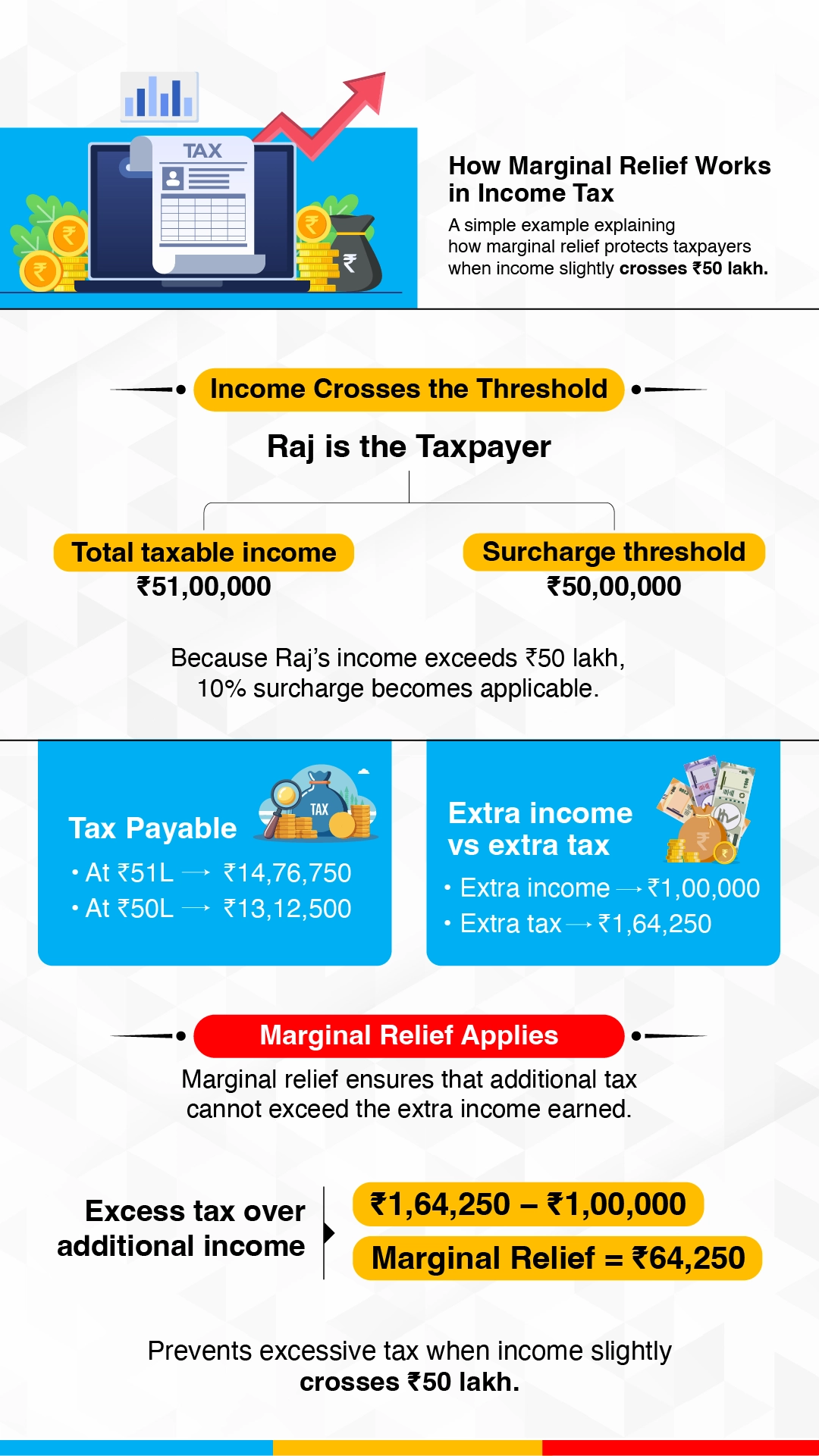
Say Raj earns a total income (net income after all possible deductions or the taxable income) of ₹51 Lakhs in a financial year, which is more than the 50 Lakhs limit but does not exceed ₹1 Crore. Therefore, Raj will have to pay a surcharge on the income tax computed at the rate of 10%.

Therefore, the total tax payable will be ₹14,76,750. But, if Raj had earned only ₹50 lakhs, then he would have to pay only ₹13,12,500, which means earning an extra ₹1 Lakh gets him to pay extra income tax of ₹1,64,250.

Fortunately, Raj receives marginal relief on the difference between the excess tax payable, ₹1,64,250 (₹ 14,76,750 – ₹13,12,500), and the amount of income exceeding ₹50 Lakhs, ₹1 Lakh (₹51,00,000 – ₹50,00,000). The marginal relief that Raj receives will be ₹64,250 (₹1,64,250 – ₹1,00,000).


2. Marginal Relief for Firms:

In the case of a firm, if the total income of the firm exceeds ₹1 Crore, a surcharge is levied at a 12% rate. In such a case, marginal relief will be the difference between the income tax payable (including surcharge) and the amount exceeding ₹1 Crore.

  1. For instance, if you are running a firm whose total income is ₹1.01 crores, you will have to pay an income tax, including the surcharge on income tax at 12%. Hence, the total tax payable will be ₹32.24 lakhs.
  2. However, if the total income of your firm is ₹1 Crore, the tax payable would be ₹31.2 Lakhs only. That means you are paying an extra income tax of ₹1.04 Lakhs for earning an extra income of ₹1 lakh.
  3. Hence, your firm can avail a marginal relief, which is the difference between the excess tax payable on higher income, i.e., ₹1.04 lakhs, and the amount exceeding ₹1 crore, i.e., ₹1 lakh in this case.
  4. Accordingly, your marginal relief comes out to be (1,04,000 — 1,00,000) = ₹4,000.
     

3. Marginal Relief for Domestic Companies:

If you are operating a domestic company whose turnover is between ₹1 crore to ₹10 crore, you will have to pay a surcharge on the income tax of 7%.

Marginal relief will be provided to such a company whose total income is between ₹1 crore to ₹10 crores. The relief will be the difference between the amount of income tax payable (including surcharge) on the higher income and the amount exceeding ₹1 crore.

4. Detailed Calculation Scenarios

If an individual’s income is ₹50.1 lakh, the surcharge is calculated on the excess ₹0.1 lakh. Marginal relief ensures the total tax liability is not higher than what it would have been below the threshold.

For companies, similar calculations apply, balancing the surcharge impact against the slight income increase.

Tax Planning and Avoiding Surcharge Legally

Effective tax planning can help reduce or avoid surcharge liability. Strategies include:

  • Utilising deductions and exemptions.
  • Opting for the appropriate tax regime based on income structure.
  • Investing in government-approved savings schemes.
  • Structuring income or bonuses to remain below surcharge thresholds
  • Consulting a tax professional ensures compliance with regulations while optimising tax liability

Final Words

An income tax surcharge is an additional tax imposed in India on individuals, businesses, and Hindu Undivided Families (HUFs) whose income surpasses a predetermined threshold. The surcharge rate is determined by the income level; it usually begins to apply at incomes over ₹50 lakh, with greater rates being applied to higher income brackets.

Conversely, a measure known as marginal relief aims to lessen the tax burden resulting from the surcharge. It guarantees that the amount of the tax increase resulting from the surcharge does not surpass the amount by which the income surpasses the designated threshold. By providing this relief, taxpayers can avoid paying disproportionately high taxes simply for narrowly exceeding the income level.

Glossary:

  1. Cess: A cess is an extra tax the government charges for specific purposes until enough funds are collected.
  2. Marginal Relief: Marginal relief reduces surcharge when income slightly crosses the surcharge threshold
  3. Exemptions: An exemption lets you exclude specific income from your total taxable income.
  4. Slab Rate: A slab rate is the tax rate applied to different income ranges as per government rules.
glossary-img
Uncertain About Insurance

FAQ

Apply the appropriate surcharge rate to your income tax liability based on your income bracket. For instance, there is a 10% income tax surcharge if your total income exceeds ₹50 lakh but is less than ₹1 crore.


Under Section 115BAC, surcharge is 10%, 15%, 25%, and 37% for incomes above ₹50L, ₹1 Cr, ₹2 Cr, and ₹5 Cr respectively.

While the surcharge is added to the tax amount and can be utilised for any purpose, the cess is imposed on the tax amount for a specific purpose. Several cesses and surcharges exist, including the crude oil and Swachh Bharat Abhiyan cess.


Taxpayers whose taxable income falls between ₹7 lakhs and ₹7.5 lakhs after deducting allowable expenses are now eligible for marginal relief in income tax. Thus, revenue that is just marginally above ₹7 lakhs will not require you to pay taxes.

According to the Income Tax Act, persons and companies granted relief from paying a surcharge are referred to as beneficiary relief. For many people and businesses, marginal relief in income tax lessens the burden of fees.

No, it is not compulsory for all taxpayers to pay a surcharge on income tax in India. The surcharge is an additional income tax charge and applies only to individuals and entities whose income exceeds specified thresholds. For instance, as of the current tax regulations, a surcharge is levied on individuals earning above ₹50 lakh annually, with rates increasing for higher income slabs.

Marginal relief = excess income – excess tax payable due to surcharge; it ensures tax payable doesn’t exceed income exceeding the surcharge threshold.

Marginal relief applies to surcharge in both old and new tax regimes in India, helping taxpayers reduce excess tax burden when income marginally exceeds thresholds. However, for a rebate under Section 87A, marginal relief is available only in the new regime.

Marginal relief prevents excessive tax where income slightly exceeds surcharge thresholds, providing a limited but significant tax rate reduction.

The 37% surcharge was cut to 25% under the new regime to ease the tax burden on the super-rich and promote investment growth. This reduction aligns with more relaxed slab rates, making the regime more attractive and fostering economic growth.

Disclaimer - This article is issued in the general public interest and meant for general information purposes only. The views expressed in this blog are solely those of the writer and do not necessarily reflect the official policy or position of Canara HSBC Life Insurance Company Limited or any affiliated entity. We make no representations or warranties of any kind, express or implied, about the completeness, accuracy, reliability, suitability, or availability with respect to the blog or the information, products, services, or related graphics contained in the blog for any purpose. Any reliance you place on such information is therefore strictly at your own risk. You should consult with a qualified professional regarding your specific circumstances before taking any action based on the content provided herein.

Recent Blogs

Will Budget 2026 Allow Joint Taxation for Married Couples?
29 Jan '26
8 Views
8 minute read
Find out what Budget 2026 may introduce on joint taxation for married couples, expected benefits, policy outlook, and how it may impact taxpayers in India.
Read More
Tax Saving
What is Income Tax Return (ITR)? Meaning & Filing Process of Filing ITR
21 Jan '26
4901 Views
10 minute read
Learn what an Income Tax Return (ITR) is, why filing your income tax return is important, and how to file your ITR online via the Income Tax Department. Documents, forms, steps, and FY 2026-27 details included.
Read More
Tax Saving
What Is Advance Tax? How to Calculate Advance Tax and Pay It Online
20 Jan '26
2518 Views
9 minute read
Understand advance tax under income tax, who should pay it, how advance tax is calculated, due dates, and online payment steps to avoid penalties.
Read More
Tax Saving
Importance of Taxes in India: Why Taxes Matter?
15 Jan '26
1613 Views
7 minute read
Understand the importance of taxes in India, how they support public services, economic growth, welfare schemes, and national development.
Read More
Tax Saving
What Is SGST? Meaning, Rates & Applicability Explained
15 Jan '26
627 Views
5 minute read
Learn what SGST means, its full form, tax rates, applicability, and how it works under the GST system for intra-state transactions.
Read More
Tax Saving
What is the GST Council? Role, Members & How It Works
14 Jan '26
542 Views
5 minute read
Understand what the GST Council is, its structure, powers, and how it decides GST rates, laws, and policies across India.
Read More
Tax Saving
Why is Your ITR Refund Delayed and What Can You Do?
13 Jan '26
537 Views
5 minute read
ITR refund delayed? Know the common reasons, timelines, and step-by-step actions to track, raise grievances, and speed up your income tax refund.
Read More
Tax Saving
80CCC: What is Deduction Under Section 80CCC?
11 Jan '26
1185 Views
6 minute read
What is Section 80CCC? How can you claim deductions under section 80CCC? Learn the eligibility criteria to claim a deduction under section 80CCC with a life insurance policy.
Read More
Tax Planning
How to Save Tax on Salary Above ₹15 Lakhs? | Tax Saving Guide 2026
10 Jan '26
4816 Views
14 minute read
Learn how to save tax on salary above ₹15 lakhs using effective tax saving options, deductions, exemptions, and smart income tax planning strategies
Read More
Tax Saving

Tax Savings - Top Selling Plans

We bring you a collection of popular Canara HSBC life insurance plans. Forget the dusty brochures and endless offline visits! Dive into the features of our top-selling online insurance plans and buy the one that meets your goals and requirements. You and your wallet will be thankful in the future as we brighten up your financial future with these plans.