

What Are Indirect Taxes In India

Indirect Tax in India: Know Types of Indirect Tax

Indirect taxes make up a sizable amount of the government's revenue in India. These taxes affect consumer behaviour and revenue creation.

Written by : Knowledge Center Team

2025-12-17

2494 Views

12 minutes read

The taxes collected by the Indian Government can be categorised into direct and indirect taxes. Direct Taxes are the taxes that are levied on the income, revenue, or profits earned by an individual or firm.  For instance, income tax, surcharge, and gift tax. These are implemented and governed by the Central Board of Direct Taxes (CBDT).

Indirect tax is a type of tax that is passed on to another individual or entity. Indirect taxes are generally levied on a manufacturer or supplier who then passes that tax to the final consumer. Examples of indirect taxes include sales tax, entertainment tax, excise duty, etc. One of the common examples of an indirect tax is the excise tax imposed on alcohol.

Key Takeaways

  • Indirect tax is imposed on goods and services instead of income. It is included in the price of the item and is paid by the customer via the business.

  • There are various types of indirect taxes, including Goods and Services Tax (GST), customs duty, excise duty, service tax, entertainment tax, and stamp duty.

  • GST can be categorised into three segments: SGST (State GST), CGST (Central GST), and IGST (Integrated GST).

  • Indirect taxes are beneficial, but they can also increase the financial burden on lower-income individuals.

  • Since businesses are intermediates, they must follow tax regulations carefully for the seamless implementation of GST to meet compliance.

What is Indirect Tax with Example?

The meaning of indirect tax is very simple. It is the tax levied on a person upon the consumption of goods and services rather than on personal income. It is not directly imposed on a person’s income; instead, the buyer pays the tax along with the actual price of the goods or services to the seller.. Generally, indirect tax is levied on sellers who pass it on to the final consumer.

In indirect taxes, the person on whom the burden falls and the person who pays the tax are different. The sellers are required to pay these taxes to the government (e.g., manufacturers, retailers). But since they sell goods to consumers, they pass the tax burden to you.

Thus, when you purchase goods, you pay the amount inclusive of tax to the seller. The seller then pays the tax to the government.

  • Indirect Tax Examples: Examples of indirect taxes are excise tax, VAT (Value Added Tax), service tax, customs duty, sales tax, entertainment tax, and Securities Transaction Tax.
  • Illustration of Indirect Tax: Suppose you go out for dinner. In the bill, you may see your total amount plus the GST (Indirect tax). Let’s say the bill is ₹2000 and the GST rate is 5% (dine-in or take-away restaurants ). Then you will have to pay 2000 + 100 = 2100. This ₹100 is the indirect tax that is passed on to you by the service provider.

Latest Indirect Tax Changes in India (2025-26)

The Indian tax system keeps evolving, and these changes occur to improve compliance and transparency. It enhances the country's efficiency. Here are some of the latest developments in the indirect tax system in the country.

  • GST Rate Revisions: This refers to the process where the government reviewed rates of various goods and services and reduced the GST on them accordingly. It resulted in the increase of GST on luxury goods while decreasing it on essential items. 

  • E-Invoicing Expansion: E-invoicing is a method where businesses with a turnover of over ₹5 crore must mandatorily register. It aims to curb tax evasion and streamline compliance. From April 1, 2025, businesses with turnover above ₹10 crore must upload e-invoices to the IRP within 30 days of invoice generation.

  • Customs Duty Adjustments: Import duty rates were reintroduced on electronic gadgets and luxury goods. This was done to encourage sales and manufacturing of local goods.

  • Digital Services Tax (DST): The government introduced a tax on digital services and on foreign e-commerce platforms that operate in India. 

  • The GST Amnesty Scheme: A fresh scheme that allows businesses to settle their dues with reduced penalties in case of pending GST liabilities. 

Maximize Your Tax Savings - Talk to an Expert

Please enter correct name Please enter the Full name
Please enter valid mobile number Please enter Mobile Number
Please enter valid email Please enter Email

Enter OTP

An OTP has been sent to your mobile number

Didn’t receive OTP?

Application Status

Name

Date of Birth

Plan Name

Status

Unclaimed Amount of the Policyholder as on

Name of the policy holder

Policy Holder Name

Policy No.

Policy Number

Address of the Policyholder as per records

Address

Unclaimed Amount

Unclaimed Amount
Error

Sorry ! No records Found

.  Please use this ID for all future communications regarding this concern.

Request Registered

Thank You for submitting the response, will get back with you.

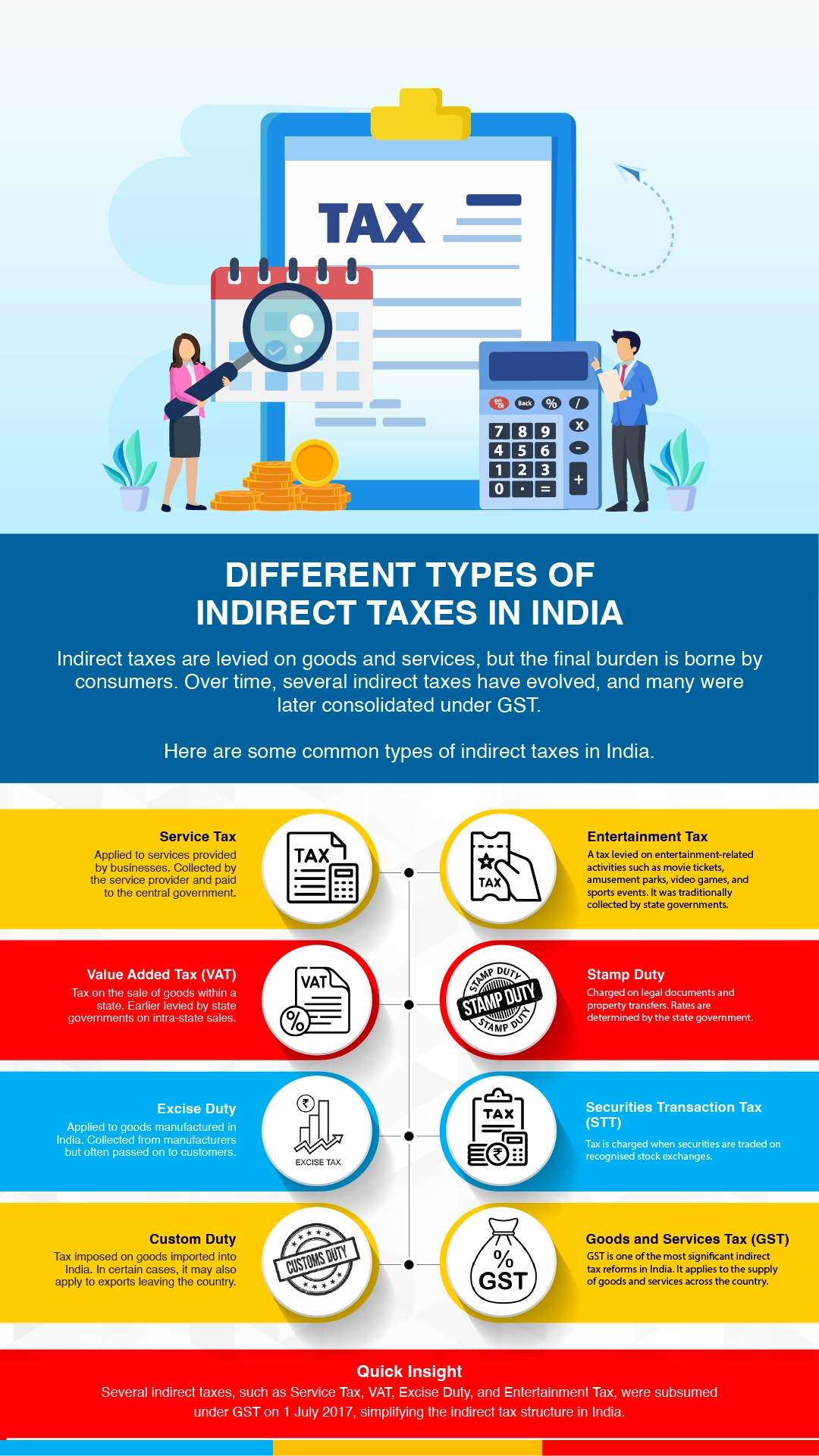
Different Types of Indirect Taxes in India

There are different types of indirect taxes in India. Listed below are some popular examples of indirect taxes, explained in brief:

  • Service Tax: Applicable on the services provided by a company and paid by the recipient of their services, collected by and deposited with the central government.

  • Value Added Tax: Popularly known as VAT, this tax was levied on the sale of movable goods or goods sold directly to customers. The respective state governments exacted it on intra-state sales.

  • Excise Duty: Levied on the goods produced or manufactured in India, paid by the manufacturers of different goods. It was often recovered from the customers.

  • Custom Duty: Applicable to goods imported into India from other countries. In some cases, it is also levied on the goods being transported out of India.

  • Entertainment Tax: Levied on all financial transactions related to entertainment, such as movie shows, amusement parks, video games, arcades, and sports activities, and is charged by the respective state governments.

  • Stamp Duty: Levied on the transfer of immovable property located within the state and is charged by the state government. It may vary in rate. It is also applicable to all legal documents.

  • Securities Transaction Tax: Levied at the time of trade of securities through the Indian Stock Exchange.

  • Goods and Services Tax (GST): The most popular type of indirect tax that was imposed on the supply of goods and services. The GST series starts with the manufacturer and ends with the consumer. There are three categories of this tax
    1. State Goods and Service Tax (SGST): When the sale happens within the same state (intra-state transactions of goods and services), the individual state and the central government share the tax revenue. The part that the state government takes is called SGST.
    2. Central Goods and Service Tax (CGST): The component of GST that the central government imposes on intrastate supplies of goods and services. It is imposed alongside SGST.
    3. Integrated Goods and Service Tax (IGST): This is the tax imposed on interstate transactions of goods and services, whether import or export. The central government collects IGST and then distributes it to the involved states.

Note: Service Tax, VAT, Excise Duty, and Entertainment Tax have been largely subsumed by GST on 1 July 2017

Features of Indirect Tax

In India, there are many different Indirect Taxes that apply to different kinds of goods, imports, manufacturing, and services. Understanding the features of indirect tax will also help you understand the meaning of indirect tax.

They are as follows:

  • Charged on Commodities: Indirect taxes are charged on material things such as goods and services. These are not levied on the income you earn.

  • Shifts the Burden of Tax: Sellers of the goods are required to pay the indirect taxes to the government. But they transfer the liability to their consumers.

  • Tax Evasion: Indirect taxes are already included in the price of the commodities. Thus, when you buy goods or a service, you automatically pay your share of the tax. This can help to reduce tax evasion.

  • Paid by the Consumer: The liability for indirect taxes is passed on by sellers to consumers. This tax is thus charged at the point of sale and is paid by the customers.

  • Revenue for Government: Since this type of tax cannot be easily evaded and applies to most commodities, it serves as a major revenue source for the government. Its contribution is higher than that of direct taxes.

  • The Consumer is Not Directly Affected: The main cause of direct tax evasion is that it is charged directly on  the income. Indirect taxes face no such problem as they are not directly affected.

5 Benefits of Indirect Tax in India

Indirect tax provides many benefits that are not available in the case of direct taxes:

  1. Helps Maintain Equity: Indirect taxes are very equitable. The tax depends on the cost of the goods. The higher the price of the goods, the more indirect taxes are involved. Thus, the people who can purchase high-priced goods pay higher indirect taxes.

  2. Easy to Pay/Collect: Indirect taxes are easy for both taxpayers and authorities to pay and collect. For the taxpayers: While making direct tax payments, you need to file an income tax return statement. Though you can do it yourself, it generally requires a chartered accountant. But in the case of indirect taxes, there is no such need, as it is paid when you purchase a good. 

  3. For Authorities: It is easier for the authorities because the taxes are collected in the shops and factories.

  4. Convenient: While calculating the income, there are 5 heads of income. It should include all the earnings you have made; this is the reason why people evade income tax. But indirect taxes provide you with convenience, as these are collected at the point of sale.

  5. Limit Harmful Consumption: Commodities that are harmful to our health, such as tobacco and wine, are subject to the highest indirect tax. This makes them highly expensive. The high cost of goods helps limit their consumption.

  6. Broader Scope: Indirect taxes are levied on a range of products and services. It is not the case that some brands incur taxes and some don’t. Also, unlike direct taxes, which are a one-time, high payment, indirect taxes are paid as you purchase and are much smaller.

Disadvantages of Indirect Tax 

Despite having many advantages, indirect taxes also have some limitations. The following disadvantages of indirect taxes are:

  1. Can be Regressive: Regression is a state that pushes a country backwards. Indirect taxes are regressive as they are the same for all commodities. Thus, it doesn’t matter if you are rich or poor; you pay the same tax. Thus, if you have a lower income, a larger proportion will go towards indirect tax, making your income even less.

  2. Inflationary Pressure: If the indirect taxes are increased by the government, the sellers will add higher charges to their products, which will increase the prices of goods. Thus, it can lead to inflation.

  3. Discourage Industry Growth: Indirect taxes, when levied on the raw materials, will make them costly, which  can discourage the industry owners from making the product. This can also affect market competitiveness.

  4. Unpredictable Revenue: The indirect tax collection is not fixed. It depends on the purchase of goods and services. Thus, the government cannot be sure how much revenue will be collected through indirect taxes.

Who is Eligible to Pay Indirect Tax? 

Let us take a look at who all are eligible to pay indirect tax.

  • Indirect taxes are paid by end consumers when they buy goods or services, regardless of their income level or status

  • Both individuals and businesses that consume goods or services are eligible to pay indirect tax

  • Sellers, manufacturers, distributors, or retailers collect the tax from buyers and remit it to the government; however, the actual burden falls on the customer

  • All persons, whether rich or poor, pay the same percentage of indirect tax on taxed items, making it regressive in nature

  • Indirect tax eligibility is broad and covers everyone involved in transactions for taxable goods or services, ensuring a wide revenue base for the government

Understanding Goods and Services Tax ( GST)

The inception of Goods & Services Tax (GST) has consumed almost all the indirect taxes prevailing in India It came into action on 1st July 2017 and has been used since. In India, there is a slab system under which several GST rates are applied. Each commodity can be put in a specific slab. GST is levied on the supply of goods.

If you buy a product, you have to pay GST based on the slab rate it falls under. If you run a business and your turnover exceeds ₹20 lakhs (services) and ₹40 lakhs (goods) per year, then you are also eligible to pay GST.

Though GST has replaced all the previous taxes, there are still some taxes prevailing. Each of these taxes is required to be paid by different parties.

  • Customs Duty Tax: If you are involved in international trading, then you are eligible to pay customs duty. This is a tax that is charged on the goods that need to be transported outside of your country.
  • Excise Duty: Though GST has replaced this tax, there are still some commodities that are charged with excise duty. These commodities are liquor, petroleum, fuel, etc. Excise is levied at the time when the goods are removed from the warehouse.

Must Read: How to login in GST portal?

How is GST an Indirect Tax?

As there are many different types of indirect taxes levied on the expenses incurred by a buyer, the government has sought to simplify the tax process by merging these indirect taxes into a single tax, the Goods and Services Tax (GST).

Merging all these taxes has reduced the hassles of compliance associated with all these indirect taxes, improving tax governance in the country. Introduced in 2017, the GST has eliminated the cascading effect of multiple taxes.

The reason why goods and services tax is categorised as an indirect tax is that, instead of paying directly to the government, you pay it to the supplier, and then they pass it on to the government. It is levied at every stage of the transaction and supply chain. The entire burden of GST falls on the consumer's shoulders, and the companies only act as intermediaries in the process. Now, since this tax is also applied to consumption rather than income, it again falls under the category of an indirect tax. 

India has significantly changed since the implementation of the GST Act of 2017. It has simplified the revenue collection process for the government and also allowed consumers to pay one tax instead of multiple taxes like  VAT, excise duty, and service tax. It unifies the entire market by digitalising the entire process and further enhances the functioning of the business. 

Direct Tax vs. Indirect Tax: Key Differences

Both direct and indirect taxes are essential for the smooth running of the nation’s economy. With direct taxes, the government ensured progressive taxation. Meanwhile, indirect taxation plays an essential role in contributing to the government’s revenue and economic growth. 
 

Aspect

Direct Tax

Indirect Tax

Definition

Tax is applied directly to an individual's or entity’s income.

Tax imposed on goods and services and levied on consumers.

Examples

Income tax, corporate tax, taxes on assets

GST, VAT, customs duty, excise duty

Paid By

Paid directly by individuals or businesses

Paid by consumers when purchasing goods or services

Tax Burden

Individuals or entities bear the entire tax

Tax burden shifts from seller to buyer

Administration

Governed by the Central Board of Direct Taxes (CBDT)

Governed by the Central Board of Indirect Taxes & Customs (CBIC)

GST and the Insurance Industry: Latest Update

GST used to apply to most sectors, including insurance. But after the 56th GST Council meeting in September 2025, GST on individual life and health insurance premiums was removed. This change took effect from September 22, 2025, making these policies GST-free.

What has Changed?

Previously, insurance premiums attracted GST at varying rates:
 

Insurance Plan TypePrevious GST Rate on PremiumCurrent GST Rate (2025)
Term Insurance Plans18% on full premium0%
Health Insurance Plans18% on full premium0%
Guaranteed Savings Plans25% (1st year), 12.5% (later)0%
Single-Premium Pension Plans10%0%
ULIPs (Unit Linked Insurance Plans)GST on the protection portion only0%


Key Implications

This change affects how policyholders pay premiums and how they benefit from their insurance plans.

  • Lower Premium Costs: Policyholders now pay only the base premium; no additional GST required
  • Improved Returns: Investment-linked plans like ULIPs and endowment policies now yield better post-tax returns
  • No GST Deduction: Since GST is no longer charged, it can’t be claimed as a tax deduction

GST and Other Sectors

GST has transformed many sectors in the Indian market, not only the insurance industry. Take, for example, the manufacturing industry- a streamlined tax structure has allowed businesses to get rid of the cascading taxes and, in turn, the production costs. In the e-commerce sector, interstate commerce has been simplified to an exceptional degree. Hospitals and the tourism industry are thriving because instead of paying multiple taxes, you only need to pay a single tax for that specific service or product.

Summing Up

In India, indirect taxes play a significant role in the country's revenue generation. These taxes are levied on goods and services, and the liability is passed on to the consumers. Indirect taxes are an essential source of revenue for the government, contributing more than direct taxes. They are also convenient for taxpayers and the authorities, as they are collected at the point of sale and do not require complex filing procedures. However, indirect taxes can have a regressive effect on low-income households, as they spend a larger share of their income on goods and services subject to these taxes. 

Additionally, increased indirect taxes can lead to inflation and decreased consumer demand. Overall, the impact of indirect taxes on the Indian economy and consumers is multifaceted, and it is crucial for the government to carefully consider their effects when setting tax policies to ensure a fair distribution of the tax burden.

Glossary

  1. ULIP: A market-linked insurance plan offering life cover and investment in one product
  2. Cascading Taxes: Taxes are applied on each stage of production, causing tax-on-tax
  3. Tax Evasion: Illegally avoiding taxes by hiding income or falsifying information
  4. Inflation: A rise in overall prices that reduces the purchasing power of money
  5. Corporate Tax: Corporate tax charged on the profits earned by companies
glossary-img
Uncertain About Insurance?

FAQs Related To Indirect Taxes

Indirect tax is a tax that is charged on goods and services. The rate is not fixed and can be charged depending on some factors, including economic conditions, political conditions, etc.

Yes, you will be charged GST if you purchase a ticket for a cricket match. Watching a cricket match in a stadium comes under entertainment and thus will be charged with GST. Earlier, there was an Entertainment tax.

Customs duty is charged on goods and services that are either:

A. Imported to India from abroad

B. Exported from India to any other country

Since the food items are for personal use, they will not be subject to customs duty.

The goods and services tax (GST) is an indirect tax in India that has taken the place of numerous other indirect taxes, including service tax, VAT, and excise duty. It was approved by the legislature on March 29th, 2017, and it became operative on July 1st, 2017.

Tax Deducted at Source, or TDS, is an indirect tax system in which income is collected directly from the recipient at the time of earning. 'Pay as you earn' and 'collect when it is earned' are concepts used by TDS.

Major indirect taxes in India include Goods and Services Tax (GST), customs duty on imports, excise duty, value-added tax (VAT), and various cesses and stamp duties administered by central and state governments.

The introduction of GST unified multiple indirect taxes like excise, VAT, and service tax into a single, destination-based tax system, simplifying compliance, improving tax efficiency, and ensuring seamless input tax credit across states.

CGST and SGST are levied on intra-state supplies, with revenue shared between central and state governments; IGST is levied on inter-state supplies and imports, collected by the central government and apportioned later.

Customs duty is an indirect tax charged on goods imported into India at applicable rates based on customs valuation; it protects domestic industries and generates government revenue, paid by importers at clearance.

Indirect taxes are regressive because they apply uniformly to all consumers; lower-income groups pay a higher proportion of income on these taxes, bearing more burden than higher-income individuals who spend less proportionally.

Disclaimer - This article is issued in the general public interest and meant for general information purposes only. The views expressed in this blog are solely those of the writer and do not necessarily reflect the official policy or position of Canara HSBC Life Insurance Company Limited or any affiliated entity. We make no representations or warranties of any kind, express or implied, about the completeness, accuracy, reliability, suitability, or availability with respect to the blog or the information, products, services, or related graphics contained in the blog for any purpose. Any reliance you place on such information is therefore strictly at your own risk. You should consult with a qualified professional regarding your specific circumstances before taking any action based on the content provided herein.

Recent Blogs

Tax Savings - Top Selling Plans

We bring you a collection of popular Canara HSBC life insurance plans. Forget the dusty brochures and endless offline visits! Dive into the features of our top-selling online insurance plans and buy the one that meets your goals and requirements. You and your wallet will be thankful in the future as we brighten up your financial future with these plans.