what-is-inflation

What Is Inflation and How Does It Impact Your Financial Planning?

Understand what inflation is, how it impacts your purchasing power, and how you protect and grow your wealth.

2025-08-02

887 Views

8 minutes read

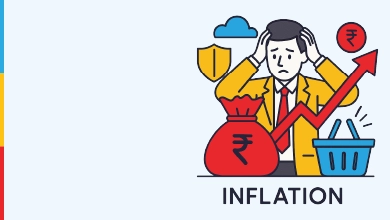
Any inflation rate essentially tells us the rate at which prices have been rising in an economy and is expressed as a percentage. If the price of potatoes rises from ₹45 per kg this year to ₹67 per kg next year, the inflation rate will be 48.9%. Inflation impacts your buying capacity.

A bar of chocolate used to cost ₹25 in the year 2012. The same chocolate costs ₹45 in 2022. Chocolate has become costlier in the last 12 years. With the same ₹25, one can get only almost half a chocolate in 2022. Inflation erodes the value of money, making it feel like your purchasing power shrinks with time.

Key Takeaways

  • Inflation refers to the rise in the prices of everyday goods and services, reducing the value of money over time.
  • There are three primary types of inflation: demand-pull, cost-push, and built-in.
  • Inflation affects your daily expenses, borrowing costs, and savings, and can trigger a cycle of overspending.
  • Strategic investments in real estate, equities, commodities, and gold can help you hedge against inflation.
  • Life insurance plays a vital role in maintaining your family's lifestyle even as the cost of living rises.

Therefore, inflation refers to the increase in the prices of everyday items, such as food, housing, clothing, transportation, and entertainment. Inflation is measured by the average change in prices over a specified period. The RBI aims to limit inflation in order to maintain a smooth functioning of the economy. There are both benefits and drawbacks to inflation. However, before that, let us look at the different types of inflation. 

Worried About Emergencies? Start Planning Now

Please enter correct name Please enter the Full name
Please enter valid mobile number Please enter Mobile Number
Please enter valid email Please enter Email

Enter OTP

An OTP has been sent to your mobile number

Didn’t receive OTP?

Application Status

Name

Date of Birth

Plan Name

Status

Unclaimed Amount of the Policyholder as on

Name of the policy holder

Policy Holder Name

Policy No.

Policy Number

Address of the Policyholder as per records

Address

Unclaimed Amount

Unclaimed Amount
Error

Sorry ! No records Found

.  Please use this ID for all future communications regarding this concern.

Request Registered

Thank You for submitting the response, will get back with you.

Types of Inflation in India

There are broadly three types of inflation, namely: 

  1. Demand-pull Inflation: When demand exceeds supply, producers increase prices and a new market equilibrium is formed. In simple terms, when more money chases fewer goods, the prices increase, and this is called “Demand-Pull” inflation.
  2. Cost-push Inflation: When the cost of input (such as labour, raw materials, etc) increases, companies prefer passing on this hike to the customer so that their margin remains unaffected. It occurs when the cost of production increases.
  3. Built-in Inflation: Expectation of future inflation results in built-in inflation. An increase in prices results in higher wages to match the increased cost of living. These increased wages result in an increased cost of production, which in turn affects market pricing. A vicious circle is created.

How Does Inflation Affect You?

Inflation, the steady rise of prices for "anything” over time, has many effects, good and bad. Some of them are listed below:

  1. Erodes Purchasing Power
    At its core, inflation means your money doesn’t stretch as far as it used to. As prices rise across the economy, the value of currency effectively falls, and you end up spending more to buy the same goods and services. For instance,  a kg of oranges cost ₹100 in 2024 and  ₹110 in 2025; then there would be a 10% increase in the cost of a kg of oranges.

  2. Increase Expenditure
    As prices rise, you end up stocking stuff that you feel would get costlier with time. In the quest to tame inflation, you end up overspending.

  3. The Vicious Cycle
    You spend to stock up on goods so that you do not end up overpaying for those essential items. When everyone thinks alike, the stores go empty, increasing demand further and putting inflation in a vicious circle.

  4. Increases Interest Rates
    If you're saving money, you might earn a bit more in interest. But if you're planning to borrow,  or already have loans with floating interest rates, be ready for higher repayments.

    If you own property, rising market rates could boost your net worth. Renting out your house may also fetch you more income, and while maintenance costs will go up too, they’re usually not as steep as the jump in rent, which can leave you financially better off.

    Your employer might also respond to inflation by raising product prices, and potentially your salary as well. Meanwhile, gold often acts as a natural hedge against inflation, so it's common to see gold prices surge when inflation runs high.

Can You Benefit From Inflation?

Yes, you can. Provided you adopt a prudential approach while investing. Givenbelow are a few ways to help you beat inflation:

  • Invest in Real Estate: Property prices tend to increase during periods of inflation. If you’ve invested in real estate, you can benefit not just from increasing asset value but also from higher rental income. You can let out the property at higher rents while the maintenance costs may not increase at the same pace.
  • Use Commodities to Ride the Inflation Wave: As commodity prices increase due to inflation in consumer goods, you may consider investing in commodities through mutual funds.
  • Boost Long-Term Wealth with Equities and Tax-Saving Instruments: Equity exposure is a must to generate wealth. ELSS helps you fetch good returns plus the investment is deductible from taxable income. However, the returns are not exempt from tax. ULIPs provide a similar benefit.. ULIPs are eligible for a tax deduction (investment) and are exempt from tax (on maturity).
  • Turn to Gold as a Time-Tested Hedge Against Inflation: The price of gold increases because gold is limited in supply. The gold pricing is a classic example of more money chasing limited goods. Beyond economics, gold is widely seen as a safe investment. It is a reliable store of value that has stood the test of time.

Which Factors Affect Inflation?

Here is a list of the five primary causes of inflation:

  1. Growing Economy
    In a growing economy, unemployment declines and wages increase. As a result, people have more disposable income, which they spend on things beyond basic necessities. This rise in demand allows suppliers to increase prices, which in turn leads to more jobs and puts more money in circulation.

    A growing economy leads to an increase in consumer spending and demand. This is considered a form of demand-pull inflation.

  2. Expansion of Fiat Money
    A sudden influx of money in the economy can also drive demand-pull inflation. This happens when the RBI prints money at a rate higher than the growth rate of the economy. With more money in circulation, there is more money chasing the same number of goods as earlier. The market finds its own equilibrium with an increase in prices.

  3. Government Regulation
    The government can make it more expensive for companies to produce goods or import them. The companies pass on this increase in production cost to customers by increasing selling prices. This results in cost-push inflation.

Wrapping Up

Inflation quietly erodes the value of your money, and over time, even basic necessities become increasingly expensive. A lifestyle that feels comfortable today may be significantly harder to sustain tomorrow, especially for your loved ones if you're not around. While investments like real estate, gold, and equity can help protect your wealth from inflation, there’s another important tool to consider- life insurance plan.

A well-planned life insurance policy from Canara HSBC Life Insurance secures your family's financial future and also ensures they can maintain the same standard of living, no matter how high the cost of living climbs.

Because preparing for tomorrow isn’t just smart but essential.

Disclaimer - This article is issued in the general public interest and meant for general information purposes only. The views expressed in this blog are solely those of the writer and do not necessarily reflect the official policy or position of Canara HSBC Life Insurance Company Limited or any affiliated entity. We make no representations or warranties of any kind, express or implied, about the completeness, accuracy, reliability, suitability, or availability with respect to the blog or the information, products, services, or related graphics contained in the blog for any purpose. Any reliance you place on such information is therefore strictly at your own risk. You should consult with a qualified professional regarding your specific circumstances before taking any action based on the content provided herein.


Financial Planning - Top Selling Plans

We bring you a collection of popular Canara HSBC life insurance plans. Forget the dusty brochures and endless offline visits! Dive into the features of our top-selling online insurance plans and buy the one that meets your goals and requirements. You and your wallet will be thankful in the future as we brighten up your financial future with these plans.


Recent Blogs