5 Retirement Planning Concept Everyone Should Know About

5 Retirement Planning Concept Everyone Should Know About

Want to do better for your retirement without becoming a retirement planning expert? Lean on the simple and basic concepts of retirement savings. 

Written by : Knowledge Centre Team

2025-10-02

2914 Views

8 minutes read

And before we dive into these amazing concepts let’s recall a few old age wisdom nuggets which hold even in modern times:

Retirement may feel like a distant milestone, especially when you're busy building your career or managing family responsibilities. However, the truth is that your future comfort depends on the choices you make today. And the sooner you start planning, the more freedom and peace of mind you’ll enjoy later in life.

Key Takeaways

  • The sooner you begin saving for retirement, the more time your money has to grow through compounding.
  • Understand that the two phases- accumulation and distribution both require thoughtful planning, especially if you're aiming for early retirement.
  • Your retirement corpus should be able to support your lifestyle even as the cost of living rises.
  • Managing healthcare, housing, and lifestyle costs helps your savings last longer.
  • Build consistent habits like automating your investments, avoiding emotional decisions, and reviewing your plan once a year.
  • No matter your age, starting now is better than waiting for the "right time".

5 Golden Retirement Principles

You don’t need to be a financial expert to secure your golden years. What you do need is a firm grasp of a few timeless principles, concepts that are easy to understand and powerful enough to guide your retirement journey from your first paycheck to your last.

And before we dive into these concepts, let’s recall a few old-age wisdom nuggets that still hold true:

  • Plan for the worst & hope for the best
  • Save first, spend later
  • Time is the most significant factor in the growth of your wealth

Retirement is ultimately just another financial goal. Like any other goal, it’s about managing your expenses and increasing your savings to make the most of your income.

These principles will recur throughout the retirement concepts outlined below.

  1. Early Retirement means Longer Distriution Period- The retirement goal is not a static goal situated at one point in time. It is a continuous goal that begins the moment you start earning and continues until you die. The whole retirement journey is divided into two phases.
    • Accumulation phase, when you save, invest and try to accumulate a huge corpus.
    • Distribution phase, when you stop investing and expect the corpus to support you financially for the rest of your life.

    Nowadays, ‘early retirement’ is quite a buzzword among Gen-Y. However, what does early retirement mean?

    If retiring, for you, means relying solely on your savings to sustain your lifestyle, you may soon face challenges for the following reasons:

    • Early retirement means your money gets less time to grow; i.e. lower money pool
    • Your distribution period will be longer; i.e. the smaller corpus must last longer
    • Inflation will be more prominent for you; inflation is higher in younger years as lifestyle changes
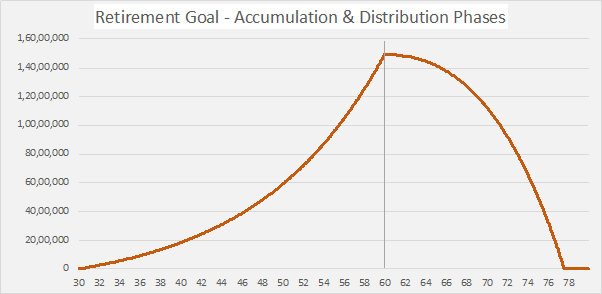
    • Accumulation & Distribution Phases of Retirement

    Thus, early retirement should mean that you will start working on something closer to your heart. Starting a business enterprise and making it profitable has been one of the popular early retirement plans.
  1. Inflation vs. Pension -Thus, the chance of your corpus depleting much faster than you expect is higher in the early years. So, while investing for your retirement goal, you need to ensure that you can accumulate more than your estimate. This will need you to:
    • Use high-risk-high-reward investment options, such as equity funds
    • Manage your portfolio risk so that your corpus keeps growing

    Use plans which will do both of the above automatically for you, a few examples are, Tier-I account of New Pension Scheme, pension plans from life insurers, and online ULIP plans.

    Best online ULIP plans have the features to allow you to not only invest in good equity funds but also, manage your portfolio with proven strategies. ULIPs from Canara HSBC Life can easily double up as your tax-free retirement plan in India.

  2. Make Sure Your Savings Grow with Your Income- When you plan your retirement, you are planning based on your current income and expenses. But, both will likely change over time, and if stars are properly aligned, income will grow more than the expenses. Your retirement savings should grow along with your income, and if possible more than the income growth.

    For example, you receive an increment of 10% on your annual income. First, before heading to the party, increase all your investments by at least 10%.

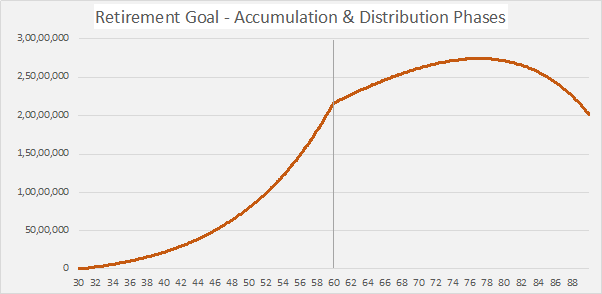
    In the first chart of the accumulation and distribution phase, we maintained a monthly investment of ₹10,000 for the entire period. The result was that the corpus did not even last for the next 20 years.

    However, if you increase your savings by just ₹500 a month each year, you get enough corpus to last more than 30 years. Not only that, but you can also leave a significant legacy for your children.

    Withdrawals are the same in both estimates and are growing at the same rate each year. 
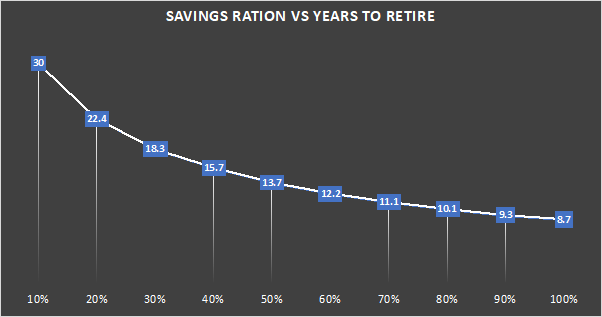
  1. Savings Ratio vs. Time to Retirement-This is one of the most interesting concepts of retirement planning. This concept gives a simple connection between your savings ratio for retirement goal and your ability to replicate the same income.

    For example, if you are earning ₹1 lakh a month, and save 10% of your income towards retirement, you can replicate the same income within 30 years.

    Similarly, Image 3 gives you more years to retirement based on other savings ratios. The rate of return of the investment plays a role in these estimates, and we have assumed 8% p.a. ROI for our calculation.

    You have known that ‘the more you save, the faster you will achieve your financial goal,’ but this image should solidify your knowledge into a firm belief with numbers.

    PS, if you save 90% of your income, you can have enough money to replicate the same within the next 10 years.
  1. Minimising Post-Retirement Expenses- While we have been trying to maximise our savings and returns so far we should not miss the beat on expenses. Growing expenses can easily outmanoeuvre your income growth and even the most meticulously laid out plans. So, what do you do?

    You figure out which are the possible major expenses post-retirement and you take measures to minimise them. For now, these could be the most common major expenses on most post-retirement budgeting sheets:

    • Medical costs
    • Travelling
    • Home maintenance/rent

    So, taking care of your health will possibly resolve at least two of these. However, you should also keep the senior citizen health insurance handy, just in case the uninvited concern knocks on your door. For home maintenance, moving to a more manageable property could be recommended. But, there could be so many more solutions.

Now that we've explored the five key concepts of retirement planning, one important question remains: When should you actually begin your retirement journey? Let us find out. 

How Early Should You Start Retirement Planning?

The short answer? As early as possible. The best time to start planning for retirement is with your first job or first steady income. The earlier you begin, the more powerful your money becomes, thanks to the compounding effect.

Ideal Ages and Milestones to Begin

  • Early 20s: This is the best time to start. You may not have high earnings yet, but you have the biggest advantage: time. Even modest monthly savings can grow exponentially.
  • Mid to Late 20s: You’re likely earning more and becoming more financially independent. This is still an ideal stage to establish the habit of regular investing.
  • 30s: If you’ve delayed planning, now is the time to get serious. You’ll need a more focused approach, but with consistent effort, you can still reach your goals.
  • 40s and beyond: Starting now will require more aggressive saving and investing, but it’s never too late. You can still build a reliable corpus by optimising returns and controlling expenses.

The Power of Compounding: Why Starting Early Pays Off

Let’s look at a simple example:

  • Aarav, age 25, invests ₹5,000/month for 35 years
  • Riya, age 35, invests ₹10,000/month for 25 years

Assuming a 10% annual return:

  • At 60, Aarav would have around ₹1.9 crore
  • Riya would have only about ₹1.1 crore, despite investing double every month

Why the gap? Because compounding rewards time more than amount. The earlier you start, the more your money multiplies, without extra effort.

Connecting This to Early Retirement

If early retirement is your goal, say at 50 or even 45, you’ll have fewer working years to save and more non-working years to fund. This means:

  • Your corpus needs to be larger
  • Your savings rate needs to be higher
  • Your investment strategy must be smarter

Starting in your early 20s or as soon as possible helps build that cushion, giving you options later, such as retiring, switching careers, travelling, or simply slowing down without financial anxiety.

Retirement Calculator

A retirement planning calculator is a simple tool that gives you an idea of the corpus you can accumulate with a regular monthly investment for your golden years.

1
My Retirement Age
2
Amount Invested
3
Additional Details
4
Our Recommendation
My Retirement Age
Amount Invested
Additional Details
Our Recommendation
Retirement
Your Current Expenses are Rs 50,000/month
Inflationary Expenses you will need post retirement Rs 1,00,000/month
Hi {customerName}
We recommend to start Investing
For remaining {remainingYears} years
View Now
Desclaimer-

The above calculation and illustration of figures are indicative only and not on actual basis.

Behavioural Tips: How to Stay Consistent with Long-Term Goals

While starting early gives you a strong head start, staying consistent over the long haul is what truly builds a secure retirement. After all, even the best-laid plans can fall apart without the right mindset and discipline. That’s where behavioural habits bridge the gap between intention and action.

Retirement planning is not a one-time decision but a lifelong habit. Here are a few practical ways to stay on track:

  • Automate Your Investments- Set up automatic transfers to your retirement funds every month. This ensures that saving becomes a priority and not an afterthought. When investments are automated, you’re less likely to skip or delay contributions due to monthly expenses or impulse spending.
  • Avoid Emotional Investing or Withdrawals- Market ups and downs are inevitable. Avoid making panic-driven decisions, like withdrawing funds during a market dip or chasing high-risk investments during a rally. Stick to your long-term plan and let your money grow steadily over time.
  • Review Your Plan Once a Year- Your financial situation, income, goals, and even market conditions may change. Set a fixed date every year to revisit your retirement plan, assess your progress, rebalance your portfolio if needed, and adjust your contributions based on income growth.

    These small habits can make a big difference over the decades.

Your Retirement: Your Responsibility

Retirement is a stage of life that requires deliberate planning, disciplined execution, and consistent care. Through this guide, we’ve uncovered the core concepts that can help anyone, regardless of income or financial background, take control of their retirement journey.

From understanding how early retirement affects your savings to tackling inflation and aligning your savings with your income growth, these concepts are more than just financial advice; they’re building blocks for a future you can look forward to.

But knowledge alone isn’t enough. The key lies in starting early, staying consistent, and being mindful of how you approach money over time. With simple habits like automating your savings, avoiding emotional investing, and reviewing your plan annually, you can set yourself up for a retirement that’s not just financially secure but also fulfilling and stress-free.

Remember, the best retirement plan is one that’s rooted in clarity, discipline, and action. To make that journey easier, retirement solutions from Canara HSBC Life Insurance offer tailored plans designed to help you build a reliable income stream and secure the lifestyle you envision. Start where you are, use what you have, and build steadily, because when the time comes to retire, your future self will thank you for the steps you took today.

Disclaimer - This article is issued in the general public interest and meant for general information purposes only. The views expressed in this blog are solely those of the writer and do not necessarily reflect the official policy or position of Canara HSBC Life Insurance Company Limited or any affiliated entity. We make no representations or warranties of any kind, express or implied, about the completeness, accuracy, reliability, suitability, or availability with respect to the blog or the information, products, services, or related graphics contained in the blog for any purpose. Any reliance you place on such information is therefore strictly at your own risk. You should consult with a qualified professional regarding your specific circumstances before taking any action based on the content provided herein.

Recent Blogs

What is Superannuation? Types and Tax Benefits
07 Jan '26
713 Views
9 minute read
A superannuation benefit is a type of benefit that is paid to the employees by their employers as a pension benefit. Learn what superannuation is and how it works.
Read More
Retirement Plan
What is Family Pension? Everything You Need to Know
05 Jan '26
1831 Views
10 minute read
Family Pension is a government scheme for central government employees. Learn its meaning, eligibility criteria, and how it works with Canara HSBC Life Insurance.
Read More
Retirement Plan
Is NPS Tax Benefit Available in New Tax Regime? | NPS Deduction Rules
05 Jan '26
4233 Views
7 minute read
Is NPS tax benefit allowed in the new tax regime? Understand eligibility, Section 80CCD(2) deductions, and how NPS works for taxpayers.
Read More
Retirement Plan
What is Pension? Meaning, Types & Benefits Explained
04 Jan '26
3686 Views
12 minute read
A pension is a retirement fund contributed by the employer, employee, or both, with the employer covering the largest share. Learn more with Canara HSBC Life Insurance!
Read More
Retirement Plan
What Is a Defined Benefit Pension Plan and How Does It Pay?
23 Dec '25
1266 Views
8 minute read
What is a defined benefit pension plan? Learn how it guarantees a fixed retirement income based on salary and years of service, and why it matters for long-term security.
Read More
Retirement Plan
How Can You Plan to Build a ₹5 Crore Retirement Corpus?
20 Dec '25
887 Views
8 minute read
Learn how to create a ₹5 crore retirement corpus using disciplined savings, investments in equities and debt, compounding, risk management, and goal-based planning strategies.
Read More
Retirement Plan
What is PRAN in NPS? Full Form & Role in National Pension System
20 Dec '25
1031 Views
8 minute read
Discover what PRAN means and its vital role in NPS. Learn how PRAN helps manage pension accounts under India’s National Pension System.
Read More
Retirement Plan
What Are the Different Types of Annuity Plans in India?
18 Dec '25
1080 Views
8 minute read
You can invest in many types of annuities in India. Learn about the main types of annuity plans in India, including immediate, deferred, life, joint life, and guaranteed annuities, and how each suits different retirement needs.
Read More
Retirement Plan
NPS Returns: Meaning and Benefits of NPS Returns
18 Dec '25
3436 Views
10 minute read
NPS returns depend on the performance of allocated funds. Learn how to maximize your NPS returns and explore alternative retirement investment options.
Read More
Retirement Plan

Retirement - Top Selling Plans

We bring you a collection of popular Canara HSBC life insurance plans. Forget the dusty brochures and endless offline visits! Dive into the features of our top-selling online insurance plans and buy the one that meets your goals and requirements. You and your wallet will be thankful in the future as we brighten up your financial future with these plans.