Retirement Plan | Best Retirement & Pension Plan

How to Check if Your Retirement Corpus Will be Enough?

Learn how saving, investing, and beating inflation can help you plan a secure, stress-free retirement starting today.

Written by : Knowledge Centre Team

2025-08-01

1918 Views

8 minutes read

When you are young, retirement feels far away and full of possibilities. But for many, the reality is quite different. A vast majority of senior citizens endure retirement, rather than enjoy it. Needless to say, health-related issues are one of the major woes afflicting the older population. But money is a bigger challenge. Financial insecurity is the biggest impediment to leading a comfortable retired life. There are a lot of investment options that are essential for a comfortable retirement.

Key Takeaways

  • Saving and investing serve different roles: both are essential for long-term financial health.
  • Inflation silently erodes the value of idle or low-interest savings.
  • Wealth creation requires investing in instruments that beat inflation over time.
  • The earlier you start saving and investing, the more flexibility you gain in your retirement age.
  • Planning for healthcare, cost of living, and income replacement is key to a financially secure retirement.

The majority of the working population lives paycheque to paycheque, putting themselves at grave risk for the future. To ensure a comfortable retirement, there are three challenges that if addressed early in life can make retirement financially comfortable:

  • Saving
  • Investing
  • Wealth Creation

These three pillars lay the foundation for financial independence in your later years.

How Much Money do you Need During Your Retirement?

Considering the overall inflation rate to plan for retirement could be detrimental. You must consider what will remain relevant to you over the years. Both healthcare and food costs account for a major portion of senior citizens living expenses.
How Much of Your Income Should Go Towards Retirement?

Instead of getting lost in complex calculations involving inflation, compounding, and returns, focus on a key question:

What percentage of your annual income should go to your retirement?

You can consider the complicated estimates and time value of money, including the inflation and rate of return on your investments. However, it all boils down to one simple factor – what percentage of your income are you saving towards your retirement?

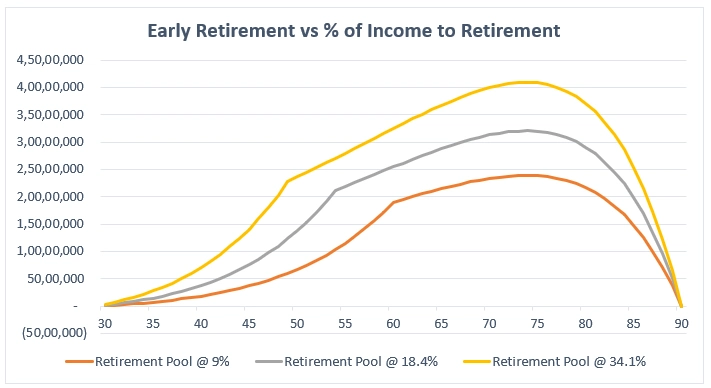
Figure 1 shows the accumulation and depletion of the retirement corpus built at different saving ratios. Here’s what it shows:

  • Let us assume that you start investing 9% of your income towards your retirement. At the age of 60 the corpus will be sufficient to provide you until the age of 90
  • Similarly, investing 18.4% of your income towards your retirement will enable you to retire at the age of 55 and continue comfortably until the age of 90
  • And, investing 34.1% of your income for retirement, will allow you to retire at the age of 50 and the corpus will be sufficient to provide for you until the age of 90

These scenarios assume the following:

  • You start withdrawing the approximately same amount of money you used to earn at the age of 30
  • Inflation, income, and pension growth are 5% p.a.
  •  Your rate of return on the invested money is 8% p.a.

This should give you an idea about how much of your income going to your retirement funds will ensure that your retirement is financially secure.

Learn the top mistakes to avoid while planning for your retirement.

Get Expert Guidance for Your Retirement & Investments

Please enter correct name Please enter the Full name
Please enter valid mobile number Please enter Mobile Number
Please enter valid email Please enter Email

Enter OTP

An OTP has been sent to your mobile number

Didn’t receive OTP?

Application Status

Name

Date of Birth

Plan Name

Status

Unclaimed Amount of the Policyholder as on

Name of the policy holder

Policy Holder Name

Policy No.

Policy Number

Address of the Policyholder as per records

Address

Unclaimed Amount

Unclaimed Amount
Error

Sorry ! No records Found

.  Please use this ID for all future communications regarding this concern.

Request Registered

Thank You for submitting the response, will get back with you.

How to Solve Post-Retirement Problems Before You Retire?

Both Saving and Investing may, prima facie, look very similar but are contrastingly different. Setting aside some money each month right from the day you start earning is quintessential. Without regular savings, you may end up with little or no funds after retirement.

Investing helps your money grow over time. When you invest your savings in financial tools like Fixed Deposits (FDs), Public Provident Fund (PPF), National Pension Scheme (NPS), your money grows at the specific rates of interest as announced by the bank or government. For example, FDs offer rates between 4% to 8% depending on the bank and tenure.

However, saving and investing alone may not be enough to maintain the lifestyle you're used to. To ensure your hard-earned money does not erode in value over time, the money must grow faster than the rate of inflation.

Saving Vs Investment: Which is Better?

Both saving and investing are essential parts of financial planning. Saving helps you build a safety net for emergencies and short-term goals. Investing, on the other hand, is what grows your wealth over time and helps you beat inflation.

Here’s how they differ:

  • Purpose: Saving is ideal for building liquidity, while investing is meant for long-term growth.
  • Returns: Savings typically earn lower but stable returns (3–6%), while investments may offer higher returns (8% or more) over time.
  • Risk: Savings are low-risk and secure. Investments involve varying degrees of market risk but also better growth potential.
  • Inflation: Savings may lose value over time due to inflation. Investments, if chosen wisely, help your money grow faster than inflation.

In short, saving keeps your money safe, but investing helps your money work harder. A balanced combination of both is the key to a financially secure retirement.


Effects of Inflation on Your Savings

If you “save” money in non-interest bearing assets or leave it idle in a basic savings account, it gradually loses value over time.

For example:

  • At a typical savings account interest rate of 3%
  • With an average inflation rate of 6%

Your real return becomes =3%-6%= (-)3%

This means your savings are effectively shrinking. Over time, the money you set aside buys less, not more. Here’s a simple illustration

  • Today, buy 2kg of Oats for ₹400. In another 10 years, the same 2Kgs of Oats may cost ₹700 at the current 6% rate of inflation.
  • If you had put ₹400 in a savings account today, the amount would have grown to ₹540 in 10 years. This amount can fetch you only 1.5Kgs of Oats then.

Both these examples demonstrate the need to focus on “wealth creation” rather than keeping money aside or “investing” in low-income yielding instruments.

The Best Retirement & Saving Plans by Canara HSBC Life Insurance

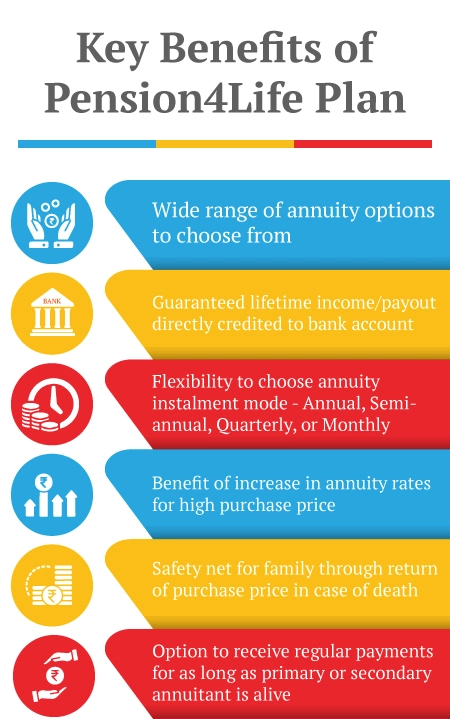
Any investment should be a well-thought-out process keeping in view long-term goals, the security of the family, and the education of children. Canara HSBC Life Insurance offers some of the best retirement plans in India. One of these is the Pension4Life Plan. It is another safe long-term investment plan that gives you income streams, post-retirement, called “annuities” till the end of your life after which the purchased/invested amount would be given to your nominee.
Key Benefits For Pension4Life

  • In case you have opted for a Joint Life Annuity, your spouse would continue receiving annuity even after you, until their demise. After that, the invested amount will be paid to the nominee.
  • Planning for major expenses and post-retirement cost of living helps you start investing the right amount from today.
  • Insurance plans help you in wealth creation in the long run as they beat inflation to give you better returns.
  • Insurance also gives you peace of mind because your family will be financially secure in the event of your untimely demise.
  • Pension plans by Canara HSBC Life Insurance give you a regular income stream even post-retirement to help you have fun in your 2nd innings!

Conclusion

Retirement planning is less about predicting the future and more about preparing for it. By understanding the impact of inflation, making smart saving and investment choices, and focusing on long-term wealth creation, you can build a retirement life that’s not just secure, but comfortable and fulfilling. The key is to start early, stay consistent, and adapt your plan as life evolves. Your future self will thank you for the steps you take today.

Disclaimer - This article is issued in the general public interest and meant for general information purposes only. The views expressed in this blog are solely those of the writer and do not necessarily reflect the official policy or position of Canara HSBC Life Insurance Company Limited or any affiliated entity. We make no representations or warranties of any kind, express or implied, about the completeness, accuracy, reliability, suitability, or availability with respect to the blog or the information, products, services, or related graphics contained in the blog for any purpose. Any reliance you place on such information is therefore strictly at your own risk. You should consult with a qualified professional regarding your specific circumstances before taking any action based on the content provided herein.

Recent Blogs

GPF vs PPF: Differences, Benefits & Which is Better?
10 Feb '26
507 Views
7 minute read
Compare GPF vs PPF in terms of eligibility, interest rates, tax benefits, withdrawal rules, and which is better for retirement planning.
Read More
Retirement Plan
Unified Pension Scheme (UPS): Benefits, Returns & Eligibility
09 Feb '26
22 Views
8 minute read
Explore UPS pension scheme benefits, eligibility rules, returns, and how it compares with NPS and other retirement plans in India.
Read More
Retirement Plan
Bucket Strategy for Retirement: Meaning & How It Works
09 Feb '26
619 Views
8 minute read
Understand the bucket strategy for retirement planning and how it helps manage risk, income stability, and long-term wealth growth.
Read More
Retirement Plan
Is a PF Account Enough for Retirement Planning in India?
15 Jan '26
3189 Views
10 minute read
Already have a PF account? Learn why a retirement plan is still essential for complete financial security and stress-free life after retirement.
Read More
Retirement Plan
Difference Between Defined Benefit Plan & Defined Contribution Plan
09 Jan '26
1741 Views
12 minute read
Your retirement will be funded by defined contribution and defined benefit plans. But how should you decide defined benefit vs defined contribution results?
Read More
Retirement Plan
What is Superannuation? Types and Tax Benefits
07 Jan '26
709 Views
9 minute read
A superannuation benefit is a type of benefit that is paid to the employees by their employers as a pension benefit. Learn what superannuation is and how it works.
Read More
Retirement Plan
What is Family Pension? Everything You Need to Know
05 Jan '26
1834 Views
10 minute read
Family Pension is a government scheme for central government employees. Learn its meaning, eligibility criteria, and how it works with Canara HSBC Life Insurance.
Read More
Retirement Plan
Is NPS Tax Benefit Available in New Tax Regime? | NPS Deduction Rules
05 Jan '26
4228 Views
7 minute read
Is NPS tax benefit allowed in the new tax regime? Understand eligibility, Section 80CCD(2) deductions, and how NPS works for taxpayers.
Read More
Retirement Plan
What is Pension? Meaning, Types & Benefits Explained
04 Jan '26
3683 Views
12 minute read
A pension is a retirement fund contributed by the employer, employee, or both, with the employer covering the largest share. Learn more with Canara HSBC Life Insurance!
Read More
Retirement Plan

Retirement - Top Selling Plans

We bring you a collection of popular Canara HSBC life insurance plans. Forget the dusty brochures and endless offline visits! Dive into the features of our top-selling online insurance plans and buy the one that meets your goals and requirements. You and your wallet will be thankful in the future as we brighten up your financial future with these plans.