what-is-the-time-value-of-money

What is the Time Value of Money (TVM)?

Understanding the time value of money helps you make smarter financial decisions by showing why money today is more valuable than tomorrow.

Written by : Knowledge Centre Team

2025-10-01

3970 Views

8 minutes read

There are different ways to look at money. You can make the most of the money you have if you understand the time value of money. The value of money is its purchasing power. What money can buy depends on the price level of the item. When the price increases, you can purchase less of it with the same money.

Key Takeaways

  • Money today is worth more than the same amount in the future due to inflation and lost interest opportunities.
  • TVM is calculated using the Present Value and Future Value concepts.
  • Fixed deposits, mutual funds, and ULIPs offer different advantages when seen through the lens of TVM.
  • Long-term, tax-efficient investments like PPF, ULIP, and NPS help maximise real returns.
  • Avoid idle money and early withdrawals to make the most of compounding and tax savings.

A decade back, with ₹ 10,000, you could have bought all your monthly groceries, but today for the same groceries, you may be spending ₹ 15,000. It means the value of money has been reduced. You will need even more for your monthly groceries in the coming years.

Definition: Time Value of Money

Assume you have lent ₹ 50,000 to your friend who has committed to paying you after a week. However, a week later, he calls you and informs you that he won't be able to return the money for the next three months. However, he assures you that he will return the complete sum in three months.

For a layman, the assurance may bring relief. However, if you understand the time value of money, you may not be satisfied with this response.

According to the Time Value of Money, the money you have in hand today is worth more than the same amount you will have in the future. In the above example, the worth of your loaned money is lower after three months. So even though you will receive the whole money, you are at a loss.

Since money can generate interest, the value of money is less if you receive it in the future. There are two reasons for it:

  • InflationInflation reduces your purchasing power. If you had planned to buy a TV for ₹50,000 today, you will not be able to afford it three months from now because of inflation.
  • Opportunity CostIf you can invest the same money, you may earn interest on it. For example, in a fixed deposit. If you keep the money idle or loan it to a friend without interest, you lose that income opportunity.

Worried About Emergencies? Start Planning Now

Please enter correct name Please enter the Full name
Please enter valid mobile number Please enter Mobile Number
Please enter valid email Please enter Email

Enter OTP

An OTP has been sent to your mobile number

Didn’t receive OTP?

Application Status

Name

Date of Birth

Plan Name

Status

Unclaimed Amount of the Policyholder as on

Name of the policy holder

Policy Holder Name

Policy No.

Policy Number

Address of the Policyholder as per records

Address

Unclaimed Amount

Unclaimed Amount
Error

Sorry ! No records Found

.  Please use this ID for all future communications regarding this concern.

Request Registered

Thank You for submitting the response, will get back with you.

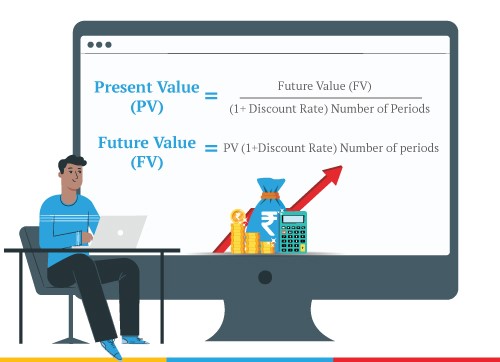
Present Value & Future Value of Money

Let us closely look at what the present and future value of money means.

  • Present Value (PV) is the money you have today that is equal to a future sum discounted by a suitable interest rate. It shows how much you should invest now to reach a future amount.
  • Future Value (FV) is the amount your money will grow into over a specific period with simple or compound interest.

Example: If you invest ₹ 1 lakh in a fixed deposit at 6% interest for one year, the future value will be ₹ 1.06 lakh.

TVM in Investment Instruments

You need to understand how TVM in different instruments works. It will help you make the correct investment. Along with future value, you should also consider taxation when choosing your investments. TVM is calculated using the following formula:

FV = PV x [ 1 + (I/ N) ]^(N*T)

Here, FV is the future value, PV is the present value, N is the number of compounding years, and T is the investment tenure.
For example, If you invest ₹ 10,000 (PV) for 10 (T) years at an 8% (I) p.a. rate of interest, you will receive ₹ 21,589.25 (FV) on maturity.

  • TVM in Fixed Deposits- Fixed deposits give you a fixed return on your investment. However, the interest you earn is taxable, and hence real return is calculated after deducting the taxes. For example, you invest ₹ 1 lakh in a Fixed Deposit at a 6% return for five years, and you are in a 30% tax slab.

    Using the above formula, FV will be ₹ 161,051. Since you are taxed at 30%, your net gain will be ₹ 42,736 only.

  • TVM in Mutual Funds - Mutual funds are investment options where you have the flexibility to stay invested as long as you want to. Mutual funds have variable market-linked returns. Thus, you can only estimate your future returns based on the past performance of the fund or similar funds.

    However, the time value of money for your investments will vary based on your investment horizon, mode of investing and withdrawal. You can estimate your real return after withdrawing the money.
    Mutual fund returns are taxed as capital gains only after withdrawal. So, you can easily establish the impact of taxation on your returns.

  • TVM with ULIPs ULIP plans also carry investments in multiple funds. However, you can invest in more than one fund option within the same ULIP at the same time. So, you have two kinds of ROIs – 
    • Individual Fund’s ROI
    • ULIP ROI


ULIP ROI is a weighted average of individual funds’ ROIs. Since ULIP returns can be completely exempt from tax, your ROI can be free from the tax effect.
Like mutual funds, you can estimate the real ULIP ROI for your portfolio at the time of withdrawal.

How to Maximise TVM for your Investments?

Based on the discussion, it is clear that you are better off if you can earn more on your investments - you can maximise TVM for your investment. Below are a few things you can do to maximise TVM for your investments:

  • Stay Invested for the Long Term- The more time you give your investment, the higher you can earn from your investments because of the power of compounding. You not only earn interest on your capital but also on the interest. 
  • Optimise CostsMost investment plans have a charge associated with them. If you invest in a non-fixed return investment option, the returns are not in your control. But you should always consider the investment charges. Choose an investment option with a lower cost to maximise your returns.
  • Invest in EEE Options -  You should opt for the EEE investment option where the capital invested, the accrued interest, and the maturity value all are tax-free.

Disclaimer: Tax benefits are subject to change in tax laws. Please consult your tax advisor.

Best EEE Investments in India 2026

Below are some of the best EEE investment options you can explore:

  • Unit Linked Insurance Plan (ULIP)- ULIPs are a smart combination of life insurance plan and investment rolled into one plan. They allow you to invest in a range of funds, equity, debt, or balanced, based on your risk appetite and financial goals. You also get the flexibility to switch between funds, make partial withdrawals, and even opt for goal-based allocation or automated portfolio strategies. The premiums paid qualify for tax deduction under Section 80C, and the maturity proceeds are tax-free under Section 10(10D), provided specific conditions are met. Also, note that the amount received from a life insurance policy, including bonuses, is exempt from income tax, as long as the annual premium does not exceed 10% of the sum assured for policies issued after April 1, 2012, or 20% for those issued before that date.
  • Public Provident Fund (PPF) - PPF is one of the most trusted long-term savings schemes backed by the Government of India. It comes with a 15-year lock-in period and offers guaranteed, inflation-beating returns that are declared quarterly. Investors benefit from features like partial withdrawals and loans against the account after a few years, which provide both liquidity and security. Contributions up to ₹1.5 lakh per year are tax-deductible under Section 80C, and the interest earned as well as the maturity amount are fully exempt from tax
  • National Pension Scheme (NPS) - NPS is designed specifically for retirement planning and allows investors to allocate funds across equity, corporate debt, and government securities as per their preferences. It’s a flexible, low-cost scheme that you can start with as little as ₹500, making it accessible for most income groups. Upon maturity at age 60, a portion of the corpus can be withdrawn lump sum, while the rest must be used to buy a pension plan, ensuring regular post-retirement income. Contributions qualify for tax benefits under Section 80C and an additional deduction of ₹50,000 under Section 80CCD(1B), making it a powerful tool for both savings and tax planning.

Final Thoughts

Understanding the time value of money is crucial, as it helps you recognise that the value of money today is higher than its value in the future. This awareness should guide all your financial decisions, encouraging you to maximise after-tax returns to preserve and grow the real value of your investments. To achieve this, it's important to align each investment with a specific goal and avoid premature withdrawals that can interrupt compounding. By focusing on tax-efficient instruments, you not only retain more of your earnings but also create space to explore market-linked options that help beat inflation. 

As your life goals and risk tolerance evolve, regularly reviewing your portfolio ensures that your investments remain relevant and effective. Ultimately, discipline, consistency, and patience are the threads that tie together a resilient and rewarding financial journey. To support this journey, savings and investment plans from Canara HSBC Life Insurance offer a smart blend of protection and wealth-building strategies, tailored to your long-term goals. 

Disclaimer - This article is issued in the general public interest and meant for general information purposes only. The views expressed in this blog are solely those of the writer and do not necessarily reflect the official policy or position of Canara HSBC Life Insurance Company Limited or any affiliated entity. We make no representations or warranties of any kind, express or implied, about the completeness, accuracy, reliability, suitability, or availability with respect to the blog or the information, products, services, or related graphics contained in the blog for any purpose. Any reliance you place on such information is therefore strictly at your own risk. You should consult with a qualified professional regarding your specific circumstances before taking any action based on the content provided herein.


Recent Blogs

Why Does Liquidity Matter in Financial Planning?
02 Jan '26
1056 Views
8 minute read
Learn what liquidity means in financial planning, why easy access to funds is important, and how liquidity helps manage emergencies and short-term needs.
Read More
Financial Planning
What Is the Right Way to Start Investing in Your 20s?
28 Dec '25
1083 Views
10 minute read
Learn how to invest in your 20s by balancing risk, building good habits early, choosing the right assets and setting the foundation for long-term wealth.
Read More
Financial Planning
Why Financial Planning Is Important for Long-Term Security?
27 Dec '25
4911 Views
11 minute read
Learn why financial planning is important, how it helps manage income, expenses and risks, and why it is essential for achieving long-term life goals.
Read More
Financial Planning
Best Investment Plans for 5 Years in India 2026
27 Dec '25
1552 Views
8 minute read
Explore the best investment plans for 5 years that balance returns and risk, helping you meet medium-term financial goals with stability and smart planning.
Read More
Financial Planning
Net Present Value (NPV): Full Form, Meaning & Formula
26 Dec '25
3904 Views
10 minute read
Net Present Value (NPV) measures an investment's total value and profitability. Learn how NPV helps in investment planning with Canara HSBC Life Insurance.
Read More
Financial Planning
How Can You Calculate SIP Returns in India?
26 Dec '25
890 Views
8 minute read
Learn how to calculate SIP returns, understand expected vs actual returns, use formula or calculators, and plan investments effectively for long-term wealth creation.
Read More
Financial Planning
Internal Rate of Return (IRR): Meaning, Formula and Usage
24 Dec '25
3875 Views
10 minute read
Understand Internal Rate of Return (IRR), its meaning, and calculation formula. Learn how it measures investment performance with Canara HSBC Life Insurance.
Read More
Financial Planning
What is a Fixed Deposit: FD Meaning, Benefits & Types
24 Dec '25
1294 Views
11 minute read
A fixed deposit (FD) is a financial instrument that allows you to invest your funds for a fixed period and earn returns at a fixed rate. Visit this section to understand in detail about FD.
Read More
Financial Planning
What Will Be The Value of Rs 1 Crore After 20 Years?
23 Dec '25
2934 Views
10 minute read
Find the actual value of Rs 1 Crore after 20 years. Why should you save Rs. 1 Crore, and how can you ensure a higher value for your wealth?
Read More
Financial Planning

Financial Planning - Top Selling Plans

We bring you a collection of popular Canara HSBC life insurance plans. Forget the dusty brochures and endless offline visits! Dive into the features of our top-selling online insurance plans and buy the one that meets your goals and requirements. You and your wallet will be thankful in the future as we brighten up your financial future with these plans.