building-an-emergency-corpus-using-insurance-plans

How Insurance Plans Can Support an Emergency Fund?

Learn how insurance plans can support an emergency corpus through payouts, riders and policy benefits, helping you manage sudden financial needs.

Written by : Knowledge Centre Team

2025-08-02

1186 Views

11 minutes read

It’s terrible when we fall into a drastic income cut due to unexpected situations like Covid-19 and do not have an emergency corpus to take care of our contingencies. Many people have had to face hardships on the money front in this pandemic. But as they say, it is never too late. People who have missed out on building an emergency corpus could create one in the months ahead through systematic planning.

An emergency corpus is critical in uncertain times and with an emergency corpus in place, you could live worry free. Many investors get carried away by the promise of higher returns on equity and end up never building an emergency corpus for themselves. An emergency fund can be in form - from sufficient deposits in a savings account, to a unit linked insurance plan that allows pre-withdrawals in times of emergency. Ensure whatever the source be, it is accessible in a day or two to help in any crisis, should you face a sudden dip in earnings from disruptions due to a market shutdown, natural calamity etc. Such emergency corpus can help pay for major expenses like children’s education, an equated monthly installment or even usual household expenses, if needed.

How much savings would you need?

Depending on your income and regular expenses, an emergency fund can be anything between three to six months of your monthly income. If you plan to start an emergency fund now, take account of the amount of money you need for your living expenses, money payable towards school fees, EMIs payable, and other unavoidable expenses. Also, it is advised you review these every few months to monitor and incorporate any increase in expenses. You may even choose to divide your emergency fund into 2 categories, and choose saving instruments accordingly.

  • Long-Term Emergency Funds- These are long term savings plans where you save a large chunk of investments for large-scale emergencies like a sudden medical exigency or a natural disaster. This fund should be invested in plans that offer wealth creation benefits and allow you to earn considerable interests, but may also be liquid to allow emergency withdrawal. For instance, ULIP plans like Promise4Growth Plus are a great tool that lets you invest in avenues depending on your risk appetite, ensuring guaranteed results along with partial withdrawal facilities.
  • Short-Term Emergency Funds- This is the fund you must rush to in cases of smaller emergencies that may arise. These funds should allow immediate accessibility, even if the rates of interest are low. Also, these are the funds that can suffice in case of extreme situations, till you gain access to your long-term emergency funds.

Start with Making the Right Investment

Health and term insurance are a must to ensure a secure financial future for your family. In addition, unit-linked insurance policies (ULIP) that promise to pay returns at the end of the tenure are also considerable options. Apart from financial security, insurance policies are also a smart way to build wealth. While investment options such as equity and mutual funds play an important role in long-term wealth creation, there are several plans that can help fulfill both cover and savings needs.
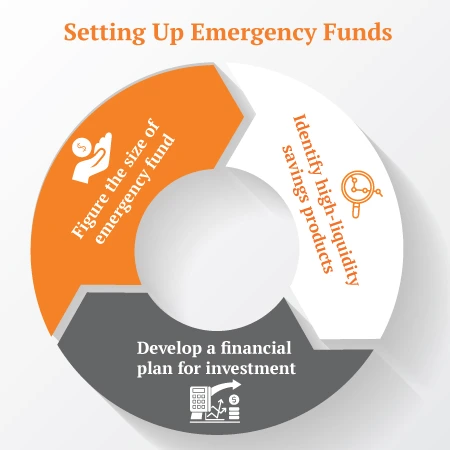
setting up emergency funds
  1. Unit Linked Insurance Plans: ULIPs combine life insurance with investment, as in the premium you pay is divided into insurance and the investment plan selected by you at the time of purchasing the policy. ULIPs let you choose from equity, debt and hybrid fund options according to your needs. Though the returns from the plan are market-linked, you have an option to switch between funds when required. Also, plans like the Promise4Growth Plus allows you to make partial withdrawal after a certain lock-in period.
  2. Endowment Plans: If you are a risk-averse, you might want to invest in endowment plans to build wealth. Endowment plans are long-term saving plans that come with life cover. The policy allows withdraw either as a lump sum amount or in monthly installments, on maturity. Also in case the insured survives the policy tenure, the lump sum amount from the policy can be used for financial objectives like children’s education, their marriage etc.

Disclaimer - This article is issued in the general public interest and meant for general information purposes only. The views expressed in this blog are solely those of the writer and do not necessarily reflect the official policy or position of Canara HSBC Life Insurance Company Limited or any affiliated entity. We make no representations or warranties of any kind, express or implied, about the completeness, accuracy, reliability, suitability, or availability with respect to the blog or the information, products, services, or related graphics contained in the blog for any purpose. Any reliance you place on such information is therefore strictly at your own risk. You should consult with a qualified professional regarding your specific circumstances before taking any action based on the content provided herein.


Recent Blogs

How do I Surrender my Life Insurance Policy?
18 Feb '26
887 Views
6 minute read
Learn how to surrender your life insurance policy, reasons not to, required documents, and whether you can surrender your term plan with Canara HSBC Life Insurance.
Read More
Life Insurance
Can I Buy A Life Insurance Policy For Someone With A Critical Illness?
17 Feb '26
879 Views
Life insurance may be difficult to obtain if you suffer from a critical illness. However, it is not impossible. Here are the details regarding this kind of life cover.
Read More
Life Insurance
Where Do Life Insurance Companies Invest Your Premiums?
17 Feb '26
2416 Views
10 minute read
Curious where life insurance companies invest your money? Get insights into how your premiums are managed for long-term growth and security.
Read More
Life Insurance
5 Ways to Cash Out a Life Insurance Policy in 2026
17 Feb '26
4907 Views
15 minute read
Learn five common ways to cash out a life insurance policy, including surrender, loans and withdrawals, and understand the impact on coverage and payouts.
Read More
Life Insurance
Prepaid Insurance: Meaning, Examples & How Does it Work?
17 Feb '26
1553 Views
6 minute read
Learn about prepaid insurance, its benefits, and why it’s crucial for securing your financial future by ensuring continuous coverage without interruptions.
Read More
Life Insurance
How Life Insurance Reduces Financial Stress During Illness?
12 Feb '26
61 Views
7 minute read
Learn how life insurance helps manage medical expenses, income loss, and family financial security during serious illness with practical examples.
Read More
Life Insurance
What Is Non-Traditional Life Insurance & Why It Matters?
11 Feb '26
127 Views
5 minute read
Explore non-traditional life insurance plans, how they differ from traditional policies, and why they matter for modern financial planning.
Read More
Life Insurance
GST on Life Insurance: Rates, Charges & Rules in India
10 Feb '26
2898 Views
10 minute read
What impact does the Goods and Services Tax have on life insurance plans and your premium payments towards them? Here’s all you need to know.
Read More
Life Insurance
Terminologies of Life Insurance: Key Terms You Should Know
10 Feb '26
1082 Views
7 minute read
Learn common life insurance terms and definitions, including premium, nominee, sum assured, riders, and policy benefits to understand your coverage better.
Read More
Life Insurance

Life Insurance - Top Selling Plans

We bring you a collection of popular Canara HSBC life insurance plans. Forget the dusty brochures and endless offline visits! Dive into the features of our top-selling online insurance plans and buy the one that meets your goals and requirements. You and your wallet will be thankful in the future as we brighten up your financial future with these plans.