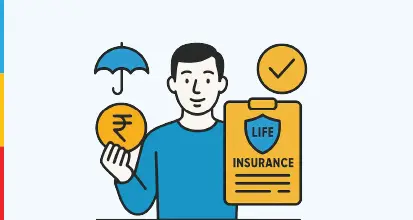



Taking A Loan Against Your Life Insurance. Things To Know

What Should You Know Before Taking a Loan Against Life Insurance?

A loan against life insurance lets you borrow using your policy’s surrender value, offering quick funds without credit checks or income proof

Written by : Knowledge Center Team

2025-11-13

903 Views

7 minutes read

A life insurance policy is a unique financial instrument. It not only helps you secure the future of your family but also provides a good return on your investment. In addition to this, a life insurance policy can also be used to avail a loan in the event of an emergency. If you’re keen on learning more about taking a loan against your policy, this blog will help you understand things you need to know.

Key Takeaways

  • Loans are available only on life insurance policies with surrender value, not pure term plans

  • Most insurers allow loans after 3 years of premium payment

  • You can borrow up to 80-90% of the surrender value, depending on policy terms

  • No credit score or income assessment is required, as it’s a secured loan

  • If unpaid, the loan is adjusted against maturity or death benefits and may lead to policy foreclosure

What is Life Insurance?

A life insurance policy is a legally binding contract between an individual and an insurance company. The individual purchasing the policy is required to make periodic premium payments to the insurer. In exchange, the insurer promises death benefits to the beneficiary in case the policyholder dies during the policy’s term. Some life insurance policies also offer the policyholder a lump-sum payment in the form of maturity benefits if the insured person survives the tenure of the policy.

  • Loan against Life Insurance: Availing a loan against your existing life insurance policy is a viable alternative to taking out a personal loan or selling your assets for cash. In recent times, loans against life insurance policies are fast becoming the preferred solution to meet emergency expenses. This is primarily because it is a hassle-free alternative that offers plenty of advantages over traditional kinds of loans. In addition to being able to quickly avail a loan on your policy, you can also enjoy an interest rate that is much lower than the rate on conventional borrowings. That said, there are some important things you should know before you go ahead and avail a loan on your insurance policy.
  • Is Your Policy Eligible for a Loan?: This is the first thing that you should determine before trying to avail a loan against your policy. Not all life insurance policies allow you to take a loan against them. Reading the terms and conditions of your policy can give you a fair idea of whether or not you are eligible. If you’re still unsure, it’s advisable to contact your insurance company for more clarity.

Get Life Cover Instantly

Please enter correct name Please enter the Full name
Please enter valid mobile number Please enter Mobile Number
Please enter valid email Please enter Email

Enter OTP

An OTP has been sent to your mobile number

Didn’t receive OTP?

Application Status

Name

Date of Birth

Plan Name

Status

Unclaimed Amount of the Policyholder as on

Name of the policy holder

Policy Holder Name

Policy No.

Policy Number

Address of the Policyholder as per records

Address

Unclaimed Amount

Unclaimed Amount
Error

Sorry ! No records Found

.  Please use this ID for all future communications regarding this concern.

Request Registered

Thank You for submitting the response, will get back with you.

When Can You Avail a Loan against Your Policy?

Most eligible life insurance policies come with a waiting period during which you cannot avail any loan against your policy. Most traditional life insurance plans, such as endowment plans, money-back plans, or whole life policies, accumulate a surrender value over time, which usually begins after the policy has been in force for a few years (commonly around 3 years). Only when the policy has sufficient cash or surrender value can you borrow against it.

Term life insurance plans do not build a cash or surrender value, and therefore are not eligible for loans unless the insurer specifically allows it in rare cases.

What is the Amount of the Loan that You Can Avail?

The amount of loan that you can avail is dependent on the terms and conditions of the policy. Some policies allow you to take a loan on the sum assured, while others permit you to take a loan on the surrender value. Generally, insurance companies only allow you to borrow up to 80% or 90% of the surrender value. 

For example:

  • Endowment or money-back plans with a strong surrender value are more likely to support higher loans

  • ULIPs (market-linked plans) may earn a loan facility depending on insurer rules, but not all ULIPs qualify

Is There a Credit Assessment Process?

A loan against a life insurance policy is treated as a secured loan, where the policy’s surrender value acts as collateral. Since you are essentially borrowing against your own accumulated assets, insurers and banks generally do not conduct a credit score check or a detailed income assessment. This means your CIBIL score is neither checked nor impacted, making it a convenient option for individuals with limited credit history or fluctuating income.

Unlike personal loans, there is no requirement to submit salary slips or employment proofs. The insurer already has your policy details, premium payment history, and surrender value on record, which significantly reduces verification time. As a result, borrowings against life insurance policies are often approved and disbursed faster, sometimes within a few working days.

However, while credit checks are minimal, insurers may still verify:

  • Policy status (active and premium paid)

  • Surrender value eligibility

  • Outstanding loans or assignments on the policy

Interest rates on such loans are usually lower than those on unsecured loans, as the lender’s risk is reduced due to the collateral-backed nature of the borrowing.

What are the Documents Required to Borrow Against a Life Insurance Plan?

The documentation for a policy loan is usually minimal. Common requirements include:

  • Filled loan application form

  • Original policy document

  • Assignment deed, transferring rights to the lender

  • Sometimes, copies of identity and address proof may be requested 

This streamlined process is because the insurer already holds most of the necessary details about the policy and the policyholder.

trivia-img

Did You Know?

If the loan and interest exceed a policy’s surrender value, insurers can foreclose the policy and terminate coverage.


Source: LiveMint

Young Term Plan - 1.5 Crore

What Happens if You Default on Repaying Your Loan?

When you take a loan against your life insurance policy, the loan is secured by the surrender value (cash value) of that policy. If you fail to repay the loan and interest, several consequences can follow:

  1. Interest Continues to Accumulate: The outstanding interest keeps building on your loan amount. Since most loans against life insurance are secured and interest compounds, the unpaid amount grows over time.
  2. Loan is Adjusted against Benefits: If you don’t repay the loan, the insurer will adjust the outstanding principal and interest against any future benefits, whether it is the maturity value (if the policy matures) or the death benefit (if the insured passes away). The insurer will first deduct the loan amount and accumulated interest, and pay the remaining balance (if any) to you or your nominee.
  3. Policy May Be Foreclosed (terminated): If the outstanding loan amount plus accrued interest equals or exceeds the surrender value of the policy, the insurer has the right to foreclose (terminate) your policy to recover the dues. When this occurs:
    • The policy lapses immediately
    • All coverage ends
    • The policyholder (or nominee) may receive no future benefit since the loan has already consumed the surrender value
  4. Loss of Insurance Protection: Once the policy is foreclosed or lapsed due to default, the life cover itself terminates. This means any death benefit payable under the policy will be reduced by the outstanding loan and interest, or may even be completely lost if the loan amount exceeds the benefits.
  5. Loan Remains until Cleared: Even if your policy matures before you clear the loan, the insurer will adjust the outstanding loan amount first and only then pay the remaining maturity benefit (if any) to you.

For example, if you borrow against your life insurance and don’t repay the loan, the interest continues to accumulate, and the insurer can deduct the loan plus interest from your policy’s surrender value or future death/maturity benefits. If the unpaid balance ever equals or exceeds the policy’s cash value, the policy can be foreclosed and coverage terminated, leaving no benefits for your beneficiaries.

We, at Canara HSBC Life Insurance, offer investors many life insurance plans to choose from. With these policies, you can enjoy the option of availing a loan against the cash value, so your contingent needs can be met. Once the policy acquires surrender value, you’re eligible to borrow money as per the limits specified. With easy borrowing options such as these available to investors, it’s no wonder that life insurance is an investment you shouldn’t pass over.

Glossary

  1. Surrender Value: The amount payable if a policy is exited early, and the base for availing a loan
  2. Policy Loan: A secured loan taken against the cash value of a life insurance policy
  3. Foreclosure: Termination of a policy when the unpaid loan and interest exceed the surrender value
  4. Assignment Deed: A document transferring policy rights to the insurer until the loan is repaid
  5. Secured Loan: A loan backed by collateral, such as a life insurance policy’s surrender valu
glossary-img
Uncertain About Insurance?

FAQs on Taking A Loan Against Your Life Insurance

No, you cannot take a loan against your life insurance policy at any time. A loan is allowed only after the policy acquires a surrender value, which usually happens after paying premiums continuously for 2–3 years, depending on the policy type. Once the policy builds sufficient value, you can apply for a loan as per the insurer’s terms.

The interest rate on a loan against a life insurance policy varies by insurer and policy, but it is generally lower than personal loans since it is a secured borrowing. Rates may be fixed or linked to the insurer’s prevailing rates, and interest is charged only on the amount borrowed.

To get a loan against an insurance policy, first check whether your life insurance plan is eligible and has acquired surrender value. Submit a loan application form along with your policy document and assignment deed. After verification, the loan amount, usually a percentage of the surrender value, is approved and disbursed directly to your bank account.

Taking a loan against a term insurance is generally not allowed, as term insurance plans do not build any cash or surrender value. Only savings-oriented life insurance plans, such as endowment, money-back, or whole life policies, usually offer the option of borrowing against the policy value.

Disclaimer - This article is issued in the general public interest and meant for general information purposes only. The views expressed in this blog are solely those of the writer and do not necessarily reflect the official policy or position of Canara HSBC Life Insurance Company Limited or any affiliated entity. We make no representations or warranties of any kind, express or implied, about the completeness, accuracy, reliability, suitability, or availability with respect to the blog or the information, products, services, or related graphics contained in the blog for any purpose. Any reliance you place on such information is therefore strictly at your own risk. You should consult with a qualified professional regarding your specific circumstances before taking any action based on the content provided herein.

Life Insurance - Top Selling Plans

We bring you a collection of popular Canara HSBC life insurance plans. Forget the dusty brochures and endless offline visits! Dive into the features of our top-selling online insurance plans and buy the one that meets your goals and requirements. You and your wallet will be thankful in the future as we brighten up your financial future with these plans.

Recent Blogs