



How to Invest in Saving Schemes to Save Tax?

How to Invest in Saving Schemes to Save Tax?

Tax planning means making smart investments in savings schemes and insurance products to cut tax liability while boosting income growth.

2025-09-15

1953 Views

8 minutes read

As the old saying goes, "A penny saved is a penny earned." Tax planning is one method for lowering your taxes while increasing your income. Saving tax, or more specifically, planning your investment, is a question that everyone seeks answers to. While tax planning is crucial, tax-saving investments are also equally significant.

As a wise investor, you should seek out tax-saving investments that provide tax exemption and allow you to earn tax-free income. There are many clever ways to save taxes and enjoy the greatest possible savings. However, for the majority of people, tax planning is something they put off until later.

A better strategy is to begin investing in the early quarters of the financial year when there is still time to plan wisely and reap the greatest returns on investment from various tax-saving investments.

Key Takeaways

  • Start tax planning early in the financial year to maximise benefits and avoid last-minute stress.
  • Review existing tax-saving expenses before investing further to avoid unnecessary investments.
  • Choose tax-saving instruments like PPF, ELSS, NPS, and bank FDs based on your financial goals and risk appetite.
  • Limited premium pay insurance plans allow paying premiums for a shorter duration while maintaining coverage.
  • Canara HSBC Life Insurance offers tax-saving plans with features like guaranteed income and loyalty additions to boost returns.

How to Save Taxes with Savings Schemes?

It is a very common practice to extend tax planning decisions until the last quarter, which can turn out to be a hassled decision. As mentioned above, the beginning of the financial year is the most favourable time to plan tax-saving investments. The investments made can then multiply over time and assist you in meeting your long-term financial goals.

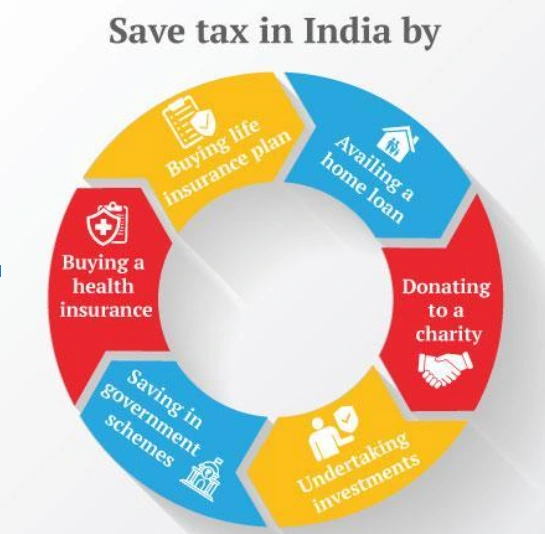
Moreover, as a taxpayer, you can use these guidelines to plan your tax savings for the year and make smart decisions when investing in saving schemes to save tax.

a. Examine your pre-existing tax-saving expenses, such as insurance premiums, EPF contributions, children's tuition fees, home loan repayment, and so on.

b. If your tax-saving expenses exceed the maximum limit of ₹1.5 lakh, there is no need to invest the full amount.

c. Choose tax-saving investments such as PPF, ELSS funds, bank FDs, and NPS based on your goals and risk-taking profile.

Making investment plans that aid in saving taxes can be helpful in many aspects. Respectively, you may find Canara HSBC Life Insurance products helpful. The key features of the savings plans offered are:

Get Life Cover Instantly

Please enter correct name Please enter the Full name
Please enter valid mobile number Please enter Mobile Number
Please enter valid email Please enter Email

Enter OTP

An OTP has been sent to your mobile number

Didn’t receive OTP?

Application Status

Name

Date of Birth

Plan Name

Status

Unclaimed Amount of the Policyholder as on

Name of the policy holder

Policy Holder Name

Policy No.

Policy Number

Address of the Policyholder as per records

Address

Unclaimed Amount

Unclaimed Amount
Error

Sorry ! No records Found

.  Please use this ID for all future communications regarding this concern.

Request Registered

Thank You for submitting the response, will get back with you.

1. Guaranteed Regular Income

A guaranteed regular income plan ensures that you receive an amount that resembles your income for the number of years included in your plan. You need to pay yearly premiums, after which the benefits that you receive shall be divided into two parts.

For the first quarter, you will get the assured amount monthly, after which the income will be doubled. It has been seen that if you invest in schemes such as this, it is highly likely that you can receive up to 7.1% annual interest as a guaranteed return.

2. Limited Premium Pay

The limited premium pay plan allows you to pay a premium for a term less than your policy term. This means that you pay premiums for a limited time, but the benefits continue for several years after that as well.

After the premium payment duration is over, you do  not have to pay any dues. For example, a person aged 40 buys a term plan for 20 years, invested in a limited pay option. He will retire at the age of 60 and therefore wants to pay off all dues in the next 10 years from today.

In this case, the person will be liable for premiums only till the age of 50 years, after which there is no need for any payment. But the policy coverage will continue for the entire 20 years.

trivia-img

Did You Know?

The origins of modern insurance can be found in the London Fire of 1666. Due to the severity of the fires, insurance became essential rather than optional.

Source: Investopedia

1cr Young term insurance

3. Assured Loyalty Additions

This plan provides fund value-related loyalty additions beginning at the end of the fifth policy year and continuing every fifth year until the end of the premium payment term, provided all due premiums are covered. Loyalty Additions for each Unit Linked Fund will be calculated as a percentage of the average fund value over the previous 60 monthly policy anniversaries for the respective Unit Linked Fund.

When it comes to tax savings, most people cannot take advantage because they are not aware of the schemes or the products they should invest in. Canara HSBC Life Insurance's products are one of a kind because of their reasonable pricing. Now that you are aware, it is time to invest in these products and save a lot of tax, legally.

Section 80CCC

Section 80CCC also relates to pensioners, and more specifically, to the premiums paid towards the pension or annuity plan. Under this Section, the premiums paid are exempted from taxation up to a maximum limit of ₹. 1.5 lakh, but it also includes the benefits under Section 80C. Thus, if you are paying premiums towards a pension plan, your maximum limit of tax exemption is capped at ₹ 1.5 lakh, combining both Sections.

Life insurance tax benefits are only one of the reasons why these policies are the most sought-after investment instruments. With the iSelect Smart360 Term Plan by  Canara HSBC Life Insurance, you can avail a range of other benefits, including customised plans wherein you can decide your frequency of premium payments as well as the manner in which the sum assured will be paid to your nominees.

Life Insurance - Top Selling Plans

We bring you a collection of popular Canara HSBC life insurance plans. Forget the dusty brochures and endless offline visits! Dive into the features of our top-selling online insurance plans and buy the one that meets your goals and requirements. You and your wallet will be thankful in the future as we brighten up your financial future with these plans.

Glossary

  1. Sum Insured: Sum insured is the maximum cap on the costs you are covered for in a year against any unfortunate event. It is applicable to non-life insurance policies like home and health insurance. 
  2. Sum Assured: Sum assured is the amount the life insurance company pays to the nominee if the insured event happens (death of insured). This term is used in life insurance policies.
  3. Maturity Value: The amount of money paid out when a life insurance policy matures is known as its maturity value.
  4. Risk Transfer: Risk transfer is a strategic method where a pure risk can be contractually shifted from one party to another as part of risk management and control.
glossary-img
Uncertain About Insurance

Disclaimer - This article is issued in the general public interest and meant for general information purposes only. The views expressed in this blog are solely those of the writer and do not necessarily reflect the official policy or position of Canara HSBC Life Insurance Company Limited or any affiliated entity. We make no representations or warranties of any kind, express or implied, about the completeness, accuracy, reliability, suitability, or availability with respect to the blog or the information, products, services, or related graphics contained in the blog for any purpose. Any reliance you place on such information is therefore strictly at your own risk. You should consult with a qualified professional regarding your specific circumstances before taking any action based on the content provided herein.

Recent Blogs

Life Insurance Policy Lapse: Impact, Risks and What You Can Do?
16 Jan '26
3002 Views
10 minute read
Know what a life insurance policy lapse means, why it happens, how it affects coverage and benefits, and the options available to restore protection.
Read More
Life Insurance
Best Investment Options with High Returns in 2026
10 Jan '26
9682 Views
16 minute read
Best Investment Options in India. Looking for investments to meet your long-term financial goals? Here are the best investment plans for the year 2026 in India.
Read More
Life Insurance
Have Multiple Life Insurance Policies? Things You Should Know
09 Jan '26
1290 Views
7 minute read
Is it legal to own multiple life insurance policies? Would it cause any problem in claim settlement? Discover your answers here.
Read More
Life Insurance
What is Survival Benefit in Life Insurance?
06 Jan '26
3233 Views
7 minute read
Learn about survival benefits in life insurance, how they work, and their key features. Understand eligibility and payouts with Canara HSBC Life Insurance.
Read More
Life Insurance
Types of Life Insurance: Which One is Best for You?
05 Jan '26
3118 Views
9 minute read
Learn about different types of life insurance policies with Canara HSBC Life Insurance. Discover the best plans in India in 2026 and know how to buy them online.
Read More
Life Insurance
Principle of Indemnity: Meaning, Concept, Example
05 Jan '26
4537 Views
11 minute read
Understand the Principle of Indemnity in insurance. Its meaning, concept, and real-life examples. Learn how it protects policyholders from financial loss.
Read More
Life Insurance
What Is a Joint Life Insurance Policy and How Does It Work?
31 Dec '25
1180 Views
10 minute read
A joint life policy is a single plan that covers both the wife and the husband whether both of them are earning or only one. Understand how it works, who it suits best, key benefits, payout structure, and important points to consider before choosing one.
Read More
Life Insurance
What Is Insurable Interest in Life Insurance?
31 Dec '25
2465 Views
11 minute read
Explains the meaning of insurable interest in life insurance, why it is required, who can have it, and how it affects policy validity and claims.
Read More
Life Insurance
9 Financial Resolutions to Become Money-Smart This Year
31 Dec '25
1281 Views
11 minute read
Buy the best life insurance plan and become financially fit. Learn 9 more different financial resolutions to make your year worthwhile.
Read More
Life Insurance