Written by : Knowledge Centre Team
Last published : 2026-02-16
6 minutes read
Share

Retirement is one of the biggest milestones in life that you aim to achieve. You work to accumulate enough wealth to live tension-free after retirement. However, certain risks can still affect you post-retirement. Living longer than expected, higher than expected inflation rates, and unexpected health expenses are some of the risks you could face during retirement years.
To combat these risks, it is important to plan in advance before you actually retire. Planning about how much money will be needed and how to use this money must be done. One important aspect of planning your retirement is budgeting.
Key Takeaways
|
Proper budgeting is the key to your happiness post-retirement. Creating and, more importantly, sticking to the budget certainly helps your retirement. A budget makes sure that you spend what you absolutely need to and helps you save as well.
Budgeting helps you to:
Spend your money wisely
Curbs unnecessary spending habits
Helps save for emergencies
A step forward towards financial security
Makes sure your bills are met and keeps you away from debt
An OTP has been sent to your mobile number

Sorry ! No records Found
Thank You for submitting the response, will get back with you.
Thank you for your interest in our product. Our financial expert will connect with you shortly to help you choose the best plan.
As discussed above, retirement planning starts way before you retire. Retirement has been divided into 4 broad phases. These are:
Accumulation Phase or wealth-building period
Wealth Preservation Phase
Retirement Decision: Now or Later
Distribution Phase
This is the wealth-building stage: the time you start having thoughts of retirement. You start investing money in different plans that will build your wealth. Since you are young, you can try for more aggressive investments in this stage.
At this stage, you try to ascertain how much money would be enough for you to live your retirement life happily. Allot a specific amount in the budget that will specifically be used for investments and premiums.
Here is an example showing how your investment will work:
If you start investing ₹10,000 every month from the age of 30 in instruments offering an average annual return of 10%, by the time you turn 60, you could build a corpus of around ₹2.3 crore. This amount can serve as your retirement fund, helping you manage expenses comfortably after you stop working.
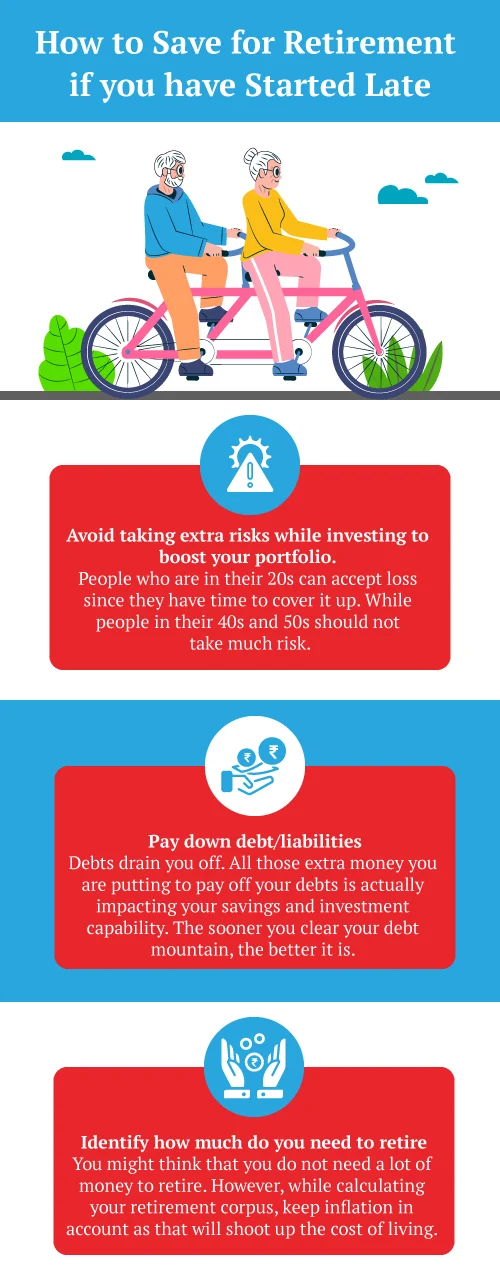
So, to have this desired income, you need to invest about 10-12% of your income from the time you turn 30.
But if you believe you can manage with a lesser income, say 80% of your income at the age of 30, then this rate can go down.
This stage occurs when you are near your retirement age. The preservation stage starts after you turn 50. You make efforts to preserve the money you have already accumulated in the years that have passed.
You would not want your portfolio to go down this close to retirement. That is why at this stage, you need to review your investments as most of them will start to mature.
This stage is less concerned with having more growth and more with sustaining the growth already made.
At 50, there are possibilities that most of your major goals would be met. If they are, then you can save even more of your income in your retirement fund to give it an extra push. You can even start an additional investment to supplement your retirement income.
At this stage, a budget should be created, keeping the following consideration in mind
Are there any debts that need to be settled?
Basic living expense
Any major expense coming up, for example, house repairs
Stock market volatility
This is the stage where you essentially attain your retirement age. At this point, you need to evaluate your financial position and personal goals to decide between the two options:
Whether to retire:
Continue working for some time
This stage is not just about age; it’s about readiness. Whether you stop working now or extend your career a bit longer, your decision should align with both your financial preparedness and the lifestyle you wish to maintain in retirement.
This is the age at which the majority of the Indian population retires. You can retire at this age if you are satisfied with the corpus you have created. If you can live the same lifestyle without any concessions, then retiring at 60 is suitable.
Many government and private sector jobs in India also have 60 as the standard retirement age, which means the salary stops, and pension or retirement benefits begin. This transition makes it even more important to review your financial situation thoroughly. If you have planned well, cleared major liabilities, and accounted for health care and emergency funds, retiring at this stage can offer you peace of mind and the freedom to focus on personal goals and interests.
Learn how to plan for your retirement at 50.
If you believe you need a larger corpus or have some goals after retirement that might need extra money, you can hustle at work some more. Working some more can increase your corpus considerably, as your amount will stay untouched for 4-5 years more and will reap the benefits of compounding.
It is better to make sure that all your debts are paid off and you are at least close, if not at the desired level of your retirement fund, before you make your decision.
This phase starts after you retire. At this stage, your income has stopped. The efforts you have put in over the years to create a retirement fund and other investments will finally come to your help at the distribution phase.
The success of the accumulation and preservation stage is judged here, as your savings now determine how comfortably you can manage expenses, healthcare, and emergencies without financial stress.
Retirement is a long-term journey with changing needs at every stage. From building your corpus to managing withdrawals and unexpected expenses, each phase demands a different approach to budgeting. By planning early, reviewing regularly, and adjusting your budget as you move through the phases, you can enjoy a secure and stress-free retirement.
Choosing the right retirement plan also plays a key role. Retirement plans by Canara HSBC Life Insurance offer flexible options that help you build a steady income stream, safeguard your savings, and prepare for unforeseen costs. These features can make a real difference when your regular income stops.
No matter when you begin, staying financially disciplined and phase-ready can ensure that your retirement years are truly your golden years.
Disclaimer - This article is issued in the general public interest and meant for general information purposes only. The views expressed in this blog are solely those of the writer and do not necessarily reflect the official policy or position of Canara HSBC Life Insurance Company Limited or any affiliated entity. We make no representations or warranties of any kind, express or implied, about the completeness, accuracy, reliability, suitability, or availability with respect to the blog or the information, products, services, or related graphics contained in the blog for any purpose. Any reliance you place on such information is therefore strictly at your own risk. You should consult with a qualified professional regarding your specific circumstances before taking any action based on the content provided herein.







We bring you a collection of popular Canara HSBC life insurance plans. Forget the dusty brochures and endless offline visits! Dive into the features of our top-selling online insurance plans and buy the one that meets your goals and requirements. You and your wallet will be thankful in the future as we brighten up your financial future with these plans.