5 Reasons to Save Money for the Future

5 Reasons to Save Money for the Future

Know 5 reasons to save money for the future, covering financial security, emergencies, goal planning, retirement readiness and income stability.

Written by : Knowledge Center Team

2025-11-06

1289 Views

6 minutes read

Financial stability plays a key role in leading a secure and fulfilling life. Among the most powerful habits of financially independent individuals is saving before spending. Building a disciplined saving routine prepares you for future needs while helping you achieve long-term goals.

While there are many ways to save, choosing the right tools can amplify your efforts. One such effective tool is a life insurance plan, which not only offers life insurance coverage but also helps build savings for the future. This blog will guide you through the reasons why saving money for the future is essential. Keep scrolling through to know the details.

Key Takeaways

  • Saving money is essential for protection against life’s financial uncertainties.

  • Consistent savings habits lead to long-term wealth creation and financial independence.

  • Early saving opens up possibilities for early retirement and stress-free living.

  • Government-backed schemes, such as NSC, PPF, and SCSS, offer safe returns.

  • Savings reduce your reliance on debt and build financial resilience.

Why Save Money for the Future?

Uncertainties in life are inevitable and unpredictable. Any future emergency may lead to a loss of surplus money from your pocket, preparing well in advance to tackle such problems is necessary. Saving money today ensures that you and your family remain protected tomorrow. Here are some of the important reasons why save money is becoming crucial nowadays-
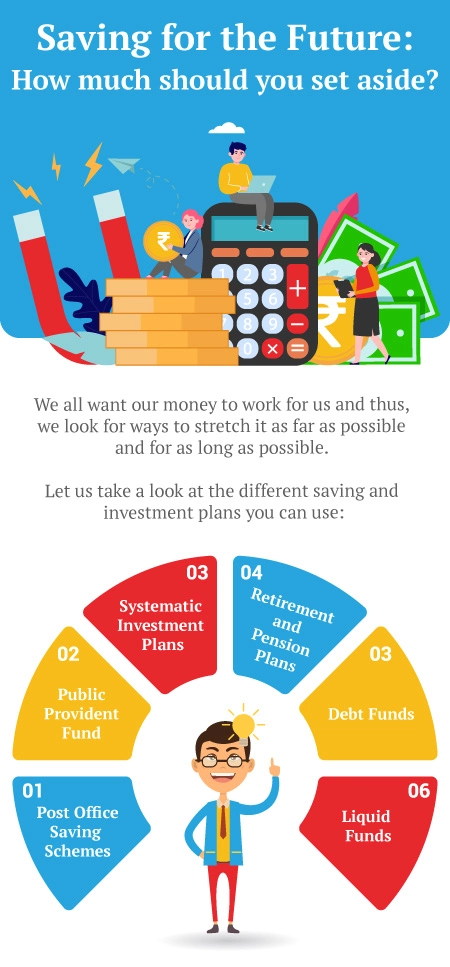
  • Gives Protection: Saving money for the future gives you protection against unexpected circumstances. With each penny saved, you ease a moment of your future. Money plays a vital role in an individual’s life, whether they are poor or rich; no one knows what will happen the next day. Even if you lose your job but have savings, you can survive while looking for another job. Savings work when you don’t work.
  • A Debt-Free Life: Savings help achieve goals and help pay off the mortgage early and live a debt-free life. Living life below your means can give you plenty of room to save. Through savings, one can also pay down debt from friends, family, or even other lenders. The bigger the amount saved, the earlier you can achieve a debt-free life.
  • Early Retirement: Most of the savings plans are retirement plans where one saves money to invest in life after retirement. People saving early can end up retiring early. Putting savings to retirement funds is a pathway for a stress-free future.
  • Improve Financial Being: A saving habit will indeed improve your life. It also avoids you from debts, overspending, resisting the temptation to spend on expensive and useless things, reduces the stress of thinking of your financial obligation and financial struggle.
  • Start Investing: After a good amount of money is saved, you can immediately start investing. You can also try buying stocks with your savings. Let your money make more money for you.

10 Best Saving Plans and Schemes for a Secure Future

Choosing the best money-saving plan is essential. One should look for a plan that offers maximum returns with minimum risks. Only after proper analysis and research, you should finalize a money-saving plan. Here are some savings schemes offered by the government, financial companies, and banks that encourage investors to invest more and earn high returns.

S. No.Savings PlansInterest Rate
1National Savings Certificate7.7%
2Senior Citizen Savings Scheme8.2%
3Recurring Deposits3-8.5%
4Post Office Monthly Income Scheme (POMIS)7.40%
5Public Provident Fund (PPF)7.1%
6Kisan Vikas Patra (KVP)7.5%
7Sukanya Samriddhi Yojana (SSY)8.2%
8Atal Pension YojanaN/A
9Employee Provident Fund (EPF)8.25%
10Pradhan Mantri Jan Dhan Yojana (PMJDY)2% above base rate not exceeding 12%
  1. National Savings Certificate (NSC): It is a fixed-income savings plan that can be opened with any post office in India. National Saving Certificate is an initiative of India's government to encourage investors mainly from small or mid-income categories to invest their money while saving on income tax. It is a low-risk investment and gives fixed returns. The minimum age requirement for a money investor is 18 years. For minors, a joint account can be opened with an adult.

    One main advantage is that there is no limit on the maximum number of NSCs that one can purchase. An investment up to Rs. 1,50,000 annually in this plan can earn a tax break, as per Section 80C of the Income Tax Act. The investor can even nominate a family member for the savings plan, even if the family member is minor. The NSC savings plan is free to open by anyone except Hindu Undivided Families (HUFs), trusts, and non-resident Indians.
  2. Senior Citizen Savings Scheme: It is an excellent tax-saving investment plan. It offers its investors very high safety, regular income. This savings scheme is available through post offices and verified banks across India. It is for senior citizens aged at least 60 years, although individuals between 55 to 60 can also invest if they have chosen the Voluntary Retirement Scheme or Superannuation.

    The investment should be made within a month after receiving the retirement benefits. There's also an option for investment for retired defence personnel aged 50 or above. In SCSS, tax deduction up to ₹ 1,50,000 can be claimed as per Section 80C of the Indian Income Tax Act. It is one of the safest and most reliable schemes, as it is under the sponsorship of the Indian government.
  3. Recurring Deposits: It is a term deposit offered by banks. This money-saving plan requires regular deposits and upon maturity, generates substantial returns. Individuals have the freedom to choose the period, the amount, and the number of monthly deposits as per their convenience. It is one of the savings plans where mid-term and premature withdrawals are not allowed, and if anyone requires an early withdrawal, the bank may charge a penalty.
    It offers high interest rates for senior citizens and also be used as collateral for taking loans. The main drawback is that the monthly amount you decide on cannot be changed, and thus, you need to have a steady income source to opt for their savings plan.
  4. Post Office Monthly Income Scheme: It is a low-risk monthly income scheme where a small amount is invested, and interest is paid monthly. It also generates a steady income while the money invested is completely safe until it matures since the Government sponsors the scheme. You can either withdraw the amount or invest again in the scheme after the maturity period is reached.
  5. Kisan Vikas Patra: A money-saving plan by the Indian Post Office, under which the minimum investment required is ₹ 1000. This plan was initially implemented to support farmers and was exclusive to them, but it is now available to everyone. This plan is not subject to market fluctuations and thus offers guaranteed returns. The returns are taxable. 
  6. Public Provident Fund: It is the safest and most popular government-backed savings option in India. The PPF benefits are payable in lump sum form or up to 12 instalments per financial year. It is a flexible savings option as one can also transfer the PPF account from one post office or bank to another.
  7. Sukanya Samriddhi Yojana: A saving scheme introduced by the Indian Ministry of Finance, specially designed to secure the girl child's future. One can open an SSY account at any authorised bank or post office in India. It is highly flexible since the account can be transferred from one post office or bank to another within India.
    Read more about Sukanya Samriddhi Yojana.
  8. Atal Pension Yojana: A money-saving scheme initiated by the Government, specially designed for the welfare of the weaker section of society. This yojana or scheme provides people with a monthly income when they are no longer able to earn a living. The subscriber is eligible to receive the tax benefit for the contribution, up to a specified ceiling, and also for the investment returns on such contributions. A subscriber is eligible for only one individual account.
  9. Employee Provident Fund: It is one of the popular saving schemes launched under the Government of India. Its main aim is to build a sufficient retirement corpus for an individual. Under this scheme, both the employee and the employer contribute equallye to the Employee Provident Fund. Also, the contributions made to the Employee Provident Fund are exempt from tax.
  10. Pradhan Mantri Jan Dhan Yojana: A scheme that is more concerned with providing access to various financial services including remittance, credit, insurance, pension, banking savings & deposit accounts under affordable rates. Under this scheme, both urban and well as rural areas are covered. No minimum balance is required to open an account under this yojana.

Start Saving Smart, Grow Wealth Faster

Please enter correct name Please enter the Full name
Please enter valid mobile number Please enter Mobile Number
Please enter valid email Please enter Email

Enter OTP

An OTP has been sent to your mobile number

Didn’t receive OTP?

Application Status

Name

Date of Birth

Plan Name

Status

Unclaimed Amount of the Policyholder as on

Name of the policy holder

Policy Holder Name

Policy No.

Policy Number

Address of the Policyholder as per records

Address

Unclaimed Amount

Unclaimed Amount
Error

Sorry ! No records Found

.  Please use this ID for all future communications regarding this concern.

Request Registered

Thank You for submitting the response, will get back with you.

Conclusion

Saving money for the future is very important. The money-saving plan is also a source of wealth creation. You must have in-depth knowledge of the different savings plans and schemes available in the market as most of these schemes are subject to market risk. The choice of a suitable plan or scheme depends on financial objectives, period, risk level, and return rates, among other factors. A money-saving plan isa passive way to save money and achieve your life's desires, while maintaining a fulfilling life after retirement. Saving money is a necessity of the time, and it will indeed be very useful for you and your family in the future

With the added advantage of life insurance plans from Canara HSBC Life Insurance, you can protect your loved ones while growing your money strategically. Take the first step today by choosing a savings plan that aligns with your life goals. Your future self will thank you.

Disclaimer - This article is issued in the general public interest and meant for general information purposes only. The views expressed in this blog are solely those of the writer and do not necessarily reflect the official policy or position of Canara HSBC Life Insurance Company Limited or any affiliated entity. We make no representations or warranties of any kind, express or implied, about the completeness, accuracy, reliability, suitability, or availability with respect to the blog or the information, products, services, or related graphics contained in the blog for any purpose. Any reliance you place on such information is therefore strictly at your own risk. You should consult with a qualified professional regarding your specific circumstances before taking any action based on the content provided herein.

Recent Blogs

Our Top-Selling Insurance Plans

We bring you a collection of popular Canara HSBC life insurance plans. Forget the dusty brochures and endless offline visits! Dive into the features of our top-selling online insurance plans and buy the one that meets your goals and requirements. You and your wallet will be thankful in the future as we brighten up your financial future with these plans.