



everything-you-should-know-about-national-saving-certificate

Everything you Should Know about National Saving Certificate

Let’s learn how NSC helps you save safely and grow your money with tax benefits.

Written by : Knowledge Center Team

2025-11-10

1207 Views

5 minutes read

Saving money helps you build a strong financial base, but to grow your money, you also need to invest it wisely. Today, it’s easy to invest with options like savings and life insurance plans. One simple and safe choice is the National Savings Certificate (NSC). It’s backed by the government and offers steady returns, along with tax benefits. 

Let’s understand what NSC is and how it can help you save and grow your money.

Key Takeaways

  • NSC offers a safe and government-backed way to grow your savings with fixed returns.

  • NSC offers tax deductions up to ₹1.5 lakh annually under Section 80C.

  • NSC is ideal for conservative investors with a 5 or 10-year lock-in period for disciplined savings.

  • Flexible holding options make NSC suitable for both individual and joint investors.

  • Premature withdrawal is allowed only in specific cases, ensuring long-term financial commitment.

What is a National Saving Certificate?

The National Savings Certificate (NSC) is a popular fixed-income security aimed at promoting savings and investment among the country's people. The Government of India fosters these savings schemes through its. Post Offices. It is a secure and low-risk product suitable for small and medium-income investors to save tax while earning returns.

The post office delivers two types of NSC or issues two methods for individual investment.

NSC Issue - VIII:

NSC Issue VIII with a maturity period of 5 years. The interest rate offered by this category of NSC is slightly lower than the interest rate given by NSC IX. NSC Issue VIII comes in denominations ranging from ₹100 to ₹10,000.NSC Issue VIII aims to offer an investment option for those seeking to invest in safe instruments while also availing tax benefits. The investor can start with a small investment and gradually increase the amount.

NSC Issue - IX:

NSC Issue IX features a distinguishing 10-year maturity period. The interest rate offered by NSC Issue IX is slightly higher than the interest rates offered by NSC VIII.

NSC Issue IX also offers denominations ranging from ₹100 to ₹10,000.

What are the 3 Types of Holdings in NSC?

You can hold an NSC in different ways. It can be just in your name or shared with someone else. Here are the three types:

  1. Single Holder Type Certificate: Only one person can hold this type of certificate. Only individuals can issue such type certificates, and joint holders are prohibited.
    Nominees can be appointed, but all the decisions are made by the individual on whose name the certificate has been issued. Certificates are only issued to adults. Nominees can also be chosen in a life insurance policy. When the policyholder passes away, the death benefits are given to the nominees, otherwise known as beneficiaries.

    Know all about the nominee in a life insurance plan.

  2. Joint 'A' Type Certificate: Certificates issued to two adults are categorised under a Joint 'A' Type certificate. After maturity, the amount is received by both the joint certificate holders.
    In the event of any legal changes, such as the transfer or cancellation of the certificate, or a change of nominee, the signatures of both holders are required. It must be a mutual decision.
  3. Joint 'B' Type Certificate: In this kind of certificate, the Joint B type pays the maturity value to any two joint certificate holders. It is the main distinctive difference. This is contrary to the maturity payment to both the certificate holders in a joint type holding, as mentioned above. Apart from this, all the other features remain the same in A and B-type joint certificates. Both types can be operated and held by two adult joint certificate holders.

How Does a National Savings Certificate Work?

National Savings Certificate (NSC) is a simple and government-backed investment option available through post offices. It enables individuals to save regularly while earning a fixed interest rate over time.

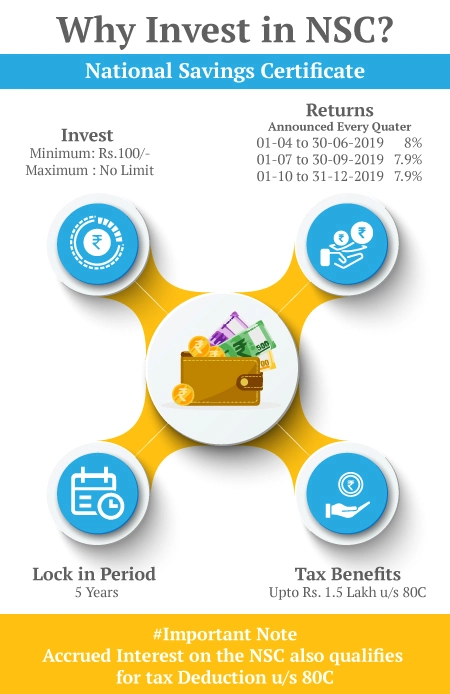
  • Easy to Start and Accessible: To invest in NSC, simply visit the nearest post office and deposit the desired amount. There is no upper limit for investment, making it suitable for all types of investors.
  • Interest Calculation and Maturity: NSC comes with a maturity period of 5 or 10 years, depending on the chosen scheme. The current interest rate is 7.7% per annum, compounded annually, but paid out only at maturity. This reinvestment of interest helps your savings grow steadily over time.
  • Returns and Comparisons: Although the interest is received at the end of the term, it is compounded annually. NSC offers better interest rates compared to other fixed-income options, such as PPF or tax-saving fixed deposits.

Who is Eligible for NSC?

The National Savings Certificate (NSC) is designed to encourage individuals in India to save and invest securely.

Here’s who can and cannot invest in NSC:

  • Resident Individuals: Any Indian resident can invest in an NSC, making it an ideal option for salaried individuals, business owners, and retirees. It offers a safe, government-backed way to earn fixed interest while enjoying tax benefits. You can start with a small amount, and there’s no upper limit, making it a flexible option for long-term financial planning.
  • Minors: Parents or legal guardians can invest in NSC on behalf of a minor. The certificate will be in the child’s name, but the guardian will manage it until the child reaches maturity. Upon maturity, the proceeds are paid to the minor. This is a great way to build a secure fund for a child’s future education or other needs.
  • Joint Holders: Two adults can jointly invest in an NSC under either Joint Type A or Joint Type B. In Joint A, both holders receive the maturity amount. In Joint B, either one can receive it. Both types require mutual consent for changes. This option is suitable for couples or partners who plan to achieve a shared financial goal.

What are the NSC Withdrawal Rules?

The National Savings Certificate (NSC) is a long-term investment option with a 5-year lock-in period. Withdrawals before maturity are generally not allowed. However, the scheme allows for early encashment under specific conditions. Let’s understand each withdrawal scenario in detail below.

  •  Lock-in Period Requirement: NSC investments come with a fixed lock-in period of five years, which means you cannot withdraw the invested amount before it matures. This rule ensures financial discipline and long-term commitment. It is especially beneficial for conservative investors looking to grow their savings securely over time. Staying invested until maturity allows you to enjoy the full interest benefits and tax savings under Section 80C of the Income Tax Act.
  • Death of the Certificate Holder: If the person holding the NSC passes away, premature encashment is allowed. This applies to single holders or one of the joint holders. The legal nominee or joint holder can claim the investment before the maturity period. The death certificate and proof of identity are required during the claim process. 
  • Withdrawal on Court Order: NSC investments can be prematurely withdrawn if directed by a court of law. This typically occurs during legal proceedings, such as property disputes, financial settlements, or cases involving insolvency. The court’s order must mention the NSC details and withdrawal terms. Only upon submission of this official order can the post office permit early encashment of the certificate, even before its full five-year term has expired.
  • Forfeiture by a Gazetted Pledgee: If the NSC is pledged as security and the pledgee is a Gazetted Government Officer, the certificate can be forfeited and withdrawn before maturity. This situation usually arises when the investor defaults on a loan or commitment. 
  • No Interest if Withdrawn Within 1 Year: If you withdraw your NSC within one year of purchase, you will not receive any interest. The post office will return only your principal amount. This rule ensures investors stay committed for longer durations. 

Conclusion 

The National Savings Certificate is a trusted choice for secure and disciplined savings. However, if you're seeking additional benefits, such as life cover, guaranteed returns, and tax savings in one plan, Canara HSBC Life Insurance offers smart savings solutions tailored to your goals. Start planning today for a future that's protected and financially strong.

Disclaimer - This article is issued in the general public interest and meant for general information purposes only. The views expressed in this blog are solely those of the writer and do not necessarily reflect the official policy or position of Canara HSBC Life Insurance Company Limited or any affiliated entity. We make no representations or warranties of any kind, express or implied, about the completeness, accuracy, reliability, suitability, or availability with respect to the blog or the information, products, services, or related graphics contained in the blog for any purpose. Any reliance you place on such information is therefore strictly at your own risk. You should consult with a qualified professional regarding your specific circumstances before taking any action based on the content provided herein.

Our Top-Selling Insurance Plans

We bring you a collection of popular Canara HSBC life insurance plans. Forget the dusty brochures and endless offline visits! Dive into the features of our top-selling online insurance plans and buy the one that meets your goals and requirements. You and your wallet will be thankful in the future as we brighten up your financial future with these plans.

Recent Blogs