Written by : Knowledge Centre Team
Last published : 2026-07-24
7 minutes read
Share

Saving money, or ‘saving habit’ - as Napoleon Hill put in 70 years ago in his book "Think and Grow Rich" - is the keystone of all financial success. Saving money is what delivers the means for you to take advantage of situations -- whether it is starting a new business, going back to college, or buying shares of stock when the market crashes.
While there is no lower age limit to start saving money, a young age is the best time to start saving money. Nevertheless, most people of the younger generation are fond of spending money, but a little saving can take you places in life. A lot of people believe that saving up for the future means living a frugal life. However, this isn’t entirely true, as you can also spare some room for entertainment in your budget.
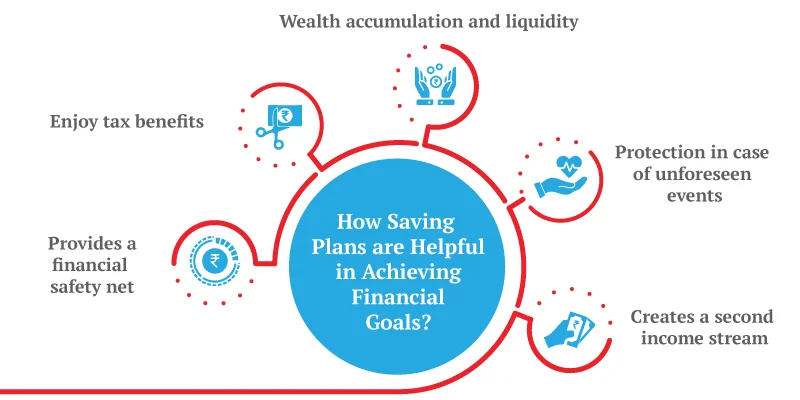
You can buy life insurance cum savings plan or choose to use different saving schemes to boost your financial fitness. Listed below are a few saving schemes that you may consider to include in your financial planning:
Purpose: saving
Interest: 5.5% - 7.5%, guaranteed returns
Minimum Investment: Varies from bank to bank
Maximum Investment: No limit
For a long time now, fixed deposits have been one of the popular savings option. They are bank-based investment products and closely monitored by RBI, assuring safety. They are low-risk investments. You can invest at a particular time and acquire a fixed interest rate with a five-year lock-in period.
Fixed deposits offer a higher interest rate than savings bank accounts and allow only a one-time lump sum deposit. Under section 80C of the income tax act, investments up to INR 1,50,000 are eligible for tax redemption.
Purpose: Regular Savings
Interest: 4.5% - 6.5%, guaranteed returns
Minimum Investment: INR 500
Maximum Investment: INR 1 Lakh per month
A recurring deposit is a tenure deposit offered by banks. RDs allow investors to deposit money regularly and avail returns upon maturity. With RDs, investors get to choose their term period, the amount they wish to deposit, and the number of deposits. Their savings plan period varies from 7 days to 10 years.
Premature withdrawals are allowed with a penalty and can be used as loan collateral. They also offer better interest rates to senior citizens, but do not allow you to change your monthly investment amount.
Purpose: Retirement
Interest: 7.10% (April - June 2020), guaranteed returns
Minimum Investment: INR 500
Maximum Investment: INR 1,50,000
PPF, one of the most popular savings plans, is a post office savings scheme and is backed by the government. You cannot have multiple accounts, and returns from PPFs are completely tax exempted. They allow you to pay investments in a single deposit or up to 12 deposits per financial year.
PPF gives you a lock-in period of 15 years and is easily transferable from one bank or post office to another. Any Indian citizen can obtain the benefits of this savings plan. Nevertheless, HUFs and NRIs are not eligible.
Purpose: Short term savings
Interest: 6.5% - 7.5%(Historical returns)
Minimum Investment: INR 500
Maximum Investment: No limit
Liquid mutual funds invest in short-term market instruments such as treasury bills, government securities, and call money. They invest in low-risk securities that have maturity up to 91 days. Liquid mutual funds are alternative to FDs and savings accounts in which you can invest surplus money for a short time.
In liquid funds, short term capital gains are added to investor’s taxable income, and long term capital gains are subjected to 20% tax with indexation benefits.
Purpose: Wealth creation through equity
Returns: Market linked (12 -15% historical returns)
Minimum Investment: INR 500
Maximum Investment: No limit, but can save tax only INR 1.5 Lakhs investment per financial year.
Indian citizens (including Non-Resident Indians) can invest in ELSS funds. ELSS are equity mutual funds that invest over market capitalization and sectors and have a lock-in period of 3 years.
You can invest in these funds even after a 3-year lock-in without the need to withdraw your investments. You will be charged an expense ratio on the NAV of the fund, and no premature withdrawals are allowed.
Purpose: Long term wealth creation
Interest/Growth Rate: 12% - 15% (Historical returns)
Minimum Investment: Lump sum INR 500 - INR 5000; SIP INR 500
Maximum Investment: No limit
Equity funds invest in stocks/equities, and each fund has to invest based on the investment objective. You can link your investments to a goal and invest towards it, and the returns are taxed based on the holding period. In this scheme, short-term capital gains are taxed at 15%, and long-term capital gains are taxed at 10 % and come with exit loads.
These funds are best suited for long-term goal-based investing as they offer significant returns only when invested for the long-term.
You should start saving at an early age to accelerate your wealth building game. Choose a saving plan or scheme after assessing your financial needs and goals. Explore all the available options, weigh their pros and cons before finalizing on any of the plan. Understanding your needs will help you to find the right type of savings plan and will benefit you in the long run.
An OTP has been sent to your mobile number

Sorry ! No records Found
Thank You for submitting the response, will get back with you.
Thank you for your interest in our product. Our financial expert will connect with you shortly to help you choose the best plan.
Disclaimer - This article is issued in the general public interest and meant for general information purposes only. The views expressed in this blog are solely those of the writer and do not necessarily reflect the official policy or position of Canara HSBC Life Insurance Company Limited or any affiliated entity. We make no representations or warranties of any kind, express or implied, about the completeness, accuracy, reliability, suitability, or availability with respect to the blog or the information, products, services, or related graphics contained in the blog for any purpose. Any reliance you place on such information is therefore strictly at your own risk. You should consult with a qualified professional regarding your specific circumstances before taking any action based on the content provided herein.






We bring you a collection of popular Canara HSBC life insurance plans. Forget the dusty brochures and endless offline visits! Dive into the features of our top-selling online insurance plans and buy the one that meets your goals and requirements. You and your wallet will be thankful in the future as we brighten up your financial future with these plans.