Written by : Knowledge Centre Team
Last published : 2026-07-29
8 minutes read
Share

ULIPs, or Unit Linked Insurance Plans, are versatile wealth-building options from life insurers. ULIPs pack a punch when it comes to investing and allow investors to create and manage their multi-asset portfolios. ULIPs are one of the rare investment options which can fulfil all three objectives of investment through a single investment plan:
Inbuilt portfolio management features of ULIPs help you achieve these three objectives, especially the wealth creation goal. But, why do you need a portfolio management strategy? How is it different than investing in a single instrument? Wouldn’t it be better if we can invest in one place and simply hold for a long time?
Viren and Hema are colleagues working and earning almost the same amounts. Their savings and investments are also identical – 50:50 equity and debt investments. However, there is one key difference:
In steady equity markets, both portfolios of both Hema and Viren would look almost identical. But, when the markets see a downtrend and then regain upward movement, Hema’s portfolio will see better gains than Viren.
This is simply because Hema readjusted her portfolio to the changing risk scenario in the equity market. She moved some money to equity funds from her debt holdings and when the markets recover; her equity portfolio would register more gains.
After the gains she will again readjust the portfolio to bring the debt-equity ratio back to 50:50; i.e. transferring the gains from equity markets to safer debt investments. This is why you need portfolio management. In short, portfolio management will help you:
Remember your rate of return on investment is a result of the risk in the investment. The higher the risk, the higher the return on investment. But, you need to keep your portfolio’s risk as close to your comfort level as possible.
If your portfolio risk is too low, your investment growth will suffer. If it’s too high, your peace of mind will suffer and so the chances of loss will increase.
Therefore, balancing your portfolio risk-return profile is the key to long-term success with investments. This is what portfolio management will help you achieve.
If investment management is not something you want to do full time, you need to consider automating most of your investment transactions. While you can easily automate investing by allowing auto-debit from your bank account, automating portfolio management could be difficult.
But, with ULIPs like Promise4Growth Plus plan from Canara HSBC Life you can automate even the portfolio management. Promise4Growth Plus offers you four different portfolio management strategies to manage your asset allocation.
The best part is despite the automation you can have full control over your portfolio and intervene when you see the opportunity. You can also change the strategy within the policy duration.
But, once you choose a portfolio strategy, the plan will automatically manage and adjust your asset allocation regularly. This is why ULIPs can be your personal portfolio manager.
Portfolio management in ULIPs can help you tackle the market risk and exploit the market opportunities with minimum involvement.
Promise4Growth Plus ULIP plan from Canara HSBC Life offers four different strategies to manage your portfolio:
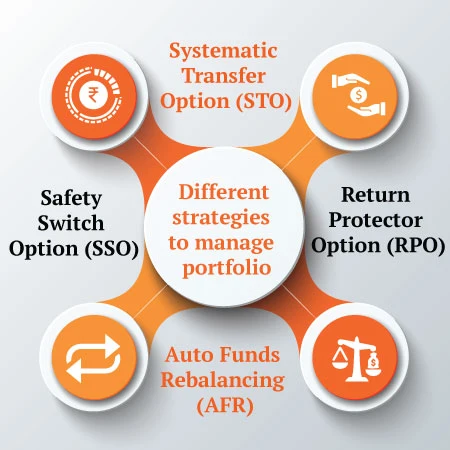
Systematic transfer means a gradual flow of funds from one asset to another. In the case of Promise4Growth Plus, the money is moved from liquid fund to an equity fund.
The systematic transfer allows your lump sum investment into the plan to benefit from rupee cost averaging while getting into the equity funds. Rupee cost averaging means you receive more units when the markets are low and lesser units when markets are high. Thus, reduce your average cost of units in the fund.
When you invest your funds in the plan, your entire investment is saved in a liquid fund. Every month the plan will liquidate 12th part of total allocated units (in the beginning) and then use the funds to purchase equity fund units.
If you do not want to invest in monthly mode, you can use this strategy to create the rupee cost averaging for your equity allocation.
Money is transferred from equity funds to debt fund. This transfer is not systematic but depends only on the gains of equity fund allocation. Once the fund value grows to a set threshold, the gain is moved to a debt fund.
Return protector helps you collect your gains from the equity funds. But does not increase your risk when equity markets don’t perform well. This strategy will gradually reduce your equity fund allocation and thus, your portfolio risk.
You can fix a return percentage for your equity fund allocation between 5-10%. The moment your equity fund allocation gains 5% (the fixed return value) the profit will be booked and transferred to debt fund.
If you want your portfolio risk to go down as you age, this strategy is perfect.
This strategy works on a fixed asset allocation ratio. Once you fix the ratio of equity, debt and liquid assets in your overall portfolio the plan will adjust your allocation every three months to match the ratios.
Auto rebalancing achieves the dual objective of keeping your portfolio risk stable while exploiting the market opportunities. Thus, you can consider this strategy the better of the three for wealth accumulation goals.
You fix the allocation ratio for debt, equity and liquid funds, say 50:30:20, or distribute only between equity and debt. The plan will revisit the allocation every three months and readjust the asset allocation to the decided ratios.
For example, after three months your allocation changes to 55:28:17. The plan will liquidate the gains in equity funds and distribute it to debt and liquid funds.
This strategy is great when you have 10+ years to stay invested and build your corpus. It works better for wealth creation goals and long-term financial goals.
This strategy simply helps you save your accumulated corpus from market volatility in the final 4 years of your policy. The plan will gradually move your entire holding to liquid funds systematically over 4 years.
The safety switch option protects your accumulated corpus from market fluctuations as you close in on your financial goal. You can use this strategy with the other three strategies to ensure your gains on the high-risk allocations remain safe near the maturity.
In the last four policy years, the plan rebalances the portfolio at the beginning of each year. The rebalancing ensures that liquid funds allocation matches the scheduled weightage of 30%, 60%, 90% and then 100% for the last 4 policy years.
You can use this strategy with any of the other three strategies. If you use this strategy, in the last four policy years, only this strategy will be active.
An OTP has been sent to your mobile number

Sorry ! No records Found
Thank You for submitting the response, will get back with you.
Thank you for your interest in our product. Our financial expert will connect with you shortly to help you choose the best plan.
Disclaimer - This article is issued in the general public interest and meant for general information purposes only. The views expressed in this blog are solely those of the writer and do not necessarily reflect the official policy or position of Canara HSBC Life Insurance Company Limited or any affiliated entity. We make no representations or warranties of any kind, express or implied, about the completeness, accuracy, reliability, suitability, or availability with respect to the blog or the information, products, services, or related graphics contained in the blog for any purpose. Any reliance you place on such information is therefore strictly at your own risk. You should consult with a qualified professional regarding your specific circumstances before taking any action based on the content provided herein.








Canara HSBC Life Insurance offers online ULIP plans that blend life insurance protection with investment growth, helping you build wealth while securing your family's future.
