how-to-use-recurring-investment-strategies-to-build-wealth

How to Use Recurring Investment Strategies to Build Wealth?

Recurring investments help build wealth through discipline, compounding, and market averaging, making them effective for long-term financial goals.

Written by : Knowledge Centre Team

2025-11-02

979 Views

8 minutes read

There is no rocket science behind building wealth. All you need to do is to understand the power of compounding. Your regular savings plans can gradually multiply into a sizeable corpus due to the compounding interest applying to them. Various practical investment approaches can help you grow your wealth. One of them is recurring investments strategies.

A recurring investment is a type of activity where you can invest a fixed amount of money into a particular investment plan. Investment plans which allow recurring investments also help you build wealth at your own pace.

5 Benefits of Recurring Investment Strategies

A recurring investment strategy has many benefits. Some of the prominent benefits include:

  1. Simple to Follow: The most obvious benefit of making recurring investments is they are very convenient. You just need to save a fixed amount from your monthly income and invest it in one of the investment plans that is suitable for you as per your risk appetite.
  2. Maximizes your Savings: Evidently, the recurring investment strategies encourage you to save more. Besides, they maximize your savings at a compounding rate of interest. The small, fixed sums that you invest in the recurring investment plans may gradually multiply into a substantial retirement corpus one day.
  3. Maximizes your Investments: Recurring investment instruments such as equity or debt mutual funds maximize your investments at an exponential rate as compared to low-risk investments such as bank FD or PPF.
  4. Maximizes your Tax-saving: There is no rocket science behind compounding wealth. If you save regularly over a long period, you will be able to maximize your savings corpus in the long run.

    If you invest more savings into various tax-saving instruments such as ULIPs, NPS, ELSS, PPF, etc., you can claim tax deductions on them u/s 80C of the Income Tax Act. This way, you can maximize your tax savings.
  5. Rupee Cost Averaging: Another major benefit of recurring investment, particularly SIPs is the Rupee cost averaging.

What is Rupee Cost Averaging?

Rupee cost averaging is the key benefit of any recurring investment strategy. This benefit is more useful in the case of high-risk or volatile investments like equity stocks or funds.

Rupee cost averaging refers to the resulting average purchase price as you continue to invest the same amount at different fund NAVs. As you receive fewer units at higher rates and more at lower rates, your overall average cost comes down.

Your aim is to eventually get the average cost of your fund units lower than the average price (NAV) of the fund. This way even in a level market, your portfolio will remain profitable.

Also, you can avoid the complex or even impossible duty of trying to figure out the exact best time to invest.

How Does Rupee Cost Averaging Work?

Rupee cost averaging works best in volatile investment plans like equity funds. For example, have a look at the table below:

If you invest in an equity fund through SIPs here’s how your unit allocation will work:

MonthSIP Amount (₹)Fund NAVUnits ReceivedPortfolio Value
Jan-202,000100202000
Feb-202,00050403000
Mar-202,000100208000
Apr-202,00050406000
May-202,0001002014000
Jun-202,00050409000
Total12,000 180

The average NAV of the Fund in the past six months: Rs 75
The average NAV of portfolio: Rs. 66.67

Thus, the average cost of the portfolio goes below the market average. This gap will continue to increase as you continue the SIP into the fund.
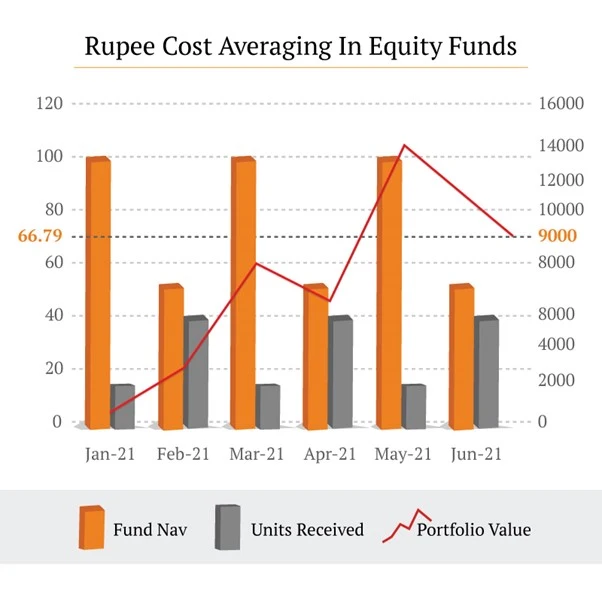
Rupee cost averaging ensures that your portfolio value keeps increasing even when the market remains stagnant.

Recurring Investment Strategy in ULIPs

ULIPs have features to allow recurring investment for every investor. Whether you want to invest monthly, quarterly or annually, if you invest in ULIP you have the option of a recurring investment strategy. Here’s how:

  1. Monthly Premium Payment: ULIPs allow you to invest your money in different modes including monthly. When you choose the monthly premium payment mode, you automatically receive the benefit of recurring investment, i.e. rupee cost averaging.
    Also, even if you are allocating all your investment to a debt fund in ULIP, you can receive the same tax benefits.
  2. Systematic Transfer Option: Canara HSBC Life Insurance Promise4Growth Plus comes with a Systematic Transfer Option. This option allows you to benefit from the recurring investment strategy even while you are investing in a lump sum.

For example, if you can only invest once a year, the systematic transfer will ensure that your funds are allocated to equity funds as SIP.

Under this option, your entire annual premium will be allocated first to a liquid fund in the policy. Afterwards, the units in the liquid funds will be systematically transferred to the equity funds you chose. The transfer occurs every month over the next 12 months. Thus, about 1/12th of your annual allocation to equity fund will be invested in the equity fund, same as a monthly SIP.

Your Fund Value available in the Liquid Fund at the start of every month shall be transferred to the 'Target STO Fund' by cancelling Liquid Fund units and purchasing units in the 'Target STO Fund'. This will continue till the availability of your Liquid fund units.

These are some of the ways how a ULIP can work as one of the best recurring investment strategies.

Get a Personalised ULIP Plan for Wealth Creation & Protection

Please enter correct name Please enter the Full name
Please enter valid mobile number Please enter Mobile Number
Please enter valid email Please enter Email

Enter OTP

An OTP has been sent to your mobile number

Didn’t receive OTP?

Application Status

Name

Date of Birth

Plan Name

Status

Unclaimed Amount of the Policyholder as on

Name of the policy holder

Policy Holder Name

Policy No.

Policy Number

Address of the Policyholder as per records

Address

Unclaimed Amount

Unclaimed Amount
Error

Sorry ! No records Found

.  Please use this ID for all future communications regarding this concern.

Request Registered

Thank You for submitting the response, will get back with you.

Thank you for your interest in our product. Our financial expert will connect with you shortly to help you choose the best plan.

Disclaimer - This article is issued in the general public interest and meant for general information purposes only. The views expressed in this blog are solely those of the writer and do not necessarily reflect the official policy or position of Canara HSBC Life Insurance Company Limited or any affiliated entity. We make no representations or warranties of any kind, express or implied, about the completeness, accuracy, reliability, suitability, or availability with respect to the blog or the information, products, services, or related graphics contained in the blog for any purpose. Any reliance you place on such information is therefore strictly at your own risk. You should consult with a qualified professional regarding your specific circumstances before taking any action based on the content provided herein.


Recent Blogs

How LTCG Tax Impacts ULIP Investments and Returns?
25 Mar '26
69 Views
7 minute read
Learn how LTCG tax affects ULIP investments, including taxation rules, returns impact and key considerations for long-term financial planning.
Read More
Ulip
How to Choose the Best ULIP Plan for Smart Investing?
10 Mar '26
1075 Views
7 minute read
Choosing the right ULIP plan can make a significant difference to your returns. A clear breakdown of top tips to pick the best ULIP plan for your goals.
Read More
Ulip
Why ULIPs Are Ideal for Stable Wealth Generation?
08 Mar '26
897 Views
6 minute read
Stable fund generation requires the right investment vehicle. Know why unit-linked plans are ideal for building a consistent fund corpus with market-linked growth, flexibility, and long-term wealth creation.
Read More
Ulip
What is NAV? Meaning, Calculation & Importance
08 Mar '26
886 Views
6 minute read
NAV is a key concept every investor should understand. Learn what NAV means, how it is calculated, and why it matters for ULIPs and your overall investment performance.
Read More
Ulip
How ULIPs Protect Your Family's Financial Goals & Future?
08 Mar '26
511 Views
8 minute read
ULIPs offer more than just investment returns - they protect your family's future too. A clear breakdown of how ULIPs safeguard your family's financial goals.
Read More
Ulip
Stop ULIP Premium Before 3 Years? Know the Consequences
07 Mar '26
946 Views
7 minute read
Stopping ULIP premiums before 3 years can lead to charges, lock-in restrictions, and limited access to funds. Learn what happens, the penalties involved, and the options to manage or revive your policy.
Read More
Ulip
How Does ULIP Partial Withdrawal Work? Key Rules & Limits
07 Mar '26
3908 Views
6 minute read
Not every ULIP policyholder knows the rules around partial withdrawals. A clear breakdown of how it works, withdrawal limits & tax impact in India today.
Read More
Ulip
What Returns Can You Expect From a ULIP in 10 Years?
07 Mar '26
893 Views
8 minute read
ULIPs can be powerful wealth-creation tools over a decade. Discover how much wealth you can realistically build in 10 years, based on returns, fund choices, and disciplined investing.
Read More
Ulip
Why You Should Not Surrender Your ULIP Policy Early?
07 Mar '26
890 Views
6 minute read
Surrendering a ULIP policy early can lead to losses and missed growth. Learn why staying invested is a smarter decision, with benefits like compounding and long-term wealth creation.
Read More
Ulip