Written by : Knowledge Centre Team
Last published : 2026-06-23
7 minutes read
Share

ULIP policies have become a priority for many people when it comes to buying life insurance. ULIP offers two choices to the policyholder for making life insurance payments - a single premium life insurance and a regular premium. Before you can figure out which payment option is the best for you, let's understand what exactly ULIP is.
Key Takeaways
|
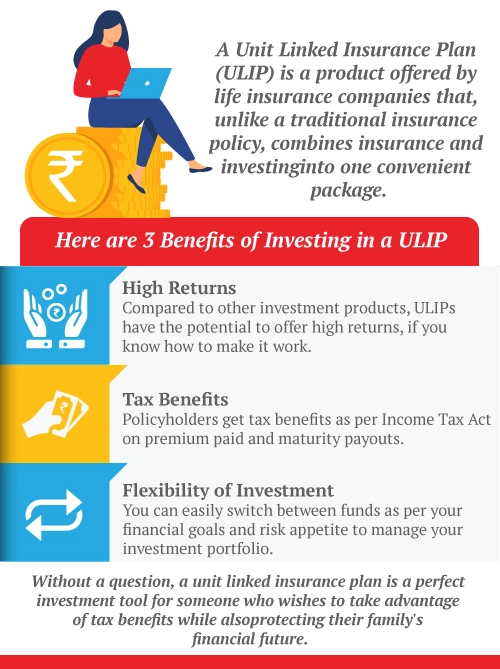
In a ULIP, the insurance holder is eligible for insurance and investment benefits in a single plan. Unit Linked Insurance Plans serve as a product with dual benefits. It invests a small amount to secure your life, and the remaining money is invested in the market.
ULIPs allow you to build wealth over time while staying protected. You also have the flexibility to switch between different fund options as your investment needs or market conditions change. These plans are ideal for long-term financial planning as they help you meet life goals like children’s education, buying a home, or retirement, all while offering tax-saving benefits under Section 80C and Section 10(10D) of the Income Tax Act.
An OTP has been sent to your mobile number

Sorry ! No records Found
Thank You for submitting the response, will get back with you.
Thank you for your interest in our product. Our financial expert will connect with you shortly to help you choose the best plan.
In a single premium ULIP, the insurer avails the benefit of the policy by paying the entire amount of premium in a single instalment. In a regular premium ULIP, the insurer avails the benefit of the policy by paying the premium amount after a fixed period. The periodicity in regular premium ULIP can be monthly, quarterly, half-yearly, or annually, depending upon the policyholder’s requirements.
The suitability of the ULIP varies from person to person. The following factors will help you differentiate between the Single Premium and the Regular Premium ULIP, enabling you to make a more informed decision.
In a regular premium policy, the policyholder has to remember the dates of instalments, plus it can be a time-consuming process to send in the payments. Regular premium policies have become a convenient choice due to the facility of automated payment systems.
The only difference between a single premium policy and a regular premium policy would be, in a single premium the policyholder can only avail of the benefit for that particular year, and in a regular payment, the policyholder can avail of the benefit of Section 80C till the term end of your insurance policy. Additionally, to enjoy tax-free maturity benefits under Section 10(10D), the premium must not exceed 10% of the sum assured.
Disclaimer: Tax benefits are subject to change in tax laws. Please consult your tax advisor.
While in a regular premium policy, the rupee cost averaging is considered. Spreading a larger sum across a period saves the policyholder from extreme market conditions.
Here's a comparison table between Single Premium ULIP and Regular Premium ULIP for better understanding:
Factor | Single Premium ULIP | Regular Premium ULIP |
|---|---|---|
Convenience | One-time payment; no need to track or remember future dates. | Requires periodic payments (monthly, quarterly, half-yearly, or annually); automation can ease this process. |
Tax Benefits | Tax deduction under Section 80C is applicable only for the year of payment. | Eligible for 80C benefits every financial year of the policy term, provided premiums are paid regularly. |
Affordability | Requires a large one-time outflow, which may strain the annual budget. | More budget-friendly; spreads the financial burden over the policy term. |
Premium Amount | A high lump-sum premium is paid at the start; ideal for those with surplus funds. | Smaller periodic premiums; more manageable for salaried or regular income individuals. |
Customisability | Customisation is possible, but it requires a large upfront premium amount. | Easier to customise due to distributed payments over 15–20 years. |
Risk | Higher exposure to market risk in one go; returns are subject to market timing. | Lower average cost due to rupee cost averaging mitigates the impact of market volatility. |
Maximum Returns | Potential for higher returns if invested at the right time, with the market performing well; no risk of policy discontinuity. | Risk of discontinuity if premiums are missed within the first 5 years, which can reduce overall returns. |
The regular premium insurance plan can have a longer period of 15-20 years and is most suitable for salaried individuals, along with families. While single premium insurance plans have a shorter period and are suitable for individuals who wish to invest a large sum of money safely.
At Canara HSBC Life Insurance, we understand that financial journeys are deeply personal. That’s why our Unit Linked Insurance Plans are designed to offer flexibility in premium payment options, fund choices, and long-term protection, so you can align your investment with life’s changing priorities.
Whether you're building wealth steadily or deploying a large sum for future security, our ULIP solutions help you protect what matters while growing your assets for tomorrow.
Explore our ULIP offerings and take a confident step toward a financially secure future with Canara HSBC Life Insurance by your side.
Disclaimer - This article is issued in the general public interest and meant for general information purposes only. The views expressed in this blog are solely those of the writer and do not necessarily reflect the official policy or position of Canara HSBC Life Insurance Company Limited or any affiliated entity. We make no representations or warranties of any kind, express or implied, about the completeness, accuracy, reliability, suitability, or availability with respect to the blog or the information, products, services, or related graphics contained in the blog for any purpose. Any reliance you place on such information is therefore strictly at your own risk. You should consult with a qualified professional regarding your specific circumstances before taking any action based on the content provided herein.








Canara HSBC Life Insurance offers online ULIP plans that blend life insurance protection with investment growth, helping you build wealth while securing your family's future.
