Written by : Knowledge Centre Team
Last published : 2025-09-04
11 minutes read
Share

In a market economy, prices of goods and services keep changing; some go up while others go down. Inflation happens when there is a general increase in prices, meaning the value of money falls over time. Simply put, you can buy less with ₹1 today than you could yesterday.
Inflation can be calculated for specific items, like clothing or services, like a salon facial. It shows how much the cost of goods or services has increased over a period.
Ask anyone in India about their biggest financial concern, and most will say it’s inflation. This is because rising prices affect almost every part of daily life, especially essentials like food. For example, a loaf of bread that cost ₹5 in the 1990s now costs around ₹45. Petrol prices have also skyrocketed. In the ’90s, petrol in Delhi was ₹9 per litre, but today, the same ₹9 buys less than a tenth of a litre. This continuous rise in prices is what we call inflation.
Key Takeaways
|
An economy experiences inflation for various reasons. Demand-pull inflation is one of the most widespread reasons. It occurs when the supply of goods and services is lower than demand, a situation that causes prices to rise. In this case, when there is an increasing number of individuals wanting to purchase cars but the capacities of selling automobiles are low, the rise in their prices would occur.
The other reason is cost-push inflation that occurs due to an increase in the price of production. When the cost of raw materials, fuel or wages increases, it is common that such costs are transferred to the consumer, who ends up paying a high price.
Additionally, automatic inflation occurs when employees issue wage increases to help them cope with rising price levels. Once the companies are offering high prices, they also increase the rates of their goods or services that they are offering to offset the extra cost incurred. This keeps on repeating itself, raising the prices further and further.
Inflation may also be caused by global events, like wars, pandemics, or disruptions of the supply chain. As an example, in case of disruption of oil production as a result of geopolitical tensions, fuel prices go up, and the disruption affects the cost of transportation and production, causing the overall increase in prices across the industries.
These factors are taken into consideration by the central banks and the government through their policies, like changing the interest rate, to maintain a stable economy and to safeguard the purchasing power of the people.
An OTP has been sent to your mobile number

Sorry ! No records Found
Thank You for submitting the response, will get back with you.
Thank you for your interest in our product. Our financial expert will connect with you shortly to help you choose the best plan.
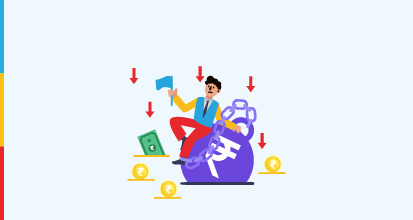
Sometimes inflation is high, and at other times it hardly garners attention. The short-term changes do not create major issues. The real havoc is created by long-term inflation. Over the long term inflation erodes the purchasing power of your money. Even if you are saving and investing diligently, your money buys less with time. If you procrastinate on savings, you are impacted even more.
The bottom line is that the value of your money reduces over time due to inflation. To protect your savings, your money needs to grow at a rate higher than inflation. Currently, inflation in India is around 7%. So, if you invest in options that give you an 8% return, you’re just about keeping up.
For example, if you think having ₹1 crore after 10 years will make you wealthy, think again. Due to inflation, that ₹1 crore will only be worth around ₹49 lakhs in today’s value.
Similarly, if you invest ₹1 crore at a 7% return for 20 years, you will have around ₹3.86 crores at the end. But with inflation also at 7%, your real growth is zero. On top of that, you’ll pay taxes on your earnings, which further reduces your returns. So, without proper planning, instead of gaining wealth, you could end up losing value.
Investing in asset classes that give inflation-beating returns is ideal. However, instruments barely beating inflation may not be a good fit if you are aspiring to generate wealth. Here is a list of investments that can help you beat inflation:
ULIPs are eligible for a tax deduction (investment) and are exempt from tax (on maturity). You can invest in a mix of equity, debt and liquid funds through ULIPs.
Saving and investment plans are important. However, what is more important is investing in the right asset classes and financial instruments. Your investments should not only beat inflation but also help you create wealth. Keeping an eye on taxation is critical else the benefits will be eroded by taxation. Tax rebates on investment and maturity will save considerable money. Efficient and effective investing is the need of the hour.
Inflation is an inevitable aspect of life that will cut down the value of your money over time. Although it is something you cannot control, you can manage your finances to overcome this effect. Using your money effectively and rather cautiously in investments where you enjoy a rate better than inflation allows you to preserve value and generate an income source as well as funds later in life. Some avenues you can look at with respect to your goals and risk appetite are equity, ULIPs, gold and real estate.
ULIP plans like Promise4Growth Plus by Canara HSBC Life Insurance offer market-linked returns that help you grow your investment while also providing tax benefits and long-term financial security.. It is never too late to start planning, so inflation cannot run over your dreams and you and your family remain financially guarded at all times.
Disclaimer - This article is issued in the general public interest and meant for general information purposes only. The views expressed in this blog are solely those of the writer and do not necessarily reflect the official policy or position of Canara HSBC Life Insurance Company Limited or any affiliated entity. We make no representations or warranties of any kind, express or implied, about the completeness, accuracy, reliability, suitability, or availability with respect to the blog or the information, products, services, or related graphics contained in the blog for any purpose. Any reliance you place on such information is therefore strictly at your own risk. You should consult with a qualified professional regarding your specific circumstances before taking any action based on the content provided herein.


We bring you a collection of popular Canara HSBC life insurance plans. Forget the dusty brochures and endless offline visits! Dive into the features of our top-selling online insurance plans and buy the one that meets your goals and requirements. You and your wallet will be thankful in the future as we brighten up your financial future with these plans.