5 Smart Tips to Maintain Your Monthly Budget

Provides five practical tips to manage a monthly budget effectively by tracking expenses, prioritising savings, and maintaining spending discipline.

Written by : Knowledge Center Team

2025-11-15

981 Views

11 minutes read

As your life progresses, you will find new responsibilities, new expenses, and financial matters falling on your way. The only way to maintain your efficiency of dealing with these many heads is to get more organised with your monthly dealings with money. Budgeting is the first, simplest and most important step towards efficiently handling your money.

It can ensure that you always have adequate savings, health and life insurance, and adequate money to look after your monthly household needs.

With budgeting, you create a spending plan for the income you are generating. The process will ensure you have enough money for things you need and prioritise your limited resources accordingly. When you budget your expenses, you also learn to prioritize your expenses.

These five budgeting tips (steps) will help you maintain your monthly budget


  1. Deduct Insurance & Retirement Costs: Insurance is a part of your contingency plan while retirement is an inevitable stage of life. Both need little monthly contributions out of your income. Thus, the income you can plan your present and future on should be counted only after you have deducted:
    • Retirement goal contribution (a % of your monthly income)
    • Cost of term life insurance and health insurance covers (only the protection plans)

      For example, you earn Rs 1 lakh a month, and contribute 10% towards your retirement and pay about Rs. 2000 a month towards insurance protection (term life and health insurance covers). You simply assume your monthly salary as Rs 88,000.

      If you are a member of EPF or NPS plans at your employer for retirement, your retirement contribution will be automatically taken care of, unless you want to save more.
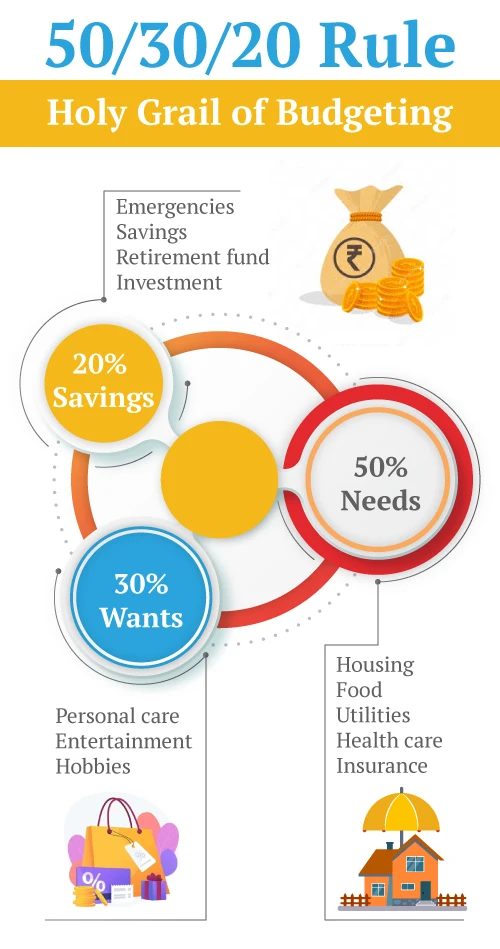
  2. Pay Yourself and Family: The amount remaining after retirement and insurance protection is the amount of income you earn for running everything else in your life. Out of this money you need to fix the two types of expenses in your family - mandatory and discretionary.
    • The mandatory expenses are your rent, your child's school fee, phone bills, etc.
    • Discretionary expenses will include expenses on entertainment, travel, shopping, etc.

      When you decide to pay yourself first, you take care of the mandatory expenses first and then prioritize your discretionary expenses. Remember that putting a monthly limit to your lifestyle expenses is important to control the family spending and a secure financial future.
  3. Allocate to Long-Term Goals: The remaining amount is your money towards your and your family’s long-term financial goals. Ideally, you should be able to save and invest 30 - 40% of your total income towards your long-term goals. But any higher percentage will obviously ensure a more prosperous future.

    When you save for the long term, you should invest in long-term saving schemes with maximum tax benefits and growth options. Below are the few plans you can invest in for maximum tax savings, as per your risk appetite:
  4. Allocate to Short-term Goals: You have been postponing your larger lifestyle expenses. However, someday you want to achieve them as well. So, your larger lifestyle expense, for example, modern home interior, high-quality lifestyle gadgets, etc. may become your short term financial goals.

    You not only have to save for your long term goals but also your short-term requirements. You invest in the short-term saving schemes for going on a vacation, buying a car, etc. These will include:
    • Debt Mutual funds
    • Bank FDs or Recurring Deposits
    • Post Office Saving Plans
    • Remember that for short term goals of less than five years, you should keep your money in a safe investment option.
  5. Record and Watch for Mismatch: Plans are never perfect. The purpose of a plan is to provide a direction to your thoughts and actions. So is your budget. It serves as a reference point for your financial actions. If you can follow it accurately, nothing better than that. But often your actions may deviate from the planned course due to circumstances.

Investing for Income After Retirement

You have to make some long-term investments that will ensure you get regular income post-retirement. Canara HSBC Life Insurance offers you two different plans for reliable lifetime income after retirement.

You can choose from either of these three plans for guaranteed income:

  1. Pension4Life
  2. Guaranteed Income4Life

Pension4Life:

It is a deferred annuity plan you can use to invest your retirement corpus and receive regular income. The plan will ensure you receive guaranteed income post your retirement as per your needs:

  • Monthly pension post-retirement until death or 99 years of age
  • Hold jointly to ensure the income continues for your spouse until his/her demise of 99 years of age
  • In case of a demise of a policyholder, the beneficiaries get the death benefit
  • You can get a loan facility to meet your short term financial needs

Guaranteed Income4Life:

This plan also offers a deferred annuity for post-retirement pension. However, unlike the Pension4Life plan, you can invest in this plan annually for up to 10 years. Thus, accumulating a larger corpus and enjoying annual tax savings as well.

Learn how to check if your retirement corpus will be enough.

Thus, the best thing to do is to evaluate and find if your expenses are in line with your budget. If there are any expenses that are running too far up or down the budgeted line. Then you figure out where you are going wrong and take the necessary actions.

Worried About Emergencies? Start Planning Now

Please enter correct name Please enter the Full name
Please enter valid mobile number Please enter Mobile Number
Please enter valid email Please enter Email

Enter OTP

An OTP has been sent to your mobile number

Didn’t receive OTP?

Application Status

Name

Date of Birth

Plan Name

Status

Unclaimed Amount of the Policyholder as on

Name of the policy holder

Policy Holder Name

Policy No.

Policy Number

Address of the Policyholder as per records

Address

Unclaimed Amount

Unclaimed Amount
Error

Sorry ! No records Found

.  Please use this ID for all future communications regarding this concern.

Request Registered

Thank You for submitting the response, will get back with you.

Disclaimer - This article is issued in the general public interest and meant for general information purposes only. The views expressed in this blog are solely those of the writer and do not necessarily reflect the official policy or position of Canara HSBC Life Insurance Company Limited or any affiliated entity. We make no representations or warranties of any kind, express or implied, about the completeness, accuracy, reliability, suitability, or availability with respect to the blog or the information, products, services, or related graphics contained in the blog for any purpose. Any reliance you place on such information is therefore strictly at your own risk. You should consult with a qualified professional regarding your specific circumstances before taking any action based on the content provided herein.


Recent Blogs

Types of Financial Planning: Key Strategies for a Secure Future
18 Feb '26
903 Views
Different types of financial planning guide your decisions at every life stage. Plan wisely from your first paycheck to retirement with Canara HSBC Life Insurance.
Read More
Financial Planning
Difference Between Financial Year (FY) vs. Assessment Year (AY)
16 Feb '26
1196 Views
7 minute read
Find out what is Assessment Year (AY) & Financial Year (FY). Visit this section and understand the difference between Financial Year and Assessment Year.
Read More
Financial Planning
Tips to Keep Financial Records Organized Effectively
12 Feb '26
619 Views
5 minute read
Learn how to sort, store, and manage your financial records with ease. Improve control and reduce financial stress.
Read More
Financial Planning
Financial Instrument: Meaning, Types and Importance
10 Feb '26
2685 Views
8 minute read
Financial instruments are essential to build and boost your wealth. Know the types of financial instruments available in India. Explore more about the tax benefits of financial instruments.
Read More
Financial Planning
Is SIP Tax Free? How to Start SIP To Save Tax on Your Income?
09 Feb '26
4420 Views
10 minute read
SIPs are one of the best tax-saving investments. Learn if SIP is tax-free under Section 80C of the Income Tax Act to plan your finances.
Read More
Financial Planning
Purpose of Financial Planning and Control in Money Management
16 Jan '26
3891 Views
10 minute read
An explanation of financial planning and control, focusing on budgeting, monitoring expenses, managing resources, and supporting long-term financial stability.
Read More
Financial Planning
PPF Account Basics: 7 Questions to Consider Before Opening
07 Jan '26
907 Views
6 minute read
Seven important questions to consider before opening a PPF account, covering eligibility, lock-in period, returns, and withdrawal conditions.
Read More
Financial Planning
Why Does Liquidity Matter in Financial Planning?
02 Jan '26
1052 Views
8 minute read
Learn what liquidity means in financial planning, why easy access to funds is important, and how liquidity helps manage emergencies and short-term needs.
Read More
Financial Planning
What Is the Right Way to Start Investing in Your 20s?
28 Dec '25
1081 Views
10 minute read
Learn how to invest in your 20s by balancing risk, building good habits early, choosing the right assets and setting the foundation for long-term wealth.
Read More
Financial Planning

Financial Planning - Top Selling Plans

We bring you a collection of popular Canara HSBC life insurance plans. Forget the dusty brochures and endless offline visits! Dive into the features of our top-selling online insurance plans and buy the one that meets your goals and requirements. You and your wallet will be thankful in the future as we brighten up your financial future with these plans.