Easy Budgeting Steps for Long-Term Financial Strength

6 Easy Budgeting Steps for Long-Term Financial Strength

Simple budgeting steps that support better expense control, savings habits, and long-term financial stability.

Written by : Knowledge Centre Team

2025-12-21

881 Views

5 minutes read

The word ‘budget’ can be scary. It might feel restricting, or the process might seem really complex. When in fact, budgeting is not only simple but also necessary. Budgeting, if done right, is the art of spending our money wisely.

We need to be aware of where our money is going, especially in this digital age where spending money has become easier than ever. Even with high income, we might always see our savings dwindle at the end of the month. However, with proper restraints, your income can ensure

  • Long-term financial security for your family
  • Funds for long-term plans
  • And enough savings for future generations, i.e., your legacy

Regular budgeting exercise can ensure proper restraint for your money and help you build your financial strength. Understanding how to budget for short-term and long-term financial goals will help you achieve financial wellness. Financial strength enables you to deal with crises and gives you the capacity to grab opportunities.

Here are 6 tips to help you budget your regular income for long-term financial strength:

  1. Pay for Financial Safety First- You need a financial safety net to ensure that your hard-earned money is protected in times of crises. It protects you and your family from unexpected emergencies, like accident or illnesses, that may derail your long-term plans.

    Insurance is a critical financial product to protect your assets and long-term investments. The right kind and amount of insurance will protect you and your family from financial loss, damage, illness, or untimely death.

    Some of the most important insurance plans you should allocate your money to first are:

    • Term life insurance plan
    • Health insurance plan for medical expenses and critical illnesses
    • Accidental death and disability insurance

    Accidental death and disability insurance cover are usually available as an added insurance plan with the term or health insurance plans. For example, the iSelect Smart360 Term Plan from Canara HSBC Life Insurance can provide accidental and terminal illness cover with the life insurance cover.

    Thus, you only need to buy a health insurance cover separately. This plan will take care of sudden hospitalisation expenses.

  2. Saving for Emergency Fund- Insurance may help protect your financial health from major mishaps, but there are other financial risks that you cannot insure. So, you will need to help yourself when it comes to such events, for example, job loss. So, you will need to create a large pool of readily available funds out of your income, and you need to do so:
    • Before starting investments for long-term goals
    • After paying for protection insurance plans

    A portion of your monthly income goes to funds specifically for financial distress. The savings must be relatively liquid, i.e., easily accessible and without penalties for an early withdrawal. Ideal instruments to park your emergency funds safely are:

    1. Liquid mutual funds
    2. Supersaver deposits linked with your savings account
    3. Bank and Post Office fixed deposits

    The portion allocated to Emergency Funds needs to increase with increasing income to ensure adequate financial protection.
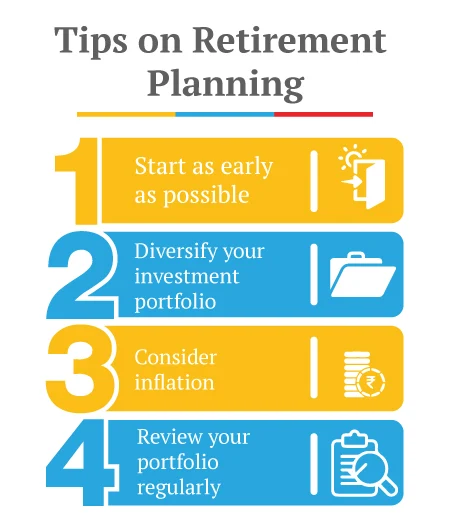
  3. Allocation for Retirement- Retirement is the time when you can replace your income with the returns on your savings. For example, you expect a monthly income of Rs. 1 lakh to sustain your lifestyle and household expenses. If you can generate this income from the returns on your saved money, you can officially retire from the money-making profession.

    Given the long-term rate of return in the country and inflation, you can replace your monthly income from your 30s if you invest 10-12% of it until 60. However, given the uncertainty around future living conditions and your legacy goals, you may aim for a higher percentage to stay on the safer side.

Several factors affect your retirement income needs such as liabilities, relocation, home purchase, etc.

A 15% allocation towards retirement funds is a reasonable investment. If you are a salaried investor, you possibly have Employees' Provident Fund or NPS subscription and investing 10-12% of your income towards your retirement goal. So, you will need to invest only 3-5% more in retirement investment.

However, in case you are self-employed, you can start investing in NPS and unit-linked plans (ULIPs) for tax-efficient retirement funds.

  1. Allocate to Long-Term Goals - The most important part of investing your savings is fulfilling long-term goals. Long-term goals like child’s marriage, education, and even starting up your own business are an important part of your life.

    An allocation of 25% of your income is a healthy ratio to fulfil your long-term financial goals. However, you may find it unreasonable if you do not have specific long-term goals yet. In such a scenario you can create a wealth-building goal for your savings.

    This will offer two benefits in future:

    1. You will have ready money if a goal props up and will need to allocate a lower portion of your income to meet the goal
    2. In case of the absence of such goals, your investment assets can become large enough to replace your occupational income

    Canara HSBC Life Insurance Promise4Growth Plus ULIP plan is a perfect instrument for such wealth goals. The plan gives you the option to invest in equity funds and switch your funds from equity to debt anytime when your needs change.

  2. Fulfilling Your Short-Term Goals -Short-term goals are the ones defining your lifestyle and household amenities. Goals like, modern interior, family vacation plan, home theatre purchase, etc. are done better with a good budget in hand. Thus, postponing these goals and saving money for them is always more rewarding than just pulling your immediate cash flow out of the line.

    You can even list things like a certain online course requirement for better job prospects, necessary equipment for the household like furniture etc. as short-term goals. However, spending money on these goals from your income is less rewarding financially.

    But if you save about 10% of your income to build a pool of funds to meet such short-term goals, you have better purchasing power. All you will need to do is invest these funds in options that not only allow growth but also let you withdraw money partially.

    Investment plans like Invest 4G ULIP allow partial withdrawals after five years of continuous investments, apart from the tax benefits. These withdrawals are tax exempt. So, after five years you can continue to invest money and make a partial withdrawal whenever you need.

  3. The Necessary Expenses - Ensuring a safe future with a life insurance and investments can take up about 50% of your regular income. The remaining 50% you can dedicate towards your family’s current financial needs, like household expenses. This 50% will also include children’s school fees and expenses.
    You can budget the remaining income to meet the necessary expenditure including EMIs, Rent, groceries, etc. This is also the corpus from which you will meet the discretionary expense like movies, eating out, etc. This is to ensure a healthy balance so that while we work for the future, we can also enjoy our present.

Disclaimer - This article is issued in the general public interest and meant for general information purposes only. The views expressed in this blog are solely those of the writer and do not necessarily reflect the official policy or position of Canara HSBC Life Insurance Company Limited or any affiliated entity. We make no representations or warranties of any kind, express or implied, about the completeness, accuracy, reliability, suitability, or availability with respect to the blog or the information, products, services, or related graphics contained in the blog for any purpose. Any reliance you place on such information is therefore strictly at your own risk. You should consult with a qualified professional regarding your specific circumstances before taking any action based on the content provided herein.


Recent Blogs

Types of Financial Planning: Key Strategies for a Secure Future
18 Feb '26
903 Views
Different types of financial planning guide your decisions at every life stage. Plan wisely from your first paycheck to retirement with Canara HSBC Life Insurance.
Read More
Financial Planning
Difference Between Financial Year (FY) vs. Assessment Year (AY)
16 Feb '26
1196 Views
7 minute read
Find out what is Assessment Year (AY) & Financial Year (FY). Visit this section and understand the difference between Financial Year and Assessment Year.
Read More
Financial Planning
Tips to Keep Financial Records Organized Effectively
12 Feb '26
619 Views
5 minute read
Learn how to sort, store, and manage your financial records with ease. Improve control and reduce financial stress.
Read More
Financial Planning
Financial Instrument: Meaning, Types and Importance
10 Feb '26
2685 Views
8 minute read
Financial instruments are essential to build and boost your wealth. Know the types of financial instruments available in India. Explore more about the tax benefits of financial instruments.
Read More
Financial Planning
Is SIP Tax Free? How to Start SIP To Save Tax on Your Income?
09 Feb '26
4420 Views
10 minute read
SIPs are one of the best tax-saving investments. Learn if SIP is tax-free under Section 80C of the Income Tax Act to plan your finances.
Read More
Financial Planning
Purpose of Financial Planning and Control in Money Management
16 Jan '26
3890 Views
10 minute read
An explanation of financial planning and control, focusing on budgeting, monitoring expenses, managing resources, and supporting long-term financial stability.
Read More
Financial Planning
PPF Account Basics: 7 Questions to Consider Before Opening
07 Jan '26
906 Views
6 minute read
Seven important questions to consider before opening a PPF account, covering eligibility, lock-in period, returns, and withdrawal conditions.
Read More
Financial Planning
Why Does Liquidity Matter in Financial Planning?
02 Jan '26
1052 Views
8 minute read
Learn what liquidity means in financial planning, why easy access to funds is important, and how liquidity helps manage emergencies and short-term needs.
Read More
Financial Planning
What Is the Right Way to Start Investing in Your 20s?
28 Dec '25
1081 Views
10 minute read
Learn how to invest in your 20s by balancing risk, building good habits early, choosing the right assets and setting the foundation for long-term wealth.
Read More
Financial Planning

Financial Planning - Top Selling Plans

We bring you a collection of popular Canara HSBC life insurance plans. Forget the dusty brochures and endless offline visits! Dive into the features of our top-selling online insurance plans and buy the one that meets your goals and requirements. You and your wallet will be thankful in the future as we brighten up your financial future with these plans.