Last published : 2024-08-02
Share
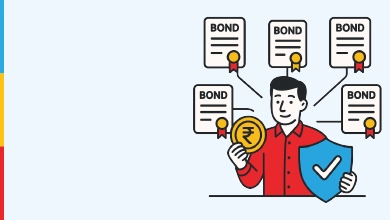
Bonds are an essential investment instrument in India, providing investors with stable returns and diversification. While stocks are market-linked and volatile, bonds offer a predictable income stream, making them ideal for conservative and balanced portfolios.
They are debt instruments where an investor lends money to an entity (government or corporation) for a fixed tenure. In return, the issuer pays periodic interest (coupon) and returns the principal upon maturity.
For example, if you buy a ₹10,000 bond at a 7% annual interest rate for 10 years, you earn ₹700 yearly as interest and receive ₹10,000 at maturity.
Key Takeaways
|
Investors in India have access to a wide range of bonds catering to different risk profiles and financial goals. These bonds vary based on their issuers, tenure, interest rates, and tax benefits. Understanding the types of bonds available can help you make informed decisions while building a diversified and stable investment portfolio.
An OTP has been sent to your mobile number

Sorry ! No records Found
Thank You for submitting the response, will get back with you.
Thank you for your interest in our product. Our financial expert will connect with you shortly to help you choose the best plan.
These bonds offer a way for local governments to finance large-scale projects without depending entirely on state or central funding. For investors, they present an opportunity to contribute to community development while earning a stable return.
Most municipal bonds come with fixed interest payouts and defined maturity periods. While municipal bonds can be a relatively safe investment option, especially those backed by state guarantees, they are not entirely risk-free. Factors such as delayed project execution, poor governance, or lower revenue collections by the issuing body may affect returns.
Recommended Reading - How to Manage Money?
It is of importance to diversify your investment portfolio as well as to reduce the levels of overall risk, but maximise returns. In this diversification technique, bonds have a major role. The price of bonds tends to follow a different direction from the equity market, and hence, holding bonds helps stabilise the portfolio when the equity market becomes volatile.
An example can be given when there is good performance of equities because of market conditions going down; chances are that it will be offset by bonds, which will earn fixed interest income, hence moderating the effects of performance on your portfolio. Further, the various categories of bonds, i.e., government securities, PSU bonds and corporate bonds have different levels of risks and duration, and an investor can diversify their investment in all these bonds depending on their risk tolerance and investment objectives.
The advantage of including bonds in your portfolio is that you will be able to combine both growth and income-generating assets, enabling you to attain financial stability in the long term.
Buying bonds offers numerous advantages:
Consistency of returns: Stable payments of interest guarantee proper income.
Diversification of portfolio: Decreasing the risks of overall investments.
Safety: Government and high-rated corporate bonds are safer than equities.
Principal protection: Bonds guarantee the initial amount in case of keeping the bonds till their maturity.
Consistent income: It is good for retirement and short-term investments that require cash flow.
Although bonds are safer compared to equities, there are some risks which accompany them:
Credit risk: The risk of realising default in the issuer.
Interest rate risk: As market interest rates increase, bond prices decrease.
Liquidity risk: Lack of ability to sell bonds prior to maturity without loss of capital.
Inflation risk: Fixed-income that is interest-bearing runs the risk of losing value to inflation.
Selecting the right bond requires a clear understanding of your financial goals, investment horizon, and risk tolerance. Bonds come in various forms, and each serves a different purpose within a portfolio. To make an informed choice, consider the following key factors:
Bond investments provide a relatively safe means of achieving financial stability, generating predictable income, and diversifying your portfolio without being fully exposed to the volatility of equity markets. While different types of bonds come with varying degrees of risk and return, the right mix aligned with your financial goals can help you gain more control over your future.
However, bonds alone may not be enough for comprehensive financial planning. Solutions like ULIPs and assured income plans from Canara HSBC Life Insurance offer the dual benefit of wealth creation and life protection. Start now to build a well-balanced portfolio that not only grows your wealth but also safeguards your family against life’s uncertainties.
Buying a life insurance plan with adequate coverage can be a financial cushion for your family. It ensures that the family's lifestyle and goals are not compromised due to unfortunate events such as death or disability.
Some life insurance plans, like Unit Linked Insurance Plans (ULIPs), offer wealth creation opportunities to policyholders, along with life coverage. These plans let you invest your premiums in different securities, like equity, debt, and more, to enjoy the benefits of inflation-beating returns.
Life insurance policies offer valuable tax benefits, enabling you to enhance your returns and accumulate savings. The premiums paid for the policy qualify for deduction under Section 80C of the Income Tax Act, 1961, up to ₹ 1.5 lakhs annually, subject to certain conditions. Furthermore, the funds withdrawn from the policy after the lock-in period and the maturity value received from life insurance plans are also tax-free.
Your source of income will no longer exist with you after retirement. It is crucial to have enough money saved up so that, when you retire, you won't need to worry about anything. Together with a steady income stream, retirement plans offer life insurance.
Rider benefits add extra coverage and more protection against risks. Insurance riders are affordable, beneficial add-ons you can select to add to your policy. They strengthen the insurance policy by extending beyond the base policy. Some of the common riders are critical illness riders, accidental death riders, disability riders, and more.
Investment-linked life insurance plans such as endowment, money-back, and whole-life plans accumulate cash value over time. While these plans typically span a longer term, you can obtain a loan against the cash value they accrue. This feature enables you to access a portion of the funds within the plan while maintaining the investment toward the intended goals.
Life insurance plans are a practical means to realise your child's aspirations. These policies offer either a lump sum payment or regular income to support your child's education and empower them to pursue their ambitions unhindered.
Disclaimer - This article is issued in the general public interest and meant for general information purposes only. The views expressed in this blog are solely those of the writer and do not necessarily reflect the official policy or position of Canara HSBC Life Insurance Company Limited or any affiliated entity. We make no representations or warranties of any kind, express or implied, about the completeness, accuracy, reliability, suitability, or availability with respect to the blog or the information, products, services, or related graphics contained in the blog for any purpose. Any reliance you place on such information is therefore strictly at your own risk. You should consult with a qualified professional regarding your specific circumstances before taking any action based on the content provided herein.







We bring you a collection of popular Canara HSBC life insurance plans. Forget the dusty brochures and endless offline visits! Dive into the features of our top-selling online insurance plans and buy the one that meets your goals and requirements. You and your wallet will be thankful in the future as we brighten up your financial future with these plans.
The premium is one of the most important factors to consider before buying a life insurance policy. Many people buy a life insurance policy with a high sum assured but are unable to process the premiums for the entire premium payment tenure. You can get a better idea of the premium outgo with the premium calculator available in the 'Tools and Calculator' section of www.canarahsbclife.com.