Written by : Knowledge Centre Team
Last published : 2025-05-20
12 minutes read
Share

At that time, when most economic activities had suffered due to the lockdown imposed to tackle the Covid-19 pandemic, some flexibility in tax laws was much needed to provide relief to taxpayers who had not yet recovered from the sluggish market conditions. Thankfully, the Government of India had announced various economic relief measures, including financial aid and the provision of subsidised or free food and water.
While businesses did not have control over tax payouts since the amount was fixed by the government, the tax relief had significantly helped ease cash flows. This, in turn, enabled people to meet their daily and business needs, cover working capital requirements, fulfill other contractual commitments, and more.
The relief measures taken by the government could be broadly categorised into the following:
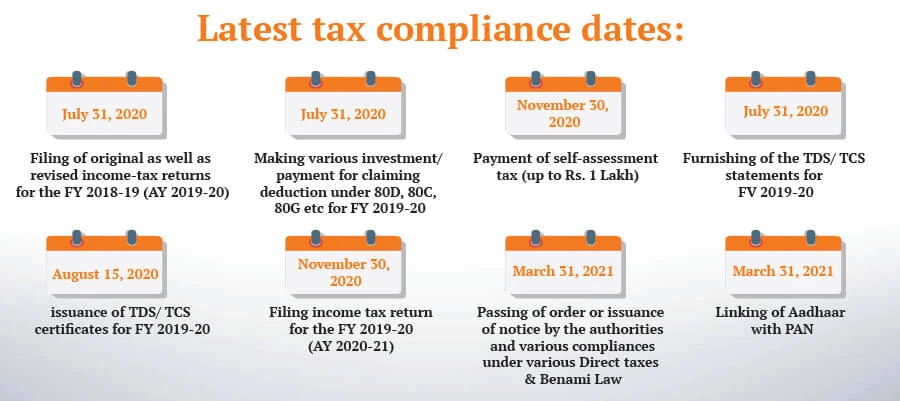
For many countries, the COVID-19 outbreak happened at a time when income tax returns and payments were due. In India, the government had provided for the extension of due dates like filing of original as well as revised income-tax returns for the FY 2018-19, which ended on 31 March 2020, has been pushed to July 31, 2020 (for salaried individuals). Also, the Central Board of Direct Taxes (CBDT) announced an extension of the deadline for making tax-saving investments for the Financial Year (FY) 2019-20. The deadline was moved from 30 June to 31 July 2020, in order to provide relief to taxpayers amid the corona-virus pandemic. So, tax-payers had more time for making investments in tax savings instruments to claim tax relief under various sections of the Income Tax Act.
An OTP has been sent to your mobile number

Sorry ! No records Found
Thank You for submitting the response, will get back with you.
Thank you for your interest in our product. Our financial expert will connect with you shortly to help you choose the best plan.
The finance minister announced a reduction of 25% in the rate of tax deducted at source (TDS) for non-salaried payments made to residents in order to enhance liquidity in the hands of taxpayers. Plus, to provide more funds at the disposal of the taxpayers, the rates of Tax Collection at Source (TCS) also reduced by 25% of the existing rates. Moreover, to give relief to employers in payment of Provident fund (PF) and to increase the take-home salary for employees, the EPF contribution was initially reduced to 10% each for employers and employees. In an extension, the government also announced that the central government will pay 24% of the monthly EPF obligations into employee accounts below 15,000/ month, working in organizations having up to 100 employees.
The COVID-19 outbreak had an unexpected impact on the cash-flow situation for many businesses as well as individuals. Such cash flow issues impacted the functioning of not just one, but several businesses connected to each other. Therefore, to assist taxpayers and ease their cash flow burdens, the Indian Government announced the issuance of all pending income-tax refunds of up to ₹ five hundred thousand immediately. This move will ease the cash flow burden of small businesses. In addition, all pending refunds to charitable trusts and non-corporate businesses including LLP, Co-operatives, proprietorship, and partnership was issued immediately.
All these measures were a huge relief to businesses and individual tax-payers as they were imposed to help increase cash flow and offer beneficial rates.
Disclaimer - This article is issued in the general public interest and meant for general information purposes only. The views expressed in this blog are solely those of the writer and do not necessarily reflect the official policy or position of Canara HSBC Life Insurance Company Limited or any affiliated entity. We make no representations or warranties of any kind, express or implied, about the completeness, accuracy, reliability, suitability, or availability with respect to the blog or the information, products, services, or related graphics contained in the blog for any purpose. Any reliance you place on such information is therefore strictly at your own risk. You should consult with a qualified professional regarding your specific circumstances before taking any action based on the content provided herein.



We bring you a collection of popular Canara HSBC life insurance plans. Forget the dusty brochures and endless offline visits! Dive into the features of our top-selling online insurance plans and buy the one that meets your goals and requirements. You and your wallet will be thankful in the future as we brighten up your financial future with these plans.