Tips for Retirement Planning

7 Beneficial Plans for Retirement Planning

Best retirement plans in India to help you build a stable post-retirement income, reduce tax, and stay ahead of inflation.

Written by : Knowledge Centre Team

2025-08-01

1512 Views

10 minutes read

For many, retirement marks the end of the earning period. Among all the most discussed and planned aspects of retirement, the financial element is the most prominent. This is because a person needs regular income to afford a comfortable lifestyle.

The primary importance is to wisely use the retirement corpus to keep the tax liability at bay and get regular income. The challenge is that people retire at the age of 58 or 60, but the life expectancy is almost 80. Besides, they need to build a retirement portfolio with a mix of fixed income and market-linked investments. While earning a regular income, you don't get concerned about personal finances. However, it becomes so once you retire, and the cash inflow stops. Thus, planned and structured investment is an important decision to have sufficient funds post your retirement.

Key Takeaways

  • Start retirement planning early to take full advantage of compounding and lower investment costs.
  • Aim for a retirement corpus that covers at least 80% of your current monthly income.
  • Choose a mix of fixed-income and market-linked instruments for balance and growth.
  • Always factor in inflation, life expectancy, and tax liability while planning.
  • Government-backed schemes like PPF, SCSS, and NPS offer stable returns and tax benefits.

Seven Best Retirement Investment Plans in India for Regular Income

Retirement doesn’t stop your expenses. It only stops your paycheques. To maintain financial independence, you need investment options that offer steady income, low risk, and tax benefits. The right retirement plan can turn your savings into a reliable monthly income and help you stay ahead of inflation.

Here are seven retirement plans to help you achieve your retirement goals:
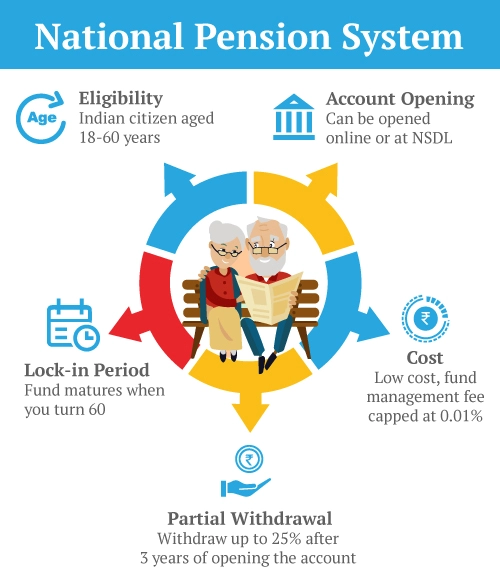
  1. National Pension Scheme- This pension cum investment scheme allows investors to regularly invest in a pension account during their working life tenure. It is an ideal option for people planning for their retirement. This investment scheme provides monthly income after retirement, along with the market returns. As soon as you are retired, you can withdraw a part of the lump sum and then buy a life annuity to  receive monthly income. Besides, this scheme offers tax exemption, according to Section 80C of the Income Tax Act. The National Pension Scheme is of great importance to people who are working in the private sector.
  1. Public Provident Fund- PPF is a popular investment and guaranteed plan with a competitive rate of interest, and the returns are exempt from tax. This scheme mobilises small savings as it offers an investment that has reasonable returns and provides income tax deduction according to Section 80C of the Income Tax. Anyone planning a secure retirement should open a PPF account as it is a safe investment option. You get the benefit of guaranteed returns after 15 years. Moreover, PPF has low risk if we compare it to other investment plans.

    Key highlights of PPF:

    • Interest is compounded annually and paid by the government.
    • Investment tenure is 15 years, with the option to extend in 5-year blocks.
    • Minimum investment: ₹500; maximum: ₹1.5 lakh per year.
    • Eligible for tax benefits under Section 80C.
    • Withdrawals allowed from the 7th year; loans available from the 3rd year.
    • Ideal for conservative investors seeking long-term, tax-free returns.
  2. Senior Citizens Saving Scheme- It is the most preferred choice of most retirees. This scheme is applicable to senior citizens and early retirees. Anyone above the age of 60 can avail of this scheme from a bank or a post office. The early retirees can invest in this scheme if they start investing within 90 days of receiving their retirement money.

    The scheme's period is five years, and you can also extend it further by three years once it matures. The minimum deposit amount is ₹1,000, and if the amount is more significant than ₹1000, then the investor has to invest in multiples of ₹1000. The maximum limit deposit is ₹15 lakh.

    > Learn more about Senior Citizen Savings Scheme.

    The current rate of interest in SCSS is 8.2% per annum, which is payable quarterly. Among all the small savings schemes in the country, SCSS has the highest rate of interest. The scheme is available through any private or public sector bank or post office. Since it's a government savings plan, the terms and conditions remain the same, regardless of whether you invest in the post office or a bank. These are the historical rates of interest for this scheme:

    Time PeriodRate of Interest in % annually

    April to June (Quarter 1 for 2025‑26)

    8.2

    July–September 2025 (Q2 FY 2025‑26)

    8.2

    January–March 2025 (Q4 FY 2024‑25)

    8.2

    October–December 2024 (Q3 FY 2024‑25)

    8.2

    July–September 2024 (Q2 FY 2024‑25)

    8.2

    April–June 2024 (Q1 FY 2024‑25)

    8.2

    April to June (Quarter 1 for 202-21)

    7.4

    January to March(Quarter 4 for 2019-20)

    8.6

    October to December(Quarter 3 for 2019-20)

    8.6

    July to September(Quarter 2 for 2019-20)

    8.6

    April to June (Quarter 1 for 202-21)

    7.4


  3. Pension Plan

    It is ideal for anyone looking for a retirement investment option. This plan makes sure that a person can afford the same lifestyle even after his/her retirement. With this investment plan, you have to save a part of your income that will build over time and post-retirement, and you will get a steady income. Besides ensuring a regular flow of revenue, this plan will help you in any contingencies post-retirement.

    Key highlights of pension plans:

    • Designed to offer monthly income after retirement from accumulated savings.
    • Available as deferred or immediate annuity options, depending on when you start receiving income.
    • Can be purchased from insurance providers or financial institutions.
    • Some plans offer lifetime payout with return of purchase price to the nominee.
    • Premiums may be eligible for tax deduction under Section 80CCC.
    • Helps build financial discipline by encouraging long-term saving habits.
  1. Unit Linked Insurance Plan- To strengthen your retirement goals, the unit-linked insurance plan is a long-term guaranteed savings plan which gives the investor a dual benefit of investment and insurance. This means the plan offers both guaranteed returns and protection as well. Besides, this plan's average returns are higher than other investment plans such as endowment, pension plan, etc.

    If you want to customise your plan according to your goals and changing requirements, you can opt for ULIPs by Canara HSBC Life Insurance. Unit Linked Individual Life Insurance will give you full control over your savings with an unmatched blend of flexibilities and Portfolio Management Options and flexibilities. We offer you a Life Insurance Cover to protect your family if you have unfortunate demise.

  2. Bank Fixed Deposits- It is another popular plan among the retirees as it provides protection and a fixed return. Also, the ease of operation makes it reliable for the retirees. The current interest rate stands between 3.25% and 7.75% per annum. This option allows deposits starting from ₹100, with flexible tenures ranging from 7 days to 10 years. The senior citizens get an additional 3.75 to 7.30% per annum, depending on the bank they choose. Unlike the SCSS, the bank deposits offer flexibility concerning the terms of the tenure.

    Learn what is a fixed deposit and the benefits of including it in your investment portfolio.

    One of the major concerns of the retiree is to running out of cash. Here are some of the essential investment options that must be taken note of. These investments will provide long-term stability along with maximum return on investment. If you plan to enrol in a pension scheme, Canara HSBC Life Insurance would be the best option for you.

  3. Post Office Monthly Income Scheme (POMIS)-The POMI Scheme is a five-year investment plan. This scheme has two variants: joint ownership and single ownership. The maximum cap of joint ownership and single ownership is ₹9 lakh and ₹4.5 lakh, respectively. The interest rate offered in POMIS is 7.4% per annum, which is payable monthly. The amount invested in POMIS is exempt from all tax benefits, but the interest is entirely taxable.

    The interest can also be transferred to the savings account of the same post office. Physical presence is not mandatory. The same interest can also be automatically transferred from the savings account to a recurring deposit in the same post office. The account can be single, joint, or minor, and the limit varies for each.

    Account TypeCap-in (in ₹)
    Single4.5 Lakh
    Joint9 Lakh
    Minor3 Lakh

    Now that you know about the different investment plans post-retirement let us give you a few tips on how to plan it.

Get Expert Guidance for Your Retirement & Investments

Please enter correct name Please enter the Full name
Please enter valid mobile number Please enter Mobile Number
Please enter valid email Please enter Email

Enter OTP

An OTP has been sent to your mobile number

Didn’t receive OTP?

Application Status

Name

Date of Birth

Plan Name

Status

Unclaimed Amount of the Policyholder as on

Name of the policy holder

Policy Holder Name

Policy No.

Policy Number

Address of the Policyholder as per records

Address

Unclaimed Amount

Unclaimed Amount
Error

Sorry ! No records Found

.  Please use this ID for all future communications regarding this concern.

Request Registered

Thank You for submitting the response, will get back with you.

Things to Consider While Planning Your Retirement

Retirement planning is not all about choosing investment products. It also includes understanding the risks and preparing for the long term. A few common oversights can severely impact your financial stability after 60.

Here are five important factors to keep in mind as you plan for a stress-free retirement:

  1. Shortage of Retirement Corpus- One of the major problems people face is planning for retirement just five years before. On the other hand, they would have 20 more years to live. This usually happens when you fail to calculate the retirement corpus. In various cases, people miscalculate the actual size of a retirement fund. They end up either depending on their children or starting to work once again, if possible. Negligence of inflation, life expectancy and tax: There is a shortage of funds after retirement if you don't take factors such as inflation, tax liability, and life expectancy into consideration.
  2. Inflation- The Indian inflation rate is 2.1% in June 2025. If your monthly expenditure is around ₹50,000 and you are supposed to retire after 20 years. You need approximately ₹1.6 lakh per month to live with the same spending if the rate of inflation remains unchanged. Ignoring inflation while planning your retirement is a significant mistake.
  3. Life Expectancy- Life is uncertain; thus, it is impossible to predict our lives. Hence, we need to have life insurance to offer your family financial support, even in your absence. Your life expectancy increases as you age. Accordingly, it would be best if you built your retirement corpus too. Let's take an example where your age is 30 years and you expect to live up to 75 years. You have planned to retire at 60. Hence, it would be best to build a retirement corpus to protect you for at least 15 years.
  4. Tax- People often end up giving a huge part of their retirement savings in taxes. Many times tax eats away at your retirement savings. Therefore, it is always advised to invest in such instruments offer maximum tax benefits. ULIPs are known for retirement plans because of their magnificent tax benefits.
  5. Starting Late- Irrespective of your retirement plan, it is always recommended to start early. Starting is one of the keys to offering a lump sum during maturity. The power of compounding is best utilised when started early, and this leads to healthy retirement funds. The premium keeps on increasing with age in both term insurance plans and ULIP retirement plans. If you start early, you will acquire more funds and get them at a low premium. This soft premium would lead to a maximum return. If you are planning to invest for your retirement, do not delay it.
Retirement Calculator

A retirement planning calculator is a simple tool that gives you an idea of the corpus you can accumulate with a regular monthly investment for your golden years.

1
My Retirement Age
2
Amount Invested
3
Additional Details
4
Our Recommendation
My Retirement Age
Amount Invested
Additional Details
Our Recommendation
Retirement
Your Current Expenses are Rs 50,000/month
Inflationary Expenses you will need post retirement Rs 1,00,000/month
Hi {customerName}
We recommend to start Investing
For remaining {remainingYears} years
View Now
Desclaimer-

The above calculation and illustration of figures are indicative only and not on actual basis.

Five Quick Tips on Retirement Planning

Finally, let us brief you about a few things that you should keep in the back of your mind while planning your post-retirement investments. These simple yet crucial reminders can help you avoid common pitfalls and make smarter financial choices. Think of them as a checklist to stay on track as you prepare for a financially secure retirement.

  • If you plan to retire at 60 or in your early 60s, you should invest in a manner that will provide you with 80% of your current monthly income.
  • Do not forget to factor in inflation when planning.
  •  Invest in instruments that offer more than 6% annual returns to help tackle inflation.
  • Your portfolio of market-linked and fixed-income instruments should be diverse.
  • Do not forget to buy term life insurance with ample coverage for your family's financial protection

Finally, let us brief you about a few things that you should keep in the back of your mind while planning your post-retirement investments.

Conclusion

Retirement planning requires more than just saving money. You need to set clear financial goals, choose the right investment options, and account for factors like inflation, taxes, and life expectancy. A well-diversified portfolio, comprising both fixed and market-linked instruments, can help you manage risk and generate a steady income.

Start early, stay consistent, and review your plan regularly. This approach will help you build financial security for your post-retirement years.

Disclaimer - This article is issued in the general public interest and meant for general information purposes only. The views expressed in this blog are solely those of the writer and do not necessarily reflect the official policy or position of Canara HSBC Life Insurance Company Limited or any affiliated entity. We make no representations or warranties of any kind, express or implied, about the completeness, accuracy, reliability, suitability, or availability with respect to the blog or the information, products, services, or related graphics contained in the blog for any purpose. Any reliance you place on such information is therefore strictly at your own risk. You should consult with a qualified professional regarding your specific circumstances before taking any action based on the content provided herein.


Recent Blogs

What is Superannuation? Types and Tax Benefits
07 Jan '26
707 Views
9 minute read
A superannuation benefit is a type of benefit that is paid to the employees by their employers as a pension benefit. Learn what superannuation is and how it works.
Read More
Retirement Plan
What is Family Pension? Everything You Need to Know
05 Jan '26
1828 Views
10 minute read
Family Pension is a government scheme for central government employees. Learn its meaning, eligibility criteria, and how it works with Canara HSBC Life Insurance.
Read More
Retirement Plan
Is NPS Tax Benefit Available in New Tax Regime? | NPS Deduction Rules
05 Jan '26
4225 Views
7 minute read
Is NPS tax benefit allowed in the new tax regime? Understand eligibility, Section 80CCD(2) deductions, and how NPS works for taxpayers.
Read More
Retirement Plan
What is Pension? Meaning, Types & Benefits Explained
04 Jan '26
3682 Views
12 minute read
A pension is a retirement fund contributed by the employer, employee, or both, with the employer covering the largest share. Learn more with Canara HSBC Life Insurance!
Read More
Retirement Plan
What Is a Defined Benefit Pension Plan and How Does It Pay?
23 Dec '25
1264 Views
8 minute read
What is a defined benefit pension plan? Learn how it guarantees a fixed retirement income based on salary and years of service, and why it matters for long-term security.
Read More
Retirement Plan
How Can You Plan to Build a ₹5 Crore Retirement Corpus?
20 Dec '25
886 Views
8 minute read
Learn how to create a ₹5 crore retirement corpus using disciplined savings, investments in equities and debt, compounding, risk management, and goal-based planning strategies.
Read More
Retirement Plan
What is PRAN in NPS? Full Form & Role in National Pension System
20 Dec '25
1027 Views
8 minute read
Discover what PRAN means and its vital role in NPS. Learn how PRAN helps manage pension accounts under India’s National Pension System.
Read More
Retirement Plan
What Are the Different Types of Annuity Plans in India?
18 Dec '25
1077 Views
8 minute read
You can invest in many types of annuities in India. Learn about the main types of annuity plans in India, including immediate, deferred, life, joint life, and guaranteed annuities, and how each suits different retirement needs.
Read More
Retirement Plan
NPS Returns: Meaning and Benefits of NPS Returns
18 Dec '25
3432 Views
10 minute read
NPS returns depend on the performance of allocated funds. Learn how to maximize your NPS returns and explore alternative retirement investment options.
Read More
Retirement Plan

Retirement - Top Selling Plans

We bring you a collection of popular Canara HSBC life insurance plans. Forget the dusty brochures and endless offline visits! Dive into the features of our top-selling online insurance plans and buy the one that meets your goals and requirements. You and your wallet will be thankful in the future as we brighten up your financial future with these plans.