what-is-a-fixed-deposit

What Is a Fixed Deposit (FD)? How It Works

A fixed deposit is a popular and low-risk investment option that helps individuals earn assured returns over a fixed period.

Written by : Knowledge Centre Team

2025-12-24

1288 Views

11 minutes read

Fixed deposit has been a popular savings instrument in India. It is one of the safest and easy investment options, if you are new to investments. It will help you manage your investment portfolio easily. You can park your savings into fixed deposits with banks or post-office and earn a higher rate of interest. Fixed deposit investments allow you to keep your savings safe until you can decide on an appropriate allocation for the money.

What is a Fixed Deposit?

A fixed deposit, commonly known as FD, is an investment option with a limited maturity period and a fixed rate of return. Non-Banking Financial Corporations (NBFC), banks, post-office branches and large corporations can offer FDs to the public. You can invest your funds and receive a higher interest rate than what you receive in a regular savings account.

Fixed deposits are saving plan with a limited maturity period. You can use FDs to invest your savings for a maturity of 7 days to 10 years. The rate of interest for deposited sum will be decided in the beginning and will remain fixed until maturity.

You can choose to receive the periodical interest in your savings account or leave it to accumulate in your deposit. Accumulated interest on the fixed deposits increases the principal sum after each credit. Thus, if you do not withdraw interest from your FD you benefit from the power of compounding.
Partial withdrawals are not possible and you can withdraw money from FDs prematurely but you will need to break it. Premature termination can warrant a penalty on the credited interest. You will receive a lower rate of interest than promised earlier.

How does a Fixed Deposit Work?

You can start your fixed deposit at your bank, post-office branch or with an NBFC. Corporate fixed deposits are also an option when available. Here’s how your fixed deposit will work:

  • Select the type of FD you want to start, i.e., normal or senior citizen FD
  • Select the amount of deposit
  • Choose a tenure ranging from a minimum of 7 days to up to 10 years
  • Your interest rate of the fixed deposit will be decided based on your deposit amount, type of FD and term of the deposit
  • Interest payments:
    • FD will pay interest every quarter
    • You can choose to receive the interest in your savings account
    • You can have the interest reinvested or accumulated in the FD and receive a compound interest at maturity
  • At maturity, you will receive the accrued interest and principal back
  • In the case of premature withdrawal credited interest will be reduced by a percentage depending on the remaining tenure of the FD
     

Types of Fixed Deposit Accounts

Various types of FDs are available depending on the investor type and other features. Some of the most popular types of FDs are given below:

  1. Standard Fixed Deposit or Term- These are the normal deposits available to resident Indians below the age of 60. The term of these deposits can range from 7 days to 10 years. The interest rate will depend on the term of the deposit.
  2. Senior Citizen Fixed Deposit- Senior citizen fixed deposits are available to investors above 60 years of age. Two major differences these fixed deposits have are the rate of interest and TDS limit. The rate of interest on senior citizen fixed deposits is usually 25 basis points higher than standard FD rates. The TDS limit for the interest in these deposits is Rs 50,000.
  3. Tax Saving Deposits- Tax-saving fixed deposits in India are deposits specified for deduction under section 80C of the Income Tax Act 1961. These are 5-year deposits and do not offer interest pay-out or withdrawal before maturity. So, your investment is locked in for five years in tax-saving deposits.
  4. Recurring Deposits- Recurring deposits are a great way to accumulate money over a short period. You can invest in recurring deposits of 12 months to 60 months. Recurring deposits allow you to save a small fixed amount every month.
  5. Flexi Deposit/Super Savers- Flexi deposits or super savers are fixed deposits linked to your savings account. Once you start the deposit the balance over the decided limit is automatically turned into a fixed deposit. If you withdraw more money from your savings account the deposit automatically fulfils the balance.
  6. NRI Fixed Deposits- NRI Fixed Deposits are available to NRE/NRO account holders. NRE fixed deposits are available in foreign currency and provide tax-free interest on the deposit. NRO fixed deposits are available in INR and the interest is taxable at a rate of 30%.
  7. Corporate Fixed Deposits- Corporate fixed deposits are floated by large corporations, real estate companies and businesses with significant real asset holdings. Corporate deposits also offer a fixed rate of interest. However, these FDs carry a higher risk and offer a higher return than bank FDs or NBFCs.

How to Open a Fixed Deposit Account?

In the era of internet banking opening an FD is very easy both via the offline method and online. Here’s what you can do to open an FD at a bank or post-office branch:

  • If you have a savings account with the bank/post-office

    • Fill out the fixed deposit form
    • Provide your customer code and account details
    • Submit the form at the branch
  • If you don’t have a savings account with the bank/post-office
    • Fill out the fixed deposit opening form
    • Provide your ID and address proof (PAN no as well)
    • Write a cheque or submit an ECS form for the deposit amount
       

Opening Fixed Deposit Online

  • Visit the bank website. For post-office FD you will need to visit the nearest post office to open a savings account and then activate your online account access
  • Login to your account or create a new account for a fixed deposit
  • Select your FD details, type, deposit amount, term and interest payment mode
  • Make payment for the deposit
  • Download the Certificate
     

How is Interest in a Fixed Deposit Calculated?

Interest payments on fixed deposits happen quarterly. Based on your preferred mode of interest payment it will be calculated and paid to you. You can choose any of the following two interest payment modes for your deposit:

  • Paid out to the savings account
  • Accumulated in the deposit until maturity

In the first scenario, the quarterly interest will be paid out and the FD balance remains fixed for the entire term. In the second option, the interest will also earn interest.

The basic formula to calculate interest on your FD is:

Quarterly Interest Payments = Principal x Interest Rate/4

Compounded Maturity Value = Principal*(1+ROI/4)^(Term in Years x 4)

For example, you start two FDs of Rs 50,000 each. FDs will pay an interest of 7% p.a. for the next five years. The interest payments from the FDs will be as follows:
 

Principal Amount: Rs 50,000

ROI: 7% p.a. payable quarterly

Interest Payment Mode: Paid out to savings account

Principal Amount: Rs 50,000

ROI: 7% p.a. payable quarterly

Interest Payment Mode: Paid on maturity

Quarterly interest paid to the depositor

50000 x 7% / 4 = Rs 875

Maturity Value (final payment from FD) Rs 50,875

Total interest received from the FD Rs 17,500

Quarterly Interest paid to the depositor will be zero,
as all the interest will be added to the principal and reinvested.

Maturity Value from the FD Rs 70,739

Total interest received from the FD Rs 20,739


The second option will give you better absolute returns as your deposit receive the power of compounding.

Why Should you Include FD in your Investment Plan?

Fixed deposits are among the safest investments in India. Longer-term FDs can offer better interest rates, and thus a preferred medium of depositing funds for pension for retired investors.

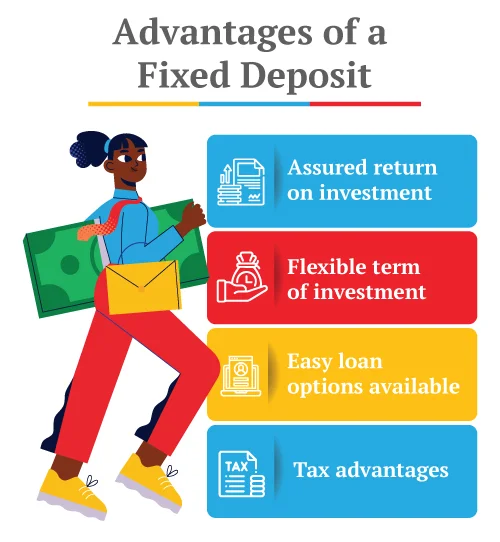
The benefits of FDs make them perfect investments to park your emergency funds. Here are the important benefits of fixed deposit investments:

  • Assured Return on Investment- The reason people invest their money in a fixed deposit is the guaranteed return on investments. Once you invest your capital in an FD (Fixed Deposit) account, you can be assured of getting the returns with a fixed rate of interest.

Banks and financial institutions regularly issue the fixed deposit rate of interest on their portal and in the branches of banks and financial institutions that makes it easier for investors to determine how much return they will receive.

In addition to this, banks and financial institutions further hold an FD interest calculator on their portals. An investor can determine the interest they will draw on investing a particular amount of money for a specific period.

  • Flexible Term- The term of investing in fixed deposit (FD) is resilient, and it entirely depends on the deposit holder to fix the term of their deposits. While every bank and financial institution holds its own minimum term rules, the deposit holder can exercise the ultimate decision. It is additionally conceivable to determine whether to extend the Fixed Deposit for the same term and redeem the fixed deposit.
  • Easy Loans- An FD is a great financial instrument that you can keep aside for meeting your financial emergencies. Apart from this, you can easily take a loan against your fixed deposit. You can get a loan of up to 95 percent of your accumulated FD amount, which may vary from bank to bank.
  • Tax Advantages- Interest or return you receive from your FD investments is exempted up to Rs 10,000 in one financial year. Apart from this, certain tax-saving fixed deposits have a lock-in period of 5 years and are exempted under section 80C of the Indian Income Tax Act, 1961 with up to relief of Rs. 1.5 lakhs.
  • Interest Rates- Fixed deposit interest rates are generally higher than the saving account interest. Also, FDs offer higher interest rates for longer-term investments and senior citizens. The interest rate on a fixed deposit is decided at the time of the deposit and remains fixed until maturity.
  • Secure Investment- A fixed deposit is a fixed-income debt instrument. Although the returns on FDs are lower than other investment options such as stocks, FDs offer the safety of the capital. Banks, post offices and NBFCs invest FD funds in government bonds and lending activities. Thus, the return on the deposit is safer than stocks.
  • Liquidity- FDs have high liquidity, as you can break the FD and withdraw funds anytime you want. You may receive a lower interest on the broken FD. However, breaking an FD is quite easy and you can receive your funds within one working day.

What Role FDs Play in your Financial Planning?

FDs can improve your financial planning by boosting your investment portfolio in several ways. The three most important aspects of including FDs in your portfolio are:

  • Offer Stability to your Portfolio-Safe and fixed ROI on fixed deposits allow FDs to add to the return stability of your investment portfolio. While your market-linked portfolio value will vary as per the market conditions, FD values will remain almost persistent.
  • Improved Asset Quality- Fixed deposits, especially long-term deposits are high-quality assets. You can borrow up to 80% of the FD value at a low rate of interest. Thus, FDs can also improve the quality of your asset portfolio.
  • Available in Short-Run- High liquidity and shorter terms of fixed deposits make it an ideal investment to fulfil short-term financial goals and offer emergency safety funds. FDs should be used for parking your emergency funds. Recurring deposits are easy ways to invest in your short-term goals.

Worried About Emergencies? Start Planning Now

Please enter correct name Please enter the Full name
Please enter valid mobile number Please enter Mobile Number
Please enter valid email Please enter Email

Enter OTP

An OTP has been sent to your mobile number

Didn’t receive OTP?

Application Status

Name

Date of Birth

Plan Name

Status

Unclaimed Amount of the Policyholder as on

Name of the policy holder

Policy Holder Name

Policy No.

Policy Number

Address of the Policyholder as per records

Address

Unclaimed Amount

Unclaimed Amount
Error

Sorry ! No records Found

.  Please use this ID for all future communications regarding this concern.

Request Registered

Thank You for submitting the response, will get back with you.

Disclaimer - This article is issued in the general public interest and meant for general information purposes only. The views expressed in this blog are solely those of the writer and do not necessarily reflect the official policy or position of Canara HSBC Life Insurance Company Limited or any affiliated entity. We make no representations or warranties of any kind, express or implied, about the completeness, accuracy, reliability, suitability, or availability with respect to the blog or the information, products, services, or related graphics contained in the blog for any purpose. Any reliance you place on such information is therefore strictly at your own risk. You should consult with a qualified professional regarding your specific circumstances before taking any action based on the content provided herein.


Recent Blogs

Why Does Liquidity Matter in Financial Planning?
02 Jan '26
1054 Views
8 minute read
Learn what liquidity means in financial planning, why easy access to funds is important, and how liquidity helps manage emergencies and short-term needs.
Read More
Financial Planning
What Is the Right Way to Start Investing in Your 20s?
28 Dec '25
1081 Views
10 minute read
Learn how to invest in your 20s by balancing risk, building good habits early, choosing the right assets and setting the foundation for long-term wealth.
Read More
Financial Planning
Why Financial Planning Is Important for Long-Term Security?
27 Dec '25
4909 Views
11 minute read
Learn why financial planning is important, how it helps manage income, expenses and risks, and why it is essential for achieving long-term life goals.
Read More
Financial Planning
Best Investment Plans for 5 Years in India 2026
27 Dec '25
1549 Views
8 minute read
Explore the best investment plans for 5 years that balance returns and risk, helping you meet medium-term financial goals with stability and smart planning.
Read More
Financial Planning
Net Present Value (NPV): Full Form, Meaning & Formula
26 Dec '25
3900 Views
10 minute read
Net Present Value (NPV) measures an investment's total value and profitability. Learn how NPV helps in investment planning with Canara HSBC Life Insurance.
Read More
Financial Planning
How Can You Calculate SIP Returns in India?
26 Dec '25
886 Views
8 minute read
Learn how to calculate SIP returns, understand expected vs actual returns, use formula or calculators, and plan investments effectively for long-term wealth creation.
Read More
Financial Planning
Internal Rate of Return (IRR): Meaning, Formula and Usage
24 Dec '25
3869 Views
10 minute read
Understand Internal Rate of Return (IRR), its meaning, and calculation formula. Learn how it measures investment performance with Canara HSBC Life Insurance.
Read More
Financial Planning
What Will Be The Value of Rs 1 Crore After 20 Years?
23 Dec '25
2927 Views
10 minute read
Find the actual value of Rs 1 Crore after 20 years. Why should you save Rs. 1 Crore, and how can you ensure a higher value for your wealth?
Read More
Financial Planning
How Can You Create a ₹1 Crore Corpus in 10 Years?
23 Dec '25
992 Views
8 minute read
Learn how to build a ₹1 crore corpus in 10 years using SIPs, asset allocation, return assumptions, discipline, and goal-based financial planning suited for Indian investors.
Read More
Financial Planning

Financial Planning - Top Selling Plans

We bring you a collection of popular Canara HSBC life insurance plans. Forget the dusty brochures and endless offline visits! Dive into the features of our top-selling online insurance plans and buy the one that meets your goals and requirements. You and your wallet will be thankful in the future as we brighten up your financial future with these plans.