Written by : Knowledge Centre Team
Last published : 2026-01-30
11 minutes read
Share
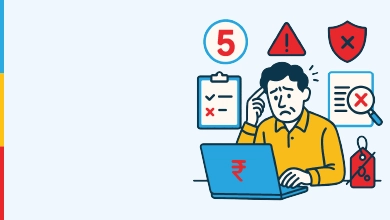
What’s your dream retirement looks like? Vacation home near a small beach town or hills perhaps? Probably, you’d like to roam around the world with your spouse, when your family responsibilities are over. You may even plan to move to a different city with your old friend circle. Quite possibly, you may not even have thought about it this deeply.
Whatever your post-retirement plans are, or will be, you need to address the challenge that comes before – retirement savings.
Retirement and pension plans are the second most important investments of your life after term life and health insurance plans. If you have been working for a while and are yet to get your first retirement plan, you must understand that opportunity of employment post-retirement age is minimal.
Meaning, if you make these five mistakes while buying a retirement plan, online or otherwise, you may increase your chances of missing your retirement goal:
Always remember, the early you start investing, the better growth you can expect on your money. Ideally, you should start planning for retirement with your first job or salary. If you did not the second-best time is now, and given the COVID situation, your best bet will be the online retirement plans.
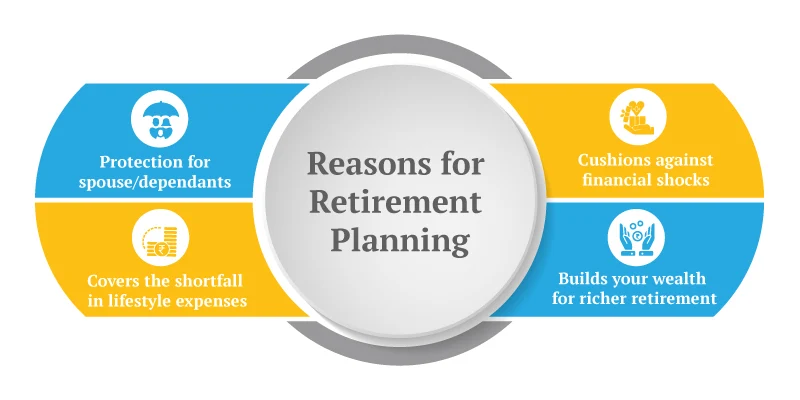
Time is the major factor deciding the king of funds you can have by the time you retire. For example, if you start investing Rs.5,000 at the age of 20, at an annual return of 12% you will have almost Rs. 6 crores by the time you reach 60.
You can also start investing Rs.10,000 at the age of 35 years. But, by the time you reach 60, you will only have about Rs. 2 crores in your pocket.
Since the rate of return on your investment is not in your control, the only two things you can really have in your hand are:
Since the amount also is dependent on your income, time is truly the only factor you can choose somewhat independently. Another way of looking at it is, ‘the earliest penny enjoys the best growth.’ So, be early with your online or offline retirement plan.
Another big challenge of retirement planning and investing is to estimate the amount of money you will need every month after you retire. The continuous career growth results in lifestyle upgrade and income growth. Hence, there is an obvious escalation in expenses.
However, post-retirement life will be somewhat different from your present lifestyle, especially if you are in your 30s. Post-retirement most of your expenses will revolve around the following heads:
Lifestyle expenses will also be there, but they are largely a minor part of your total expenses as you would have already built your household. Thus, you need to put a figure to these heads for your post-retirement expenses. Also, these monthly expenses will determine the size of your retirement corpus.
Another important thing to consider is a medical emergency. As you age your risk of landing in a hospital due to a health emergency or accident increases. However, your chances of having a health cover also decline. Hence, you must consider a medical emergency pool as part of your retirement goal.
Learn how life insurance is a key to happiness post-retirement.
Another mistake you would like to avoid while saving for your retirement is shortcutting the numbers for each expense head for post-retirement life. Wisdom says if you expect to spend 100, you should prepare for at least 110, as a little buffer is always better than no buffer at all.
For example, you surely need not pay for kids' education and their upbringing, but you will have to pay utility bills, medical bills, and the responsibility of being grandparents.
Another aspect of retirement is relocation. Many pensioners relocate to rural areas or a more peaceful setting, and nothing wrong if you want to move too. For example, you may retire from a city but plan to settle in a rural locality, away from the hustle and bustle of the crowd. Just, don’t make the mistake of missing out on major costs, such as:
One of the most difficult factors to consider in any financial plan is inflation. In the case of retirement planning this is due to two big reasons:
For example, the present inflation rate in India is about 4% p.a. However, over 30 years this may average out to be higher or lower than 4%. Once again, we should rely on the more conservative estimate for our goal. Thus, assuming a slightly higher inflation rate wouldn’t harm your retirement savings.
Also, in any case, you will find it easier to tone down your retirement investments later than to notch up.
Since retirement is a long-term goal the effect of these two erosions could be large on your savings unless you choose the correct investment options. Equity provides the best long-term growth option and can level or even best the erosion in a long run.
So, initially, a large part of your total investment should be in equity. In the later years, when you are close to retirement, you can systematically pull this money out and put it in debt. The best thing to do is to find investment plans that will make the switch automatically.
Such discipline in investment is necessary if you wish to achieve bigger financial goals. Fortunately, you have the option of plans like P4G, from Canara HSBC Life Insurance. This plan allows three portfolio management strategies for investment growth and one for the safety of corpus near maturity.
Retirement plans in India are a provision to earn a regular income post-retirement. You can buy a life insurance retirement plan while keeping the above giving tips to avoid mistakes while buying a retirement plan online.
An OTP has been sent to your mobile number

Sorry ! No records Found
Thank You for submitting the response, will get back with you.
Thank you for your interest in our product. Our financial expert will connect with you shortly to help you choose the best plan.
Disclaimer - This article is issued in the general public interest and meant for general information purposes only. The views expressed in this blog are solely those of the writer and do not necessarily reflect the official policy or position of Canara HSBC Life Insurance Company Limited or any affiliated entity. We make no representations or warranties of any kind, express or implied, about the completeness, accuracy, reliability, suitability, or availability with respect to the blog or the information, products, services, or related graphics contained in the blog for any purpose. Any reliance you place on such information is therefore strictly at your own risk. You should consult with a qualified professional regarding your specific circumstances before taking any action based on the content provided herein.







We bring you a collection of popular Canara HSBC life insurance plans. Forget the dusty brochures and endless offline visits! Dive into the features of our top-selling online insurance plans and buy the one that meets your goals and requirements. You and your wallet will be thankful in the future as we brighten up your financial future with these plans.