Written by : Knowledge Centre Team
Last published : 2025-08-02
12 minutes read
Share

While some things in life are inevitable, paying more tax than necessary doesn’t have to be one of them - especially if you make smart, timely investment choices. If you would also like to reduce your tax burden legally, you should work with the following tax-saving plans as much as possible.
There are three types of tax-saving investments based on which transactions are tax-exempt. Every investment has the following three types of transactions:
EEE stands for triple exemptions, where all the three transactions above are ‘exempt’ from tax. EET investment will have the first two transactions exempt, while the maturity value will be taxable. Similarly, ETT investments have only the first transaction as exempt. Thus, EEE investments are the most tax-efficient in the market. Fortunately, we have several of them available for investment.
An OTP has been sent to your mobile number

Sorry ! No records Found
Thank You for submitting the response, will get back with you.
Thank you for your interest in our product. Our financial expert will connect with you shortly to help you choose the best plan.
Unit linked insurance plans or ULIPs are the best tax-saving investment option in the market, due to the following reasons (apart from EEE status):
ULIPs like enable unprecedented safety for your financial goal. Once you have set the ULIP on the course towards your goal it can ensure that your family will meet those goals even if you are not there to see to it.
Also, ULIPs can offer one of the longest investment tenures and least bothersome portfolio management. You can set your investment strategies as per your risk appetite in the beginning and automate the investments. The ULIP will manage your portfolio according to the strategy and safeguard your returns as you approach maturity.
National Pension Scheme is one of the best retirement savings plan available in India. NPS Tier-I account offers great investment options along with tax benefits for employees and self-employed professionals.
The best part of NPS is, perhaps, the additional tax-saving opportunity of up to ₹ 50,000 under section 80CCD (1B). Thus, an NPS account can help you reduce your taxable income by up to ₹ 2 lakh in a financial year.
The only drawback of NPS is the long lock-in period for withdrawal. The account is specifically made for retirement and only opens for full withdrawal once you attain the 60 years of age.
Withdrawal is tax-exempt provided you convert 40% of the corpus into a pension. You can withdraw only 60% of the maturity value in a lump sum without increasing your tax liability.
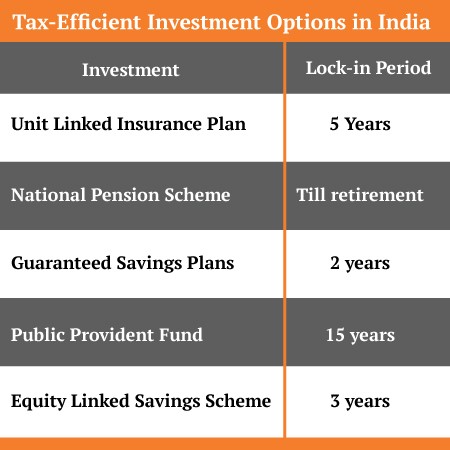
Guaranteed savings plans are another tax-efficient investment plan from the life insurance companies. These plans are similar to ULIPs for tax-exemption. That is maturity value is tax-exempt so far as your annual premium is less than 10% of the policy sum assured. The premiums up to ₹ 1.5 lakhs reduce your tax liability under Section 80C.
However, unlike ULIPs, guaranteed savings plans do not offer multiple fund options to investors. Instead, these plans offer a safe and fixed minimum return on the invested amount, apart from the life cover. Guaranteed savings plans are the best option for those financial goals, where you need to build a specific corpus without fail.
Also learn about - Fixed Income Investments options
Public Provident Fund is another popular long term saving option. The initial purpose of this investment was to help the self-employed and unorganised sector employees. However, it’s debt-market linked rate of return and EEE tax status have made it a popular investment option for long-term financial goals as well.
You need to invest money in PPF for at least 15 years, although the plan does allow partial withdrawal after 5 years. The only drawback of the PPF investment is perhaps the maximum amount you can invest in one financial year.
Maximum investment per financial year in an individual PPF account is limited to ₹ 1.5 lakhs. Also, the maximum limit is not counted based on the account but on the individual's earning . So, even though you can open PPF accounts in the name of your spouse and children you cannot deposit more than ₹ 1.5 lakh in total.
That is unless your spouse is also earning, filing a separate income tax return and operating her PPF account.
ELSS has been a popular tax saving scheme for aggressive investors. ELSS schemes are a tax-saving fund from the Indian mutual fund houses and are passively managed equity fund.
Passively managed means they maintain their portfolio as per a benchmark index, and do not actively trade in stocks. ELSS schemes have a strict lock-in period of 36 months. The lock-in period applies to every deposit you make in the same account separately.
For example, if you deposited ₹ 50,000 on 10th January 2016, you can withdraw the allocated units on this day after 9th January 2019. When you deposit another ₹ 50,000 in the same fund and account, on 18th March 2019, you can only sell these units after 17th March 2022.
ELSS funds are pure equity investments and if you want to move your earnings to a safer investment you need to wait for 36 months. After the lock-in period on the units is over you can sell the eligible units and invest the funds into a safer investment.
Also read - What is Net Present Value?
Disclaimer - This article is issued in the general public interest and meant for general information purposes only. The views expressed in this blog are solely those of the writer and do not necessarily reflect the official policy or position of Canara HSBC Life Insurance Company Limited or any affiliated entity. We make no representations or warranties of any kind, express or implied, about the completeness, accuracy, reliability, suitability, or availability with respect to the blog or the information, products, services, or related graphics contained in the blog for any purpose. Any reliance you place on such information is therefore strictly at your own risk. You should consult with a qualified professional regarding your specific circumstances before taking any action based on the content provided herein.






We bring you a collection of popular Canara HSBC life insurance plans. Forget the dusty brochures and endless offline visits! Dive into the features of our top-selling online insurance plans and buy the one that meets your goals and requirements. You and your wallet will be thankful in the future as we brighten up your financial future with these plans.