Written by : Knowledge Center Team
Last published : 2025-12-17
10 minutes read
Share
Taxes form the backbone of any nation’s economy, providing governments with the funds needed to develop infrastructure, deliver public services, and ensure economic stability. India’s taxation system is both comprehensive and diverse, encompassing direct taxes, like income tax and corporate tax, as well as indirect taxes such as the Goods and Services Tax (GST).
Among these, there exists a lesser-known yet equally significant provision: Tax Collected at Source (TCS).
This tax is collected by the seller from the buyer at the point of sale on specific goods and transactions, playing a vital role in ensuring compliance and steady revenue inflow. Wondering what exactly TCS means or how it is applicable? Worry not! This blog explores the details.
Key Takeaways
|
The meaning of Tax Collected at Source (TCS) is simple. It is a tax payable by a seller, which they collect from the buyer at the time of the sale of goods. Section 206C of the Income Tax Act mentions the list of goods on which the seller should collect tax from buyers.
The following goods and/or transactions are considered for Tax Collected at Source:
Timber wood obtained from a leased forest area
Tendu Leaves
Timber wood obtained from any mode other than leased
Forest produces (other than timber and Tendu leaves)
Scrap
Parking lot tickets, Toll Plaza, Mining and Quarrying
Minerals that include iron ore, lignite or coal
Bullion having a valuation of over ₹2 lakhs
Jewellery whose value exceeds ₹5 lakhs
Motor vehicle purchases over ₹10 lakhs
Newly notified luxury and lifestyle goods (such as certain high‑value watches, artworks, and collectables) notified under Section 206C(1F) after the April 2025 amendments.
With recent amendments, the scope of TCS has been expanded to cover certain luxury and lifestyle goods as well, in addition to traditional specified goods and minerals.
The TCS rates for various goods and transactions are listed in the table below
Kindly note that the interest charges for any late payment of the TCS are 1% for every month delayed.
| Type of Goods | Existing TCS Rate For FY 2025-26 (in %) |
|---|---|
| Liquors of alcoholic nature, including IMFL (Indian Made Foreign Liquor) that are deemed for human consumption | 1.00 |
| Timber wood obtained from a leased forest area | 2.50 |
| Tendu leaves | 5.00 |
| Timber wood obtained from any mode other than leased | 2.50 |
| Forest produces (other than timber and tendu leaves | 2.50 |
| Scrap | 1.00 |
| Parking lot tickets, toll plaza, mining and quarrying | 2.00 |
| Minerals that include iron ore, lignite or coal | 1.00 |
| Bullion having a valuation of over ₹2 lakhs or jewellery whose value exceeds ₹5 lakhs | 1.00 |
| Purchase of a motor vehicle exceeding ₹10 Lakhs | 1.00 |
Meanwhile, TCS on the sale of goods exceeding ₹50 lakhs under Section 206C(1H) has been removed effective from April 1, 2025.
Note: Effective from 1st April 2025, Sections 206AB and 206CCA, which previously mandated higher TDS/TCS rates for non-filers of income tax returns, have been omitted. This means sellers are no longer required to collect higher TCS from specified non-compliant buyers.
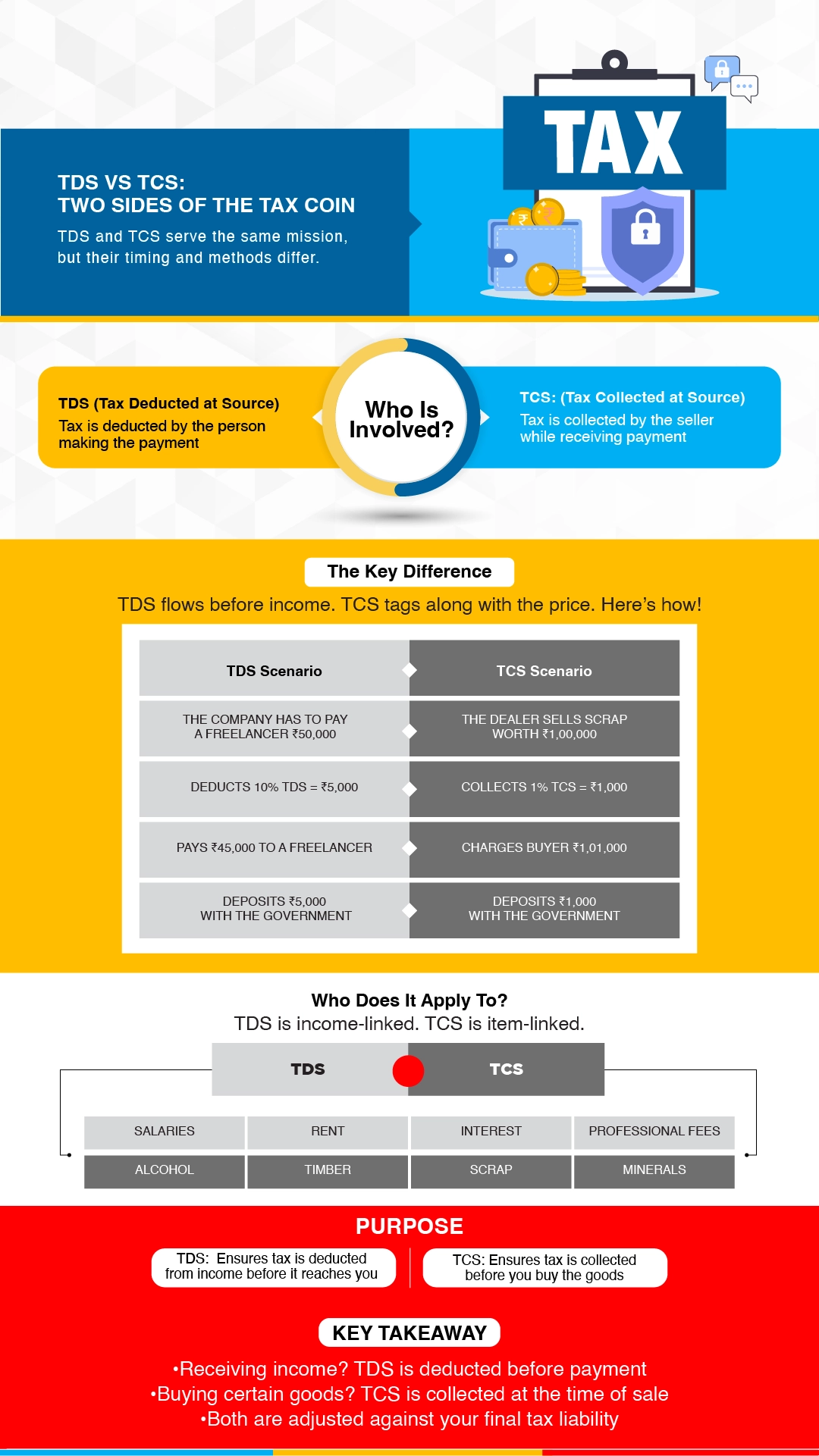
TDS (Tax Deducted at Source) and TCS (Tax Collected at Source) are both methods of tax collection, but they serve different purposes.
TDS is deducted by the payer while making payments to the recipient (e.g., salary, professional fees)
TCS is collected by the seller at the time of sale of specified goods (e.g., scrap, minerals)
While TDS ensures tax is deducted at the source of income, TCS ensures tax is collected at the point of sale, affecting different entities in a transaction.
Understanding TCS, its exemptions, compliance requirements, and penalties is essential for businesses and buyers. Proper adherence to tax laws can help avoid unnecessary interest charges and legal complications. By ensuring timely payments and maintaining accurate documentation, businesses can efficiently manage their TCS obligations and contribute to a seamless tax process. and with GST no longer applied on individual term insurance premiums, this is also a favourable time to explore affordable, protection-focused plans from insurers such as Canara HSBC Life Insurance.
TCS full form is Tax Collected at Source. It is a mechanism under the Indian Income Tax Act where specified sellers collect tax from buyers at the time of making certain sales or carrying out specified transactions.
Yes, if your total tax liability is lower, you can claim a refund while filing your ITR.
Sellers specified under Section 206C of the Income Tax Act must collect TCS.
Yes, buyers can adjust the TCS paid against their total income tax liability.
Current TCS rates for FY 2025-26 :
Liquors of alcoholic nature, including IMFL, for human consumption: 1%
Timber wood obtained from a leased forest area: 2.5%
Tendu leaves: 5%
Timber wood obtained by any mode other than leased: 2.5%
Forest produce (other than timber and tendu leaves): 2.5%
Scrap: 1%
Parking lot tickets, toll plaza, mining and quarrying: 2%
Minerals including iron ore, lignite or coal: 1%
Bullion over ₹2 lakh and jewellery over ₹5 lakh: 1%
Purchase of a motor vehicle exceeding ₹10 lakh: 1%
Under Section 206C (as reflected in your blog content and recent changes), TCS currently applies to the following main goods and transactions:
Alcoholic liquor for human consumption (including IMFL)
Timber obtained from a forest (whether from a leased area or by any other mode)
Tendu leaves
Any other forest produce (excluding timber and tendu leaves)
Scrap
Parking lot, toll plaza, mining and quarrying contracts
Certain minerals, such as coal, lignite and iron ore
Bullion valued above ₹2 lakh
Jewellery valued above ₹5 lakh
Purchase of a motor vehicle exceeding ₹10 lakh
Newly notified luxury / lifestyle goods (such as certain high-value watches, art items, etc.) were covered under Section 206C(1F) after the April 2025 amendments.
Separately, TCS on sale of goods exceeding ₹50 lakh under Section 206C(1H) has been removed with effect from 1 April 2025, so that specific provision no longer applies.
You can claim TCS credit while filing your ITR in a few simple steps:
Check that the TCS collected is correctly reflected in your Form 26AS / AIS against your PAN.
While filing your income tax return, go to the “Taxes Paid / TDS & TCS” or “Schedule TCS” section and ensure the TCS amounts (as per Form 27D / Form 26AS) are prefilled or entered correctly.
The TCS will be adjusted against your total tax liability; if total TCS and TDS exceed your final tax payable, the excess will be issued to you as an income tax refund, credited to your bank account after the return is processed
Yes. TCS is collected on:
Foreign remittances under the Liberalised Remittance Scheme (LRS), once your total remittances in a financial year cross the applicable threshold.
Overseas tour packages, where TCS is charged by the tour operator on the package amount at prescribed slab-based rates
If you don’t provide your PAN (or Aadhaar) to the seller collecting TCS, they must apply a higher TCS rate to your transaction. This means more tax will be collected upfront, and while you can still claim a credit/refund later through your income tax return, your immediate cash outflow will be higher.
Disclaimer - This article is issued in the general public interest and meant for general information purposes only. The views expressed in this blog are solely those of the writer and do not necessarily reflect the official policy or position of Canara HSBC Life Insurance Company Limited or any affiliated entity. We make no representations or warranties of any kind, express or implied, about the completeness, accuracy, reliability, suitability, or availability with respect to the blog or the information, products, services, or related graphics contained in the blog for any purpose. Any reliance you place on such information is therefore strictly at your own risk. You should consult with a qualified professional regarding your specific circumstances before taking any action based on the content provided herein.

We bring you a collection of popular Canara HSBC life insurance plans. Forget the dusty brochures and endless offline visits! Dive into the features of our top-selling online insurance plans and buy the one that meets your goals and requirements. You and your wallet will be thankful in the future as we brighten up your financial future with these plans.
