Disability Term Insurance for Self Employed

Disability Term Insurance for Self-Employed Professionals

Learn how disability and term insurance can protect your income and family if you're self-employed.

Written by : Knowledge Centre Team

2025-10-10

1091 Views

8 minutes read

There are many benefits of being your own boss. You get to make all sorts of choices for yourself and your work. However, there are many risks and challenges of being self-employed. You may have a family to take care of, and with no fixed guaranteed income, it could be challenging at times.

Also, you do not have savings schemes like the provident fund to secure your future and group health plans to provide you coverage during medical emergencies. For these reasons, self-employed people must make additional efforts to protect themselves and their loved ones from life's uncertainties.

Key Takeaways

  • Disability insurance is crucial for self-employed individuals who lack employer-provided benefits like PF and health coverage.

  • It offers income protection during recovery from an accident or illness that causes temporary or permanent disability.

  • Disability cover is available as standalone insurance or as a rider with term and critical illness insurance plans.

  • A term insurance plan with disability, accidental, and critical illness riders ensures holistic protection.

  • Setting up contingency funds, assigning policies under the MWP Act, and creating trusts for dependents further strengthen financial security.

What is Disability Insurance?

Disability Insurance is an insurance cover that offers financial support in case you suffer from a physical disability. Disability for the insurance has been defined as follows:

  • Loss of one or more limbs, i.e., hands, arms, feet, or legs

  • Loss of a sensory capacity, for example, hearing, speech, and vision in one eye or both

Disability can happen due to an accident or medical reasons, and can be permanent or temporary. A comprehensive disability cover will cover most disabilities.

Also Read - Short term vs Long term Disability Insurance

Get the Best Term Insurance Plan for Your Needs

Please enter correct name Please enter the Full name
Please enter valid mobile number Please enter Mobile Number
Please enter valid email Please enter Email

Enter OTP

An OTP has been sent to your mobile number

Didn’t receive OTP?

Application Status

Name

Date of Birth

Plan Name

Status

Unclaimed Amount of the Policyholder as on

Name of the policy holder

Policy Holder Name

Policy No.

Policy Number

Address of the Policyholder as per records

Address

Unclaimed Amount

Unclaimed Amount
Error

Sorry ! No records Found

.  Please use this ID for all future communications regarding this concern.

Request Registered

Thank You for submitting the response, will get back with you.

Why Disability Insurance is Important for Self-Employed Professionals?

Disability insurance is an important safety cover for the self-employed. While you may enjoy the freedom and flexibility that comes with working for yourself, life can take an unexpected turn. Imagine meeting with an accident on your way back from a client visit and injuring your arm or leg. Suddenly, you're unable to work, and your income stops, even as expenses continue to pile up.

As a result, you cannot work, and your income flow stops. At the same time, your medical bills will continue to rise, and your regular financial obligations will not wait. It is a tricky situation to face.

You can effectively manage such a situation with a Disability Insurance cover. Disability Insurance can help you:

  • Secure yourself and your loved ones

  • Cover essential living expenses during recovery

  • Relieve financial stress so you can focus on healing

  • Benefit from tax deductions on the premiums paid

How to Find the Right Disability Insurance for Self-Employed Professionals?

You can avail of disability insurance cover under accidental cover and critical health insurance covers. Both of these covers are available as riders and as standalone policies.

The best way to have these covers is to add them to your term life insurance cover. This way, they are more manageable, and you can avail of additional benefits too.

Other Important Insurance for Self-Employed Professionals

You cannot predict the future, but you can prepare yourself for unexpected life events by having different insurance as a self-employed individual. Below are some of the must-have insurance covers for the self-employed:
  • Term Insurance Policy: It is the simplest and purest form of life insurance. In case of an unfortunate event of your death, your nominee will receive a sum assured that will secure the future of your loved ones. Being self-employed, having term insurance with additional benefits would be a better option. Look for term insurance with:

    1. Long-Term Coverage: Online term insurance plans like iSelect Smart360 from Canara HSBC Life Insurance offer life cover till 99 years of age
    2. Regular Income Option: You and your family need a stable, regular income. So, look for a term plan which gives the following options:

      • Regular income after 60 to you
      • Pay out of death benefit as regular income to your family

        iSelect Smart360 Term Plan by Canara HSBC Life Insurance releases 0.1% of the base sum assured as regular income once you become 60. The income will continue till the expiry of the plan of your demise.
    3. Critical Illness: If you are diagnosed with a critical illness, your income will be affected. Hence, look for a plan that gives you the option of no future premiums if diagnosed with a critical illness.
    4. Accidental Death & Disability: You get an additional lump sum payment if diagnosed with a critical illness or accidental total & permanent disability to take care of your immediate needs.
    5. Child Support Rider: You should secure your child's future under all circumstances. Look for a term insurance plan that comes with child care benefits.
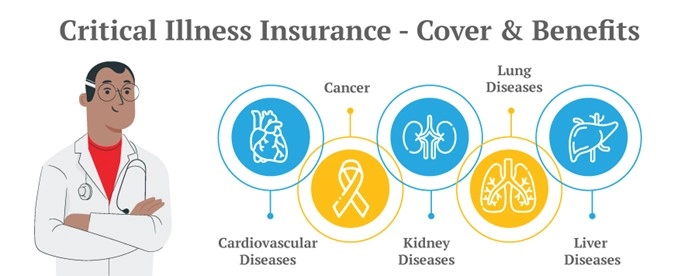
  • Health Insurance: A major illness doesn’t just impact your health but can also disrupt your income. Conditions like cancer, heart attack, or kidney failure often require expensive treatments and extended recovery periods.
    While a standard health insurance plan covers hospitalisation costs, it may not cover all out-of-pocket expenses like home care, travel, or loss of income. Critical Illness Insurance offers a lump-sum payout upon diagnosis of a listed critical illness, helping you manage treatment costs, household expenses, or any other financial needs during recovery.
    For broader protection, it's wise to choose a health insurance plan that includes or allows add-ons for critical illness coverage.

    1. Health Insurance Benefits: The medical treatment cost is high in India, and health problems can affect anyone in the family. All your family members must be covered under health insurance. Buying separate plans may be costly, and hence, you should buy a family health insurance plan - it is affordable.

      • Short-Term Plans: These plans have a policy tenure of one year and are good if you plan to port your health insurance plan.
      • Long-Term Plans: The policy tenure is between 2 to 5 years for such health insurance plans. The biggest benefit is that you don't have to worry about frequent renewal. You are eligible for discounts on the premium you need to pay. Also, you get more benefits from long-term plans.

How to Strengthen Your Financial Safety as a Self-Employed Professional?

As a self-employed individual, you can solidify your financial safety by incorporating the following practices in your journey:

  • Get an Insurance Cover: Make sure you have both life and health insurance plans in place, and that they’re active. Whether it’s term life, critical illness, or family health coverage, these policies form the foundation of your financial safety net. If you have short-term plans, renew them before they expire. And always pay your premiums on time to avoid losing coverage when you need it most.
  • Build a Contingency Fund: As you do not have a regular and guaranteed income, it is of utmost importance that you have a contingency fund for unexpected events like medical emergencies or revenue delays from a business. You should have contingency funds of 6 to 12 times your monthly expenses.
  • Have a Life Policy Under MWP: Ensure that in case of an unfortunate event, the benefits of term insurance go only to your wife and children. You can assign life insurance policies under the Married Women's Property (MWP) Act. Under this Act, only your wife and children are entitled to the sum assured in case of your death. The policy under MWP cannot be attached to lender payments by courts.
  • Pool Money Under a Trust for Children: Have the provision of trust if you need to ensure the financial safety of your child or a dependent relative. One goal you cannot compromise on is your child's future, and hence, you should pool money for your children under a trust. Until your children mature enough to manage wealth, the trust will ensure they receive the money as and when needed if you are not around.

Wrapping Up

Being self-employed comes with unmatched freedom, but it also brings significant responsibilities. From running your business and managing household expenses to planning for future uncertainties, you juggle many roles each day. And when you are handling everything on your own, having a financial safety net becomes essential.

One practical way to enhance this security is by selecting a term insurance plan that allows you to pay the death benefit as a regular income instead of a lump sum. This can help your family manage ongoing expenses comfortably, without the pressure of handling a large payout all at once.

Whether you are a freelancer, an entrepreneur, or running a small setup, protecting yourself does not have to be complicated. By making timely decisions about insurance, renewing plans on schedule, and paying your premiums regularly, you can secure both your present and your future.

Stay mindful and take simple steps to protect the life you are building.

Disclaimer - This article is issued in the general public interest and meant for general information purposes only. The views expressed in this blog are solely those of the writer and do not necessarily reflect the official policy or position of Canara HSBC Life Insurance Company Limited or any affiliated entity. We make no representations or warranties of any kind, express or implied, about the completeness, accuracy, reliability, suitability, or availability with respect to the blog or the information, products, services, or related graphics contained in the blog for any purpose. Any reliance you place on such information is therefore strictly at your own risk. You should consult with a qualified professional regarding your specific circumstances before taking any action based on the content provided herein.
Recent Blogs