Types of Disability Insurance | Term Insurance Plans with Disability Cover

What are the Different Types of Disability Insurance?

Explains the main types of disability insurance, how benefits are paid, and when such cover is needed to protect income after an accident or illness.

2025-02-02

898 Views

5 minutes read

Financial management during a disability is crucial to ensure a stable income and savings to rely on. It's important to prioritise essential expenses and build an emergency fund beforehand, which can ease the pressure.

This is where disability insurance steps in to lend a strong layer of protection. From making home modifications and adjusting daily routines to managing new commuting needs, these changes can lead to unexpected costs. In more serious cases, you may even need to take a break from work or explore a different career path altogether.

Therefore, to ensure your financial stability, different types of disability insurance are available.

Let us learn more about how you can focus on recovery with thoughtful planning and the right coverage.

Key Takeaways

  • Disabilities are classified as total, partial, temporary, or permanent, based on their impact.

  • Disability insurance can provide regular monthly benefits, as well as lump-sum payouts.

  • Assess your health risks and financial liabilities before choosing the right disability insurance.

  • Opt for increasing coverage plans to match rising medical costs during prolonged conditions.

  • Premium waiver options help reduce the financial burden when disability affects payment capacity.

What is Disability Insurance?

A person is disabled when they have a mental or physical impairment, and the impairment has a substantial effect on their ability to carry out day-to-day activities. This can result in temporary loss of income, reduced income, or permanent financial dependency. Disability insurance is a protection against the above financial situations.

Since you cannot do your daily activities, you also won't be able to go to work. Based on the type of disability insurance, what coverage can do for you is:

  • Replace a portion of your income when you are unable to work because of disability, or

  • Pay a lump sum amount so that you can meet your medical and household needs

The monthly income helps you meet your regular financial needs and maintain your current lifestyle, while the lump sum is useful for the treatment and other large liabilities.

Get the Best Term Insurance Plan for Your Needs

Please enter correct name Please enter the Full name
Please enter valid mobile number Please enter Mobile Number
Please enter valid email Please enter Email

Enter OTP

An OTP has been sent to your mobile number

Didn’t receive OTP?

Application Status

Name

Date of Birth

Plan Name

Status

Unclaimed Amount of the Policyholder as on

Name of the policy holder

Policy Holder Name

Policy No.

Policy Number

Address of the Policyholder as per records

Address

Unclaimed Amount

Unclaimed Amount
Error

Sorry ! No records Found

.  Please use this ID for all future communications regarding this concern.

Request Registered

Thank You for submitting the response, will get back with you.

What are the Four Types of Disability Insurance?

Disability insurance comes in different forms to match various needs and life situations. They offer a unique way to protect your income when illness or injury prevents you from working. The two main types of disability insurance are:

  • Short-term Disability Insurance: Short-term disability insurance plans have a waiting period of 0 to 14 days. It allows a maximum benefit period of up to two years. This type of insurance can be incredibly useful if you are recovering from a surgery or a serious injury that puts you out of work for a few weeks or months. Take the case of Priya, a marketing executive who underwent a knee surgery. Her short-term disability plan helped her pay rent, bills, and EMIs while she focused on recovery without added stress.
  • Long-term Disability Insurance: Long-term disability insurance plans can have a waiting period ranging from several weeks to months. Its benefit can last for a few years, or you can also get coverage for a lifetime. Moreover, depending on the plan, you may receive payments for a few years or continue to receive income support until retirement. 

    Consider someone like Arjun, a teacher who developed a chronic nerve disorder. His long-term plan enabled him to manage everyday expenses and continue physiotherapy even after permanently stepping away from work. These plans create a safety net so you are not left vulnerable during life's unexpected health turns.
  • Accidental Disability Insurance: A disability that arises due to an accident is covered under these insurance plans. Under this, you get a certain percentage of the sum covered depending on your insurance plan. Even if it is a temporary loss of mobility or a permanent condition that alters your ability to work, having coverage ensures that your income is not entirely wiped out. 

    For instance, someone in their mid-thirties who lost partial mobility in a road accident was able to manage home expenses and rehabilitation costs with the help of their disability cover. It offered not just money but also time to heal and adapt without the pressure of rushing back to work.
  • Critical Illness Insurance: These plans provide a wide range of cover against specific life-threatening diseases like cancer, stroke, kidney failure, etc., that impact your day-to-day work. What makes critical illness insurance even more powerful is its lump sum payout. This means the moment you are diagnosed with a covered illness, the payout is made, regardless of hospital bills or treatment costs. The financial flexibility received helps take a break from work to focus on recovery. 

    For example, Parth, a salesperson, was diagnosed with early-stage cancer. Now, he used the payout to seek advanced treatment in another city. It only improved his recovery chances and reduced the financial stress on the family. With medical expenses rising, this type of insurance gives peace of mind when life takes an unexpected turn.

What are the Types of Disabilities Covered Under Insurance?

Insurers classify disabilities based on the magnitude of the impact it has on your regular and earning activities. Below are the different types of disabilities classified in insurance plans:

  • Permanent Total Disability: It is a state where you cannot work due to prolonged illness or bodily injury caused by an accident. The disability could be a loss of eyesight, speech, or limbs.
  • Permanent Partial Disability: It results from an injury or illness that is semi but not fully disabling. Under this, the person can perform some but not all of their ordinary work functions. Alternatively, they can perform their work activities at a partial capacity rather than full capacity. Some examples include loss of one finger, loss of one leg, and loss of hearing in one ear, among others.
  • Temporary Partial Disability: When you suffer an injury and can only return to a modified version of your job, it comes under temporary partial disability. It also includes a situation where you can return to another job that involves extremely light work.
  • Total Paralysis: It occurs when you cannot move your paralysed muscles at all. Paralysis can occur in a limb or multiple limbs. The worst case of paralysis could be that the body itself is paralysed and bedridden. Your insurance may treat double limb paralysis as permanent total disability.
Disability Insurance – TypeWhat is it?
Accidental Disability InsuranceA disability that arises due to an accident is covered under these insurance plans. Under this, you get a certain percentage of the sum covered depending on your insurance plan.
Critical Illness InsuranceThese plans provide a wide range of cover against specific life-threatening diseases like cancer, stroke, kidney failure, etc that impact your day-to-day work.
Short-Term Disability InsuranceThese cover you for a limited time. The waiting time for most short-term disability insurance is 14 days, and benefits are limited to a maximum of two years. You continue to receive benefits until you have recovered or exhausted the coverage amount.
Long-Term Disability InsuranceUnder this insurance plan, you can continue to receive benefits for a few years or your entire life. The waiting period can be a few weeks to months.

How does Disability Insurance Work?

When you opt for disability insurance, you get cover for disabilities as per your disability plan. The disability insurance works as below:

  1. You make regular premium payments to keep your policy active.
  2. During the policy tenure, if you suffer from a disability due to an accident or illness, the insurance company will pay you an amount based on the severity of the disability. For example,
    • Loss of two limbs or any condition which falls into Permanent Total Disability will attract a 100% sum assured payment.
    • Loss of one limb or permanent partial disability can result in payment of up to 50% of the sum assured.
  3. Comprehensive disability policies may also pay you a monthly benefit in the case of Temporary Total Disability.
  4. The best disability insurance plans offer increasing cover for the claim-free years. That means, your sum assured will keep growing until one of the following occurs:
    • The policy expires
    • You file a claim
    • The sum assured reaches the ceiling allowed under the policy (usually 200% of the base sum assured)

How to Choose the Right Disability Insurance?

There are many options when it comes to selecting disability insurance. The first step is to assess your situation. Before buying disability insurance, consider your liabilities and evaluate your family's financial situation. Based on the data, determine the appropriate coverage level you will need, and then start to look for disability insurance.

Below are a few things you should look for in a disability insurance plan:

  1. Unhindered Coverage: Your ideal disability insurance will cover disabilities from any insurable cause, i.e., accident, illness, etc.
  2. Premium Waiver Option: It is better to add your disability cover to a term life insurance. It will allow you to benefit from the premium waiver option. Meaning that once the insurer accepts your disability claim, your remaining life cover premiums will be waived.
  3. Receive a Lump Sum Amount: Choose a plan that offers you a lump sum payment and regular income benefits. While a lump sum amount helps you meet your treatment and lifestyle change costs, the regular income can take care of the household budget.
  4. Increase Coverage Option with Time: In a disability condition, your medical needs may increase with time. Hence, look for insurance that comes with an increasing coverage option to take care of increasing medical costs.

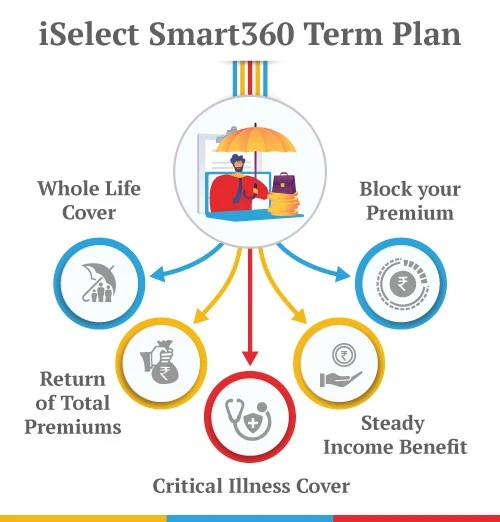
iSelect Smart360 Term Plan by Canara HSBC Life Insurance is an online comprehensive term insurance plan that offers life cover till 99 years, along with disability cover. Future premiums will be waived off if the policyholder is diagnosed with a critical illness or in case of accidental total and permanent disability, if opted for.
Conclusion

Having adequate insurance, like term and health insurance, is a must for your savings plan. However, there are specific life events that can completely overtake your planning. Hence, it is essential to consider insurance coverage for specific situations..

By understanding the types of disability insurance, you can begin investing a small amount in these insurances. They help you with solid financial safety for your loved ones and enable you to enjoy your life without worrying about unexpected life events.

To make that sense of security even more real, you can explore our insurance plans. With thoughtfully designed plans that include critical illness and disability coverage, at Canara HSBC Life Insurance, you are building a future where uncertainties do not take centre stage. Let your financial strategy reflect the same care you have for your loved ones.

Disclaimer - This article is issued in the general public interest and meant for general information purposes only. The views expressed in this blog are solely those of the writer and do not necessarily reflect the official policy or position of Canara HSBC Life Insurance Company Limited or any affiliated entity. We make no representations or warranties of any kind, express or implied, about the completeness, accuracy, reliability, suitability, or availability with respect to the blog or the information, products, services, or related graphics contained in the blog for any purpose. Any reliance you place on such information is therefore strictly at your own risk. You should consult with a qualified professional regarding your specific circumstances before taking any action based on the content provided herein.

Recent Blogs