Written by : Knowledge Centre Team
2025-11-02
1353 Views
12 minutes read
Share

NPS and PPF are two popular retirement savings schemes in India. Both offer income tax benefits and are long-term investment options.
National Pension System (NPS) was introduced in India on 1st January 2004 to provide old-age income security to all citizens of the country. It is a defined contribution pension scheme where the central Government, state government, private sector employees, and even self-employed professionals can open an account.
PPF scheme was introduced in India in 1968 to encourage small savings by offering a safe and secure investment option with attractive interest rates. The scheme is administered by the Central Government and is currently available through select banks and post offices.
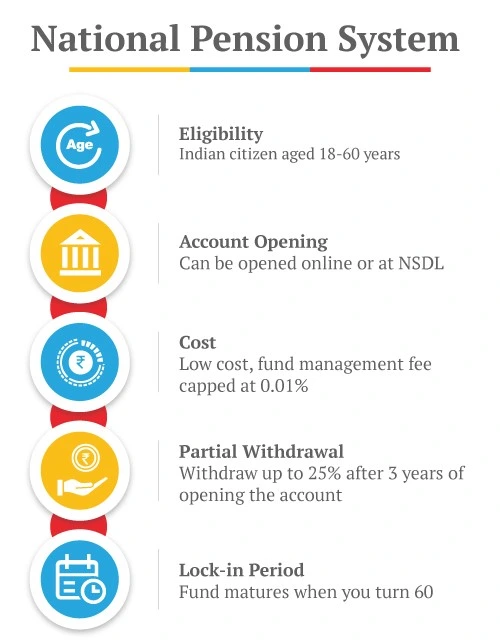
The National Pension Scheme (NPS) is a retirement savings scheme introduced by the Government of India. NPS account can be opened by any Indian citizen between the age of 18 and 60.
The scheme offers two investment options:
Tier I account is a non-withdrawable account (until the age of 60) while a Tier II account is a voluntary, withdrawable account.
Also Visit - How to Invest in NPS?
An OTP has been sent to your mobile number

Sorry ! No records Found
Thank You for submitting the response, will get back with you.

| NPS Tier-I Account | PPF Deposits |
|---|---|
| Market-linked investment | Fixed-income investment |
| Lock-in until retirement or the age of 60 | PPF has a lock-in period of 5 years before partial withdrawal |
| Multiple asset allocation options | One standard account |
| Invest in Equity, Corporate Bonds, Government Securities | Invest in a single account that gives guaranteed and fixed returns |
| Better suited for retirement savings | Suitable for any long-term goal and financial safety of family |
| Additional tax benefit of up to Rs 50,000 on additional self-contribution (total deduction up to Rs 2 lakhs) | The total tax deduction benefit is limited to Rs 1.5 lakhs |
| Can be attached by a court of law and CBDT against personal debt, income tax dues | Cannot be attached by a court of law. Only CBDT can attach the PPF balance against income tax dues |
| Can be opened only in the name of the contributor | You can open in the name of a family member or minor, except your total contribution should remain below Rs 1.5 lakhs |
| NRIs can invest in NPS Tier-I account | NRIs cannot invest money in PPF |
| No loan facility from the NPS account against your balance | You can take a loan from your PPF balance from the third to fifth financial year of the account |
| You can invest in NPS up to the age of 70 years | You can extend PPF accounts for a lifetime in batches of 5 years after maturity with or without the contribution |
| At maturity, you can withdraw only 60% corpus tax-free | The entire fund value is tax-free at maturity |
| Your employer can also contribute to your NPS account | Only you can contribute to your PPF account |
National Pension Scheme (NPS) and Public Provident Fund (PPF) are two of the most popular investment schemes in India. The NPS is a defined contribution pension scheme whereas the PPF is a defined benefit pension scheme. Under the NPS, the investor has to contribute a fixed sum of money every month towards his pension fund. The amount of pension received by the investor depends on the performance of his investment portfolio.
NPS offers more flexibility to the investor in terms of investment options. The investor can choose to invest in any of the four asset classes – equity, debt, government securities and corporate bonds.
Historical Returns
NPS returns are linked to the market and your asset allocation choices. On the other hand, PPF returns are declared by the central government every quarter.
Returns of NPS and PPF are shown in the table below:
| Period | NPS* | PPF |
|---|---|---|
| 1 Year | 14% | 7.1% |
| 3 Years | 7.9% | 7.35% |
| 5 Years | 10.3% | 7.61% |
* As on October 2022. Returns are subject to market risk and performance.
Historical performance shows that NPS offers higher returns than PPF, but the returns are not guaranteed. PPF offers guaranteed returns, but the long-term returns have been lower than NPS.
Both PPF and NPS Tier 1 accounts enjoy protection from attachment by creditors for recovery of debts. However, Tier 2 accounts are liable and can be attached.
NPS accounts are designed to mature when you turn 60. If you withdraw before you turn 60, you are allowed to withdraw only 20% of the amount. The balance has to be converted into annuities. PPF allows partial withdrawals on completion of 7 years and full withdrawals at the end of 15 years. Therefore, PPF is the obvious choice.
Yes, you can. According to current RBI guidelines, you can have both.
Withdrawal of NPS and PPF The NPS scheme allows a partial withdrawal of funds after 10 years of investment. After 60 years, the account holder can withdraw 100% of the funds from the scheme. The PPF scheme allows partial withdrawal from the account after the completion of 7 years. After 15 years, the account holder can withdraw the entire money from the saving scheme.
No investment is completely safe and there is always a certain amount of risk associated with any investment. However, one of the best ways to reduce risk and increase safety is to diversify one's investment portfolio.
This means implies investing in diverse asset classes, such as stocks, bonds, and real estate. When you spread out investments, it is less probable that any one investment will suffer a huge loss. Additionally, diversification can also help to smooth out overall returns, which can make investing less volatile.
Historical performance shows that NPS offers higher returns than PPF, but the returns are not guaranteed. PPF offers guaranteed returns, but the long-term returns have been lower than NPS.
Both PPF and NPS Tier 1 accounts enjoy protection from attachment by creditors for recovery of debts. However, Tier 2 accounts are liable and can be attached.
NPS accounts are designed to mature when you turn 60. If you withdraw before you turn 60, you are allowed to withdraw only 20% of the amount. The balance has to be converted into annuities. PPF allows partial withdrawals on completion of 7 years and full withdrawals at the end of 15 years. Therefore, PPF is the obvious choice.
Yes, you can. According to current RBI guidelines, you can have both.
Disclaimer - This article is issued in the general public interest and meant for general information purposes only. The views expressed in this blog are solely those of the writer and do not necessarily reflect the official policy or position of Canara HSBC Life Insurance Company Limited or any affiliated entity. We make no representations or warranties of any kind, express or implied, about the completeness, accuracy, reliability, suitability, or availability with respect to the blog or the information, products, services, or related graphics contained in the blog for any purpose. Any reliance you place on such information is therefore strictly at your own risk. You should consult with a qualified professional regarding your specific circumstances before taking any action based on the content provided herein.








We bring you a collection of popular Canara HSBC life insurance plans. Forget the dusty brochures and endless offline visits! Dive into the features of our top-selling online insurance plans and buy the one that meets your goals and requirements. You and your wallet will be thankful in the future as we brighten up your financial future with these plans.