


E-Verification of Income Tax Return

E-Verify Your Income Tax Return (ITR)

E-verification of ITR is mandatory to validate your return. Learn deadlines, methods, & consequences of missing income tax e-verification.

Written by : Knowledge Centre Team

2026-01-08

1369 Views

11 minutes read

Filing your Income Tax Return (ITR) is only half the job done. To complete the process, income tax return verification is mandatory. Without e-verification, even a correctly filed return is treated as invalid, meaning it is as good as not filed at all.

Understanding the ITR e-verification deadline, available methods, and consequences of missing timelines can save you penalties, delays in refunds, and unnecessary stress.

Key Takeaways

  • Filing an income tax return is incomplete without income tax return verification, making e-verification mandatory

  • The ITR e-verification deadline is 120 days for timely filings and 30 days for belated returns

  • Multiple options like Aadhaar OTP, net banking, EVC, and DSC make it easy to e-verify ITR online

  • If the return is not e-verified within the allowed period, it becomes invalid and is treated as not filed

  • Timely ITR filing and e-verification help avoid penalties and ensure faster processing of refunds

Maximize Your Tax Savings - Talk to an Expert

Please enter correct name Please enter the Full name
Please enter valid mobile number Please enter Mobile Number
Please enter valid email Please enter Email

Enter OTP

An OTP has been sent to your mobile number

Didn’t receive OTP?

Application Status

Name

Date of Birth

Plan Name

Status

Unclaimed Amount of the Policyholder as on

Name of the policy holder

Policy Holder Name

Policy No.

Policy Number

Address of the Policyholder as per records

Address

Unclaimed Amount

Unclaimed Amount
Error

Sorry ! No records Found

.  Please use this ID for all future communications regarding this concern.

Request Registered

Thank You for submitting the response, will get back with you.

Timeline to File ITR

The deadline is set by the income tax department and implies you don't have to pay any penalty if you file your return before this date. This deadline is called the due date for filing income tax returns. However, if you miss the deadlines, late fees and interest may apply.

ITR Filing Due Date for Different Taxpayers:

For FY 2025-26 (Assessment Year 2026-27), taxpayers who are not subject to audit must file their income tax returns by 31 July 2026. Filing within the due date allows you to claim eligible deductions, exemptions, and losses. If this deadline is missed, you still have the option to submit a belated return up to 31 December 2026, though additional interest and late filing penalties may apply.

Income Tax Return Due Dates for FY 2025–26 (AY 2026–27)

Taxpayer CategoryApplicable Due Date*

Individuals, HUFs, AOPs, BOIs (not liable for audit)

31 July 2026

Businesses and professionals requiring an audit

31 October 2026

Taxpayers required to file transfer pricing reports (international or specified domestic transactions)

30 November 2026

Revised return filing deadline

31 December 2026

Belated return filing deadline

31 December 2026

Updated return

31 March 2031 (within 4 years from the end of the relevant AY)

*Dates are subject to change if extended by the Income Tax Department.

Why Filing and Verifying ITR Is Necessary?

Filing your ITR is not optional if your income crosses the basic exemption limit or if you meet other prescribed conditions.

If you do not file your ITR:

  • You may face penalties under Section 234F

  • In serious cases, prosecution can lead to imprisonment ranging from 3 months to 7 years

  • Late filing fees can go up to ₹5,000, depending on income level

E‑verification of your income tax return is equally important, as it confirms that you have genuinely filed the return and that the information submitted is authentic.

trivia-img

Did You Know?

You can e-verify your Income Tax Return even after the due date, as long as it’s done within the allowed verification window.


Source:
Income Tax

save Your tax With Term Plan

What is E-Verification of ITR?

E-verification of ITR is the digital process of validating your income tax return after filing. Once verified, your return is officially accepted for processing by the Income Tax Department.

ITR E-Verification Deadline:

  • If you file your return on or before 31st July, you get 120 days to e-verify

  • If you file after the due date, the ITR e-verification last date is 30 days from filing

What if the return is not e-verified within 30 days?:

If you fail to verify your return within the allowed timeline:

  • Your ITR becomes invalid

  • It is treated as not filed

  • You may need to file a fresh return (if allowed), along with applicable penalties

How to E-Verify your ITR?

The e-verification process is accessible on the income tax e-filing site and is open to both registered and non-registered users. The site gives several convenient options to e-verify your ITR. There are a few conditions to be met before proceeding with e-verification:

  • If you do not have your ITR details, such as acknowledgement number etc, handy, you must be a registered user on the portal
  • If you are not a registered user, keep the ITR acknowledgement number ready
  • ITR filing should already be complete, either by you or an e-return intermediary (ERI)

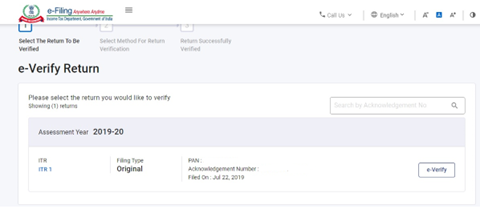
Action 1: Select the ITR that you wish to e-verify

You may then select any of the following convenient methods to e-verify your return:

1. Using Digital Signature Certificate:

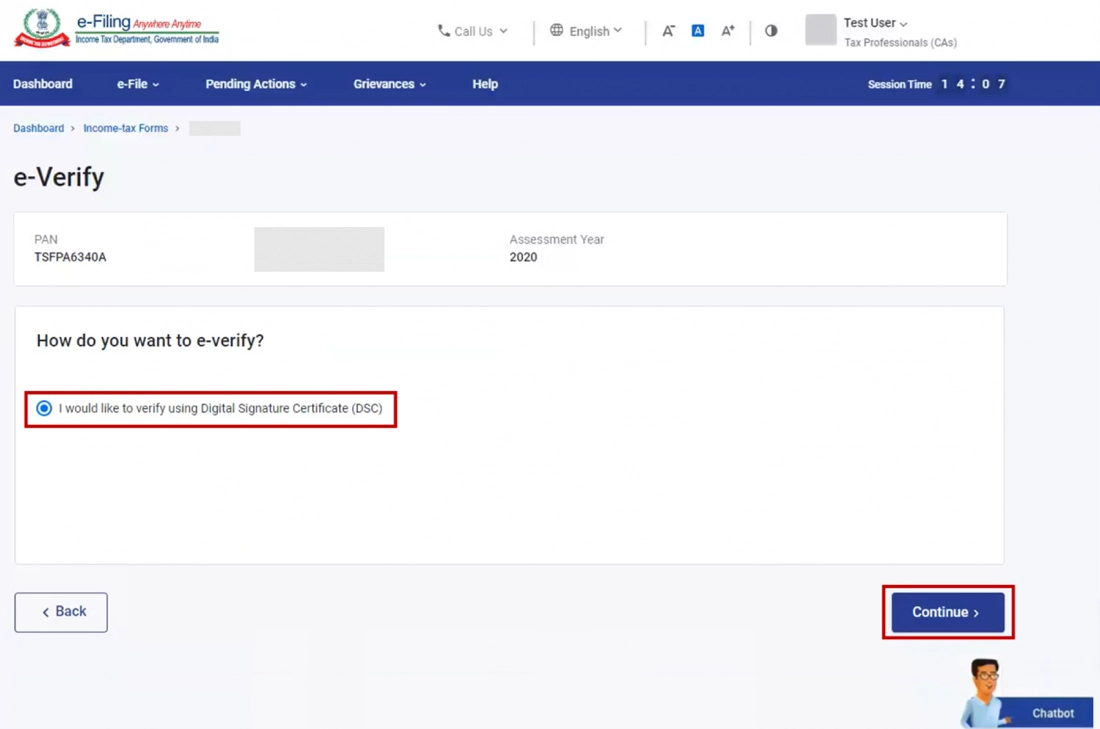
Step 1: e-Verify using Digital Signature Certificate (DSC): Choose DSC if you wish to e-verify your ITR immediately after filing. On the e-Verify page, choose “I would like to e-Verify using Digital Signature Certificate (DSC)”


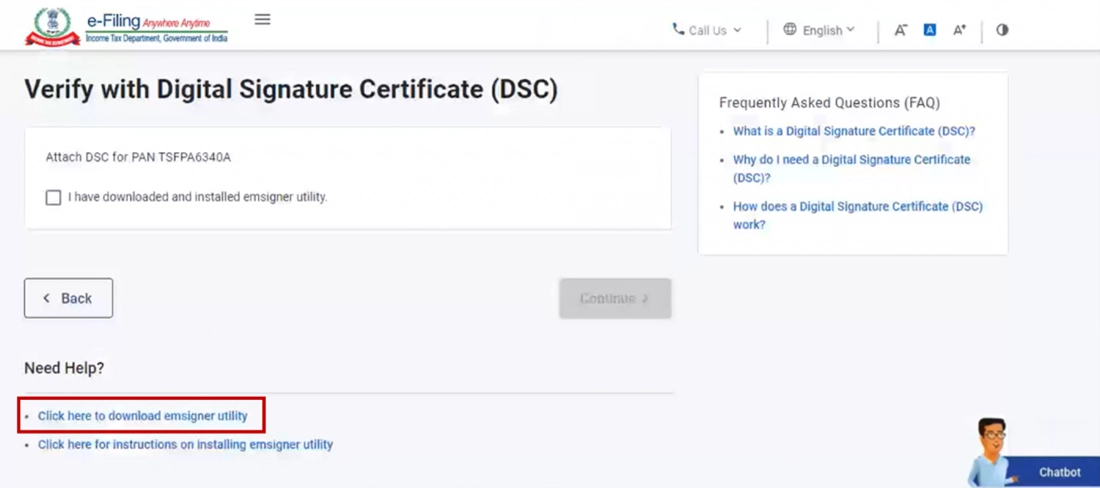
Step 2: On the Verify Your Identity page, download the EMsigner utility.


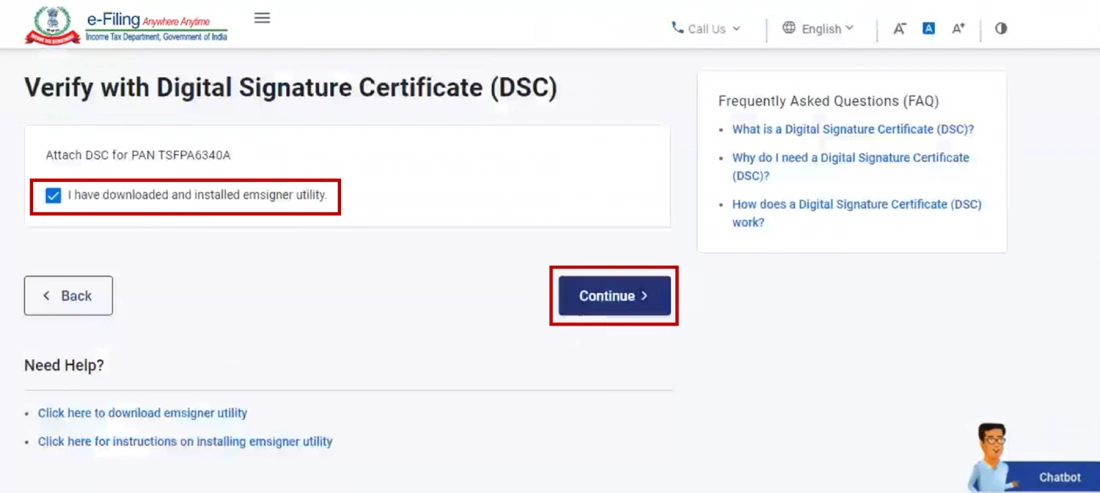
Step 3: Select “I have downloaded and installed EMsigner utility” and continue.


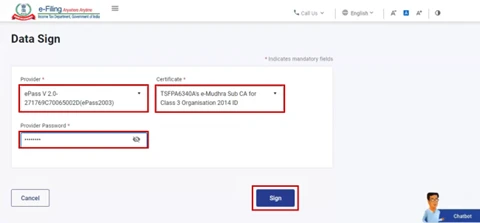
Step 4: On the Data Sign page, select your Provider, Certificate and enter the Provider Password. Click Sign.
 

2. Using Aadhar OTP:

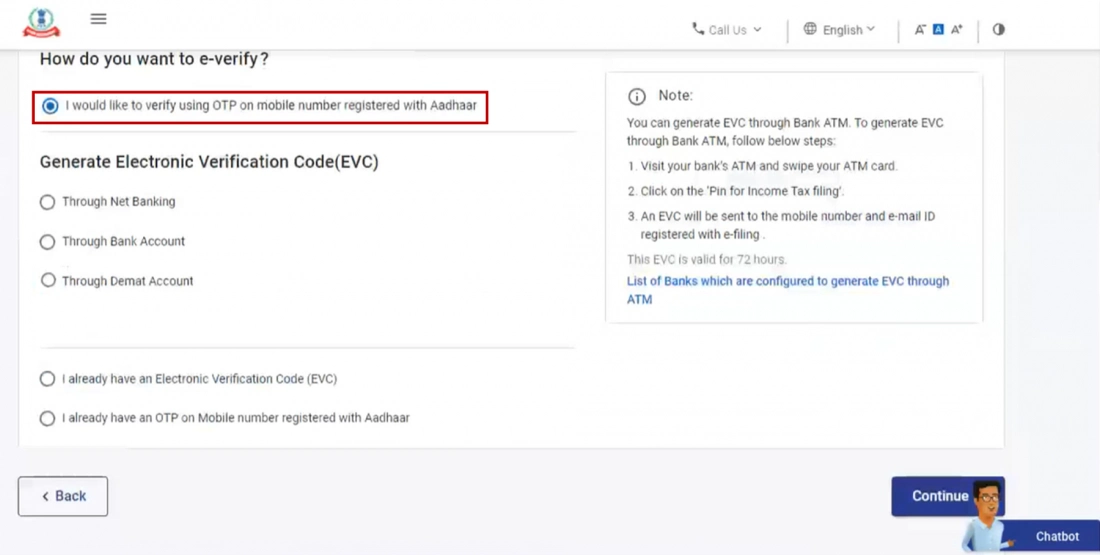
Step 1: On the e-Verify page, choose “I would like to verify using OTP on the mobile number registered with Aadhaar”


Step 2: On the OTP page, check the box “I agree to validate my Aadhaar Details” and proceed to generate Aadhaar OTP.

Step 3: Enter the OTP and click Validate.

3. Using EVC:

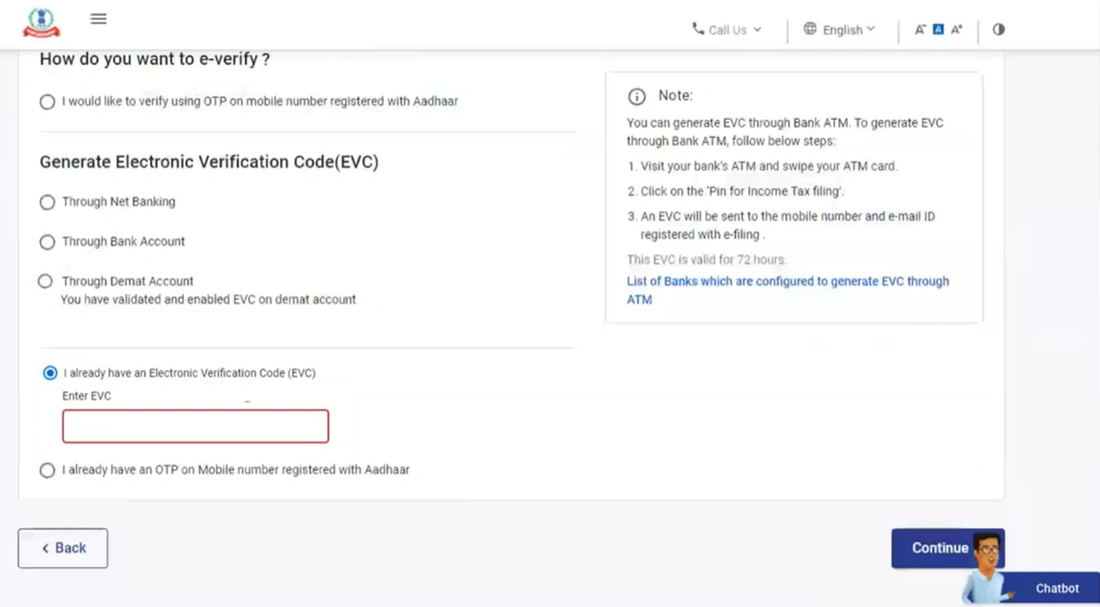
Step 1: Choose “I already have an Electronic Verification Code (EVC)”

Step 2: Enter EVC and e-verify

4. Post-generation of EVC through Bank Account:

Step 1: On the e-Verify page, choose “Through Bank Account”


Step 2:
Enter the EVC and e-verify

5. Post-Generation of EVC through Demat Account:

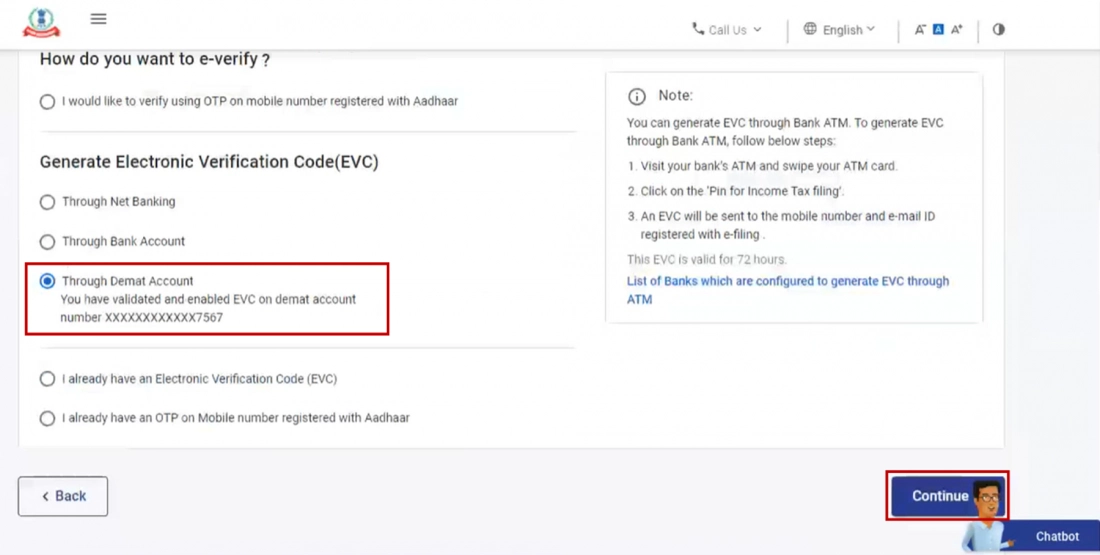
Step 1: Choose “Through Demat Account”


Step 2: Enter the EVC and e-verify

6. Through Net Banking:

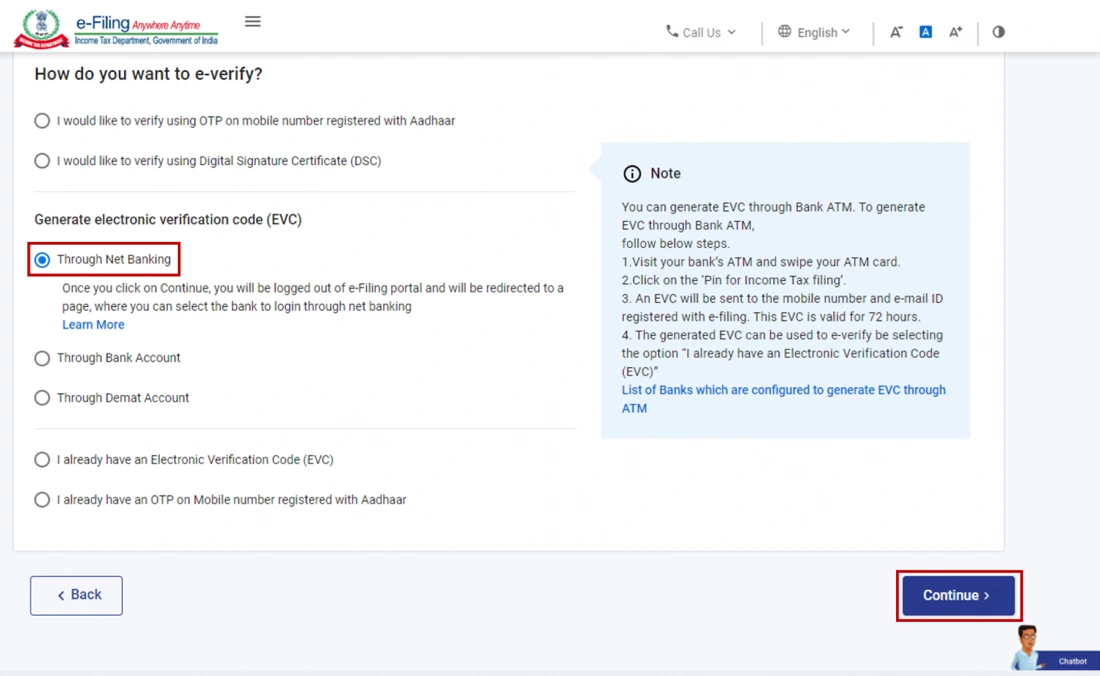
Step 1: Choose “Through Net Banking”


Step 2: Select the bank and continue

Step 3: Read the disclaimer

Step 4: Log in to your Net Banking using your Net Banking user ID and password.

Step 5: Click the link to log in to e-Filing from your bank's website.

Step 6: Go to the respective ITR/form and E-Verify.

7. Generate EVC through Bank ATM:

Step 1: Go to your bank’s ATM and insert your Debit/ATM card.

Step 2: Enter PIN.

Step 3: Generate EVC

An EVC will be sent to your mobile number

Step 4: The generated EVC can be used to e-Verify the return by following Method.

Is it Mandatory to E-Verify ITR?

One of the methods to verify the submitted ITR is through e-verification. If this method does not suit you, you may download the return filing acknowledgement, i.e., ITR V, and send the same via post after signing it.

Who can E-Verify your ITR?

You must do it, or anyone authorised by you through a valid power of attorney. You may authorise someone only if you are not available, for some reason, or are not in a condition to verify the return.

Filing ITR on time has multiple advantages. ITRs are required for visa applications and bank loans. So, your ITR may come in handy when you are asked for supporting documents. You save money on the penalty that would be levied if you miss the deadline. Moreover, verifying the return can be done within 120 days if you file your return before the due date. E-verifying the return is essential to ensure your ITR is accepted and does not become invalid.

Glossary

  1. E-Verification of ITR: The digital process of validating a filed income tax return to complete submission.
  2. ITR-V: The acknowledgement form used to verify an income tax return offline by sending it to CPC Bengaluru.
  3. Electronic Verification Code (EVC): A code generated through banks, demat, or ATM to e-verify income tax returns.
  4. Belated Return: An income tax return filed after the original due date but within the permitted timeline.
  5. Defective Return: An ITR treated as invalid due to missing e-verification or incorrect information.
glossary-img
Uncertain About Insurance?

FAQs on E-Verification of Income Tax Return (ITR)

The ITR e-verification deadline is 30 days from the filing date (post-Notification 5/2022, effective Aug 2022). For returns filed before Jul 31, 2022, the prior 120-day limit applies. Unverified returns become invalid.

Yes, you can e-verify ITR through net banking or other methods that work post-filing deadline, within 30 days. File a condonation request for delays beyond this.

E-verification of income tax return failure treats it as invalid/not filed, triggering late fees under Section 234F and other consequences. Submit condonation for approval.

Yes, e-verify ITR completes the process; filing alone is incomplete without income tax e-verification via Aadhaar OTP, EVC, or net banking.

Disclaimer - This article is issued in the general public interest and meant for general information purposes only. The views expressed in this blog are solely those of the writer and do not necessarily reflect the official policy or position of Canara HSBC Life Insurance Company Limited or any affiliated entity. We make no representations or warranties of any kind, express or implied, about the completeness, accuracy, reliability, suitability, or availability with respect to the blog or the information, products, services, or related graphics contained in the blog for any purpose. Any reliance you place on such information is therefore strictly at your own risk. You should consult with a qualified professional regarding your specific circumstances before taking any action based on the content provided herein.

Recent Blogs

Types of Allowances in Salary: Definition, and Taxation Rules
11 Feb '26
1205 Views
6 minute read
Learn about various allowances like HRA, travel, medical, and special allowances, and understand their tax treatment and exemptions to optimise salary taxation.
Read More
Tax Saving
Penalty for Late Filing of Income Tax Returns (ITR) in 2026
11 Feb '26
1133 Views
7 minute read
Avoid penalties for late ITR filing! Learn about the financial and legal implications of missing deadlines and how to file on time.
Read More
Tax Saving
HUF Taxation Explained: Benefits, Rules & How to Save Tax
11 Feb '26
111 Views
7 minute read
Learn how HUF taxation works in India, eligibility rules, tax benefits, deductions, and how Hindu Undivided Families can save income tax legally.
Read More
Tax Saving
What is IGST? Meaning, Rates and Calculation Explained
11 Feb '26
209 Views
7 minute read
Understand IGST, its full form, when it applies, current rates, and how to calculate Integrated GST for inter-state transactions in India.
Read More
Tax Saving
What is CGST? Meaning, Rates & Features Explained
11 Feb '26
160 Views
7 minute read
Learn what CGST means, its full form, key features, tax rates, and how Central GST is applied under India’s GST framework.
Read More
Tax Saving
Income Tax Rebate in India: Rules, Limits and Eligibility
10 Feb '26
1938 Views
8 minute read
Get money back with Income Tax Rebate! Learn what an income tax rebate is, who is eligible, applicable sections, limits, and how taxpayers in India can claim the rebate.
Read More
Tax Saving
Tax Collected at Source (TCS): Payment, Exemption & Rates
10 Feb '26
1059 Views
7 minute read
Learn about Tax Collected at Source (TCS), payment exemptions, and rates. Explore key details with Canara HSBC Life Insurance for smarter tax planning insights.
Read More
Tax Saving
Section 10 of Income Tax Act: Tax Exemption Guide Under Section 10(10D)
10 Feb '26
9194 Views
7 minute read
Learn sec 10 of Income Tax Act exemptions, including 10(10D) for life insurance payouts, and how tax-free incomes are treated under Indian tax law.
Read More
Tax Saving
What Is Tax Liability? Meaning, Calculation & Examples
10 Feb '26
1987 Views
7 minute read
Tax liability is the total tax payable after deductions and exemptions. Learn its meaning, how to calculate tax liability and how it affects ITR filing in India with examples for individuals.
Read More
Tax Saving

Tax Savings - Top Selling Plans

We bring you a collection of popular Canara HSBC life insurance plans. Forget the dusty brochures and endless offline visits! Dive into the features of our top-selling online insurance plans and buy the one that meets your goals and requirements. You and your wallet will be thankful in the future as we brighten up your financial future with these plans.