Written by : Knowledge Centre Team
Last published : 2026-08-06
8 minutes read
Share

We work hard and earn a living so that when we retire, we can spend time with our families. Planning a trip abroad, starting a new hobby, giving more time to your children, and, above all, attaining full freedom are the things we aspire to after retirement.
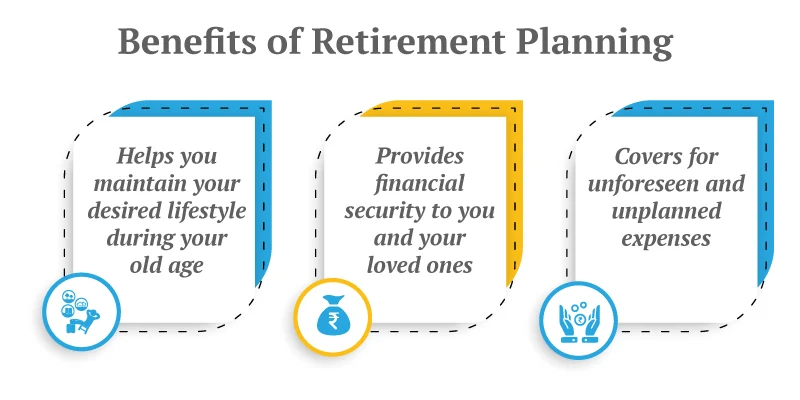
But to make all these things achievable, we need to properly plan for our retirement. Retirement planning is crucial for building a substantial corpus during your working life that can be utilised in the future.
A good retirement plan will provide answers to the most important questions about your retirement goal.Here are seven of the most essential retirement planning FAQs that will help you plan effectively:
Key Takeaways
|
This is the most common question regarding retirement. In India, the retirement age is generally between 58 and 60 years. However, nowadays, many people are taking early retirement from their jobs at the ages of 50-55.
The decision to retire must be made after considering various factors. These can be the following:
An OTP has been sent to your mobile number

Sorry ! No records Found
Thank You for submitting the response, will get back with you.
Thank you for your interest in our product. Our financial expert will connect with you shortly to help you choose the best plan.
You need to save a certain amount regularly, specifically for retirement. The answer to how much you should save depends on the age at which you will be retiring.
The more time you have before retiring, the less you will have to invest per month. On the other hand, you will have to save more if you start planning at a later stage.
The retirement fund should be such that it can replicate the income that you earned at the age of 30.
Let's understand with an example, Ishaan is a 30-year-old married individual. He decides to start saving for retirement. He currently earns ₹1 lakh per month. To be able to live on this amount at the age of 60, he must contribute at least 9-10% of his monthly salary.
If he wants to retire early, say at 55, then he has to contribute in the range of 18-20% of his salary regularly. If Rahul wants to retire at 50, then the amount he has to contribute every month rises to a whopping 34%.
Everyone lives a different life. Thus, there is no specific amount that can be deemed enough for retirement. It depends on factors such as your current expenses, number of dependents, your future needs, etc.
Take into account all the future expenses you will incur. These can include your kitchen expenses, house maintenance expenses, and monthly bills. Make sure you keep a certain amount aside to meet emergencies as and when they arise.
Apart from these basic expenses, you should also consider your plans after retirement. Will you be working again? Will you be spending your money on leisure activities such as travelling, etc.?
Use a retirement planning calculator to find out the corpus you need to build.
A retirement planning calculator is a simple tool that gives you an idea of the corpus you can accumulate with a regular monthly investment for your golden years.
The above calculation and illustration of figures are indicative only and not on actual basis.
After assessing how much you can invest and how much you will need for your post-retirement, the next question that arises is how to reach the amount you require. Sound investments can help you do that.
You can invest in the following investment options for your retirement as per your risk appetite and preferences.
If investment safety is your preference for retirement, you can consider the Savings Plan by Canara HSBC Life. This plan provides you with the benefit of savings while at the same time protecting you by offering life cover. In this plan, you are entitled to receive guaranteed returns on maturity, along with bonuses.
All the investment options listed in the above point differ based on taxability. Whether the amount you receive at the end is taxable or not depends on the option you have invested your money in.
For example, if you invest a lump sum in immediate annuities on or after retirement, your regular pension will be taxable. However, long-term ULIP plans and deferred annuity plans where you can invest regularly for some time may offer better tax benefits.
For example, ULIPs by Canara HSBC Life Insurance allow tax-free partial withdrawals if:
NPS is one of the most popular investments to safeguard your retirement. In this scheme, your money is invested in market securities. The saving scheme will mature when you retire. You can withdraw 60% of your corpus at maturity, and the remaining must be used for an annuity.
Continuing with the same example as Rahul, He decides to invest 10% of his income, i.e., ₹ 10,000, towards NPS. He decides to retire at 60. Assuming the rate of interest is at 8%, his corpus will be equal to ₹ 1.48 cr. In the same case, if he continued with the policy for another 10 years, that is till 70, his corpus would become ₹3.4 Cr.
Thus, the longer you stay invested in your NPS account and the more you contribute, the more wealth you can create.
Click here to use compound interest calculator.
From all the points listed above, it becomes clear that the more time you give yourself to invest, the better your fund value will be, no matter which investment you choose.
So, it is better to start early. You can start by setting aside a small sum from the day you start earning. As your income grows, you can increase your contribution.
Also Read - Senior Citizen Card.
Retirement may feel far off, but planning for it should start today. The earlier you begin, the more control you have over your future lifestyle and financial security. By answering key questions around savings, investment choices, and tax implications, you can build a retirement plan that suits your needs and goals.
Remember, there's no one-size-fits-all approach; what matters most is consistency and informed decision-making. Stay disciplined, review your plan regularly, and adapt as your life evolves. A well-planned retirement is not just a financial milestone, but your gateway to freedom, peace of mind, and purposeful living.
Disclaimer - This article is issued in the general public interest and meant for general information purposes only. The views expressed in this blog are solely those of the writer and do not necessarily reflect the official policy or position of Canara HSBC Life Insurance Company Limited or any affiliated entity. We make no representations or warranties of any kind, express or implied, about the completeness, accuracy, reliability, suitability, or availability with respect to the blog or the information, products, services, or related graphics contained in the blog for any purpose. Any reliance you place on such information is therefore strictly at your own risk. You should consult with a qualified professional regarding your specific circumstances before taking any action based on the content provided herein.








We bring you a collection of popular Canara HSBC life insurance plans. Forget the dusty brochures and endless offline visits! Dive into the features of our top-selling online insurance plans and buy the one that meets your goals and requirements. You and your wallet will be thankful in the future as we brighten up your financial future with these plans.