


unified-pension-scheme-ups

Unified Pension Scheme (UPS): Benefits, Returns, & Eligibility

Learn all about Unified Pension Scheme: Assured 50% pension, ₹10,000 minimum income, family pension, tax benefits, and eligibility rules

Written by : Knowledge Centre Team

2026-02-09

19 Views

8 minutes read

Retirement planning has taken a significant turn with the introduction of the Unified Pension Scheme (UPS), a game-changer for Central Government employees seeking financial stability in their golden years. Unlike market-linked pension schemes, where returns fluctuate with investment performance, the unified pension scheme guarantees a fixed pension amount, restoring predictability in post-retirement income. With over 31,555 Central Government employees already opting for this scheme by July 2025, UPS represents a thoughtful blend of the Old Pension Scheme's security and the National Pension System's sustainability.

Key Takeaways

  • Pension is calculated at 50% of the average basic pay over the last 12 months for employees completing 25 years of service

  • In the Unified Pension Scheme, employees contribute 10%, while the government contributes 18.5% of basic pay + DA, which is significantly higher than the 14% under NPS

  • Spouse receives 60% of the pension, including inflation-linked dearness relief for sustained value

  • Deadline to switch from NPS: November 30, 2025. No reversal to NPS permitted post-deadline

  • Introduced in April 2025 for employees post-2004, the Unified Pension Scheme is now adopted by states, including Maharashtra

What is the Unified Pension Scheme (UPS)?

The Unified Pension Scheme (UPS) is a retirement benefit program launched by the Central Government on August 24, 2024, and implemented from April 1, 2025, designed to provide financial security and dignity to government employees after their service years. This pension scheme is an option under the National Pension System framework, offering assured payouts to eligible Central Government employees who contribute 10% of their basic salary plus Dearness Allowance (DA), with the employer contributing 18.5% of the same.

The scheme was approved by the Union Cabinet with the primary objective of ensuring stability and a guaranteed income for government servants post-retirement. A recent change is the one-time, one-way switch facility, which allows existing NPS subscribers to migrate to UPS by November 30, 2025. However, once employees opt for the unified pension scheme, the decision becomes irrevocable. They cannot switch back to NPS or any other pension option. Additionally, state governments have been empowered to adopt UPS for their employees, with Maharashtra becoming the first state to implement it on August 25, 2024.

Get Expert Guidance for Your Retirement & Investments

Please enter correct name Please enter the Full name
Please enter valid mobile number Please enter Mobile Number
Please enter valid email Please enter Email

Enter OTP

An OTP has been sent to your mobile number

Didn’t receive OTP?

Application Status

Name

Date of Birth

Plan Name

Status

Unclaimed Amount of the Policyholder as on

Name of the policy holder

Policy Holder Name

Policy No.

Policy Number

Address of the Policyholder as per records

Address

Unclaimed Amount

Unclaimed Amount
Error

Sorry ! No records Found

.  Please use this ID for all future communications regarding this concern.

Request Registered

Thank You for submitting the response, will get back with you.

Features of the Unified Pension Scheme

The unified pension scheme brings several distinctive features that set it apart from existing retirement benefit programs, making it an attractive option for government employees planning their post-retirement life.

  • Assured Pension Amount: Under the Unified Pension Scheme (UPS), employees with at least 25 years of qualifying service are assured a pension equal to 50% of their average basic pay drawn in the last 12 months before retirement. This removes uncertainty associated with market-based returns and provides predictable post-retirement income. For example, an employee retiring with a basic pay of ₹80,000 after 25 years of service would receive a monthly pension of ₹40,000, enabling confident retirement planning.
  • Minimum Guaranteed Pension: The scheme also provides a minimum income safeguard. Government employees with at least 10 years of qualifying service are entitled to a minimum pension of ₹10,000 per month, even if they do not complete 25 years of service. This helps ensure a basic level of financial security in retirement, particularly for those with shorter or interrupted service tenure.
  • Family Pension Protection: Financial security continues for the family even after the pensioner’s death. Under UPS, the surviving spouse is eligible for a family pension equal to 60% of the retiree's last drawn pension. This lifelong benefit helps dependants maintain financial stability and cope with the loss of regular pension income.
  • Inflation Indexation: To protect pensions from the impact of rising prices, UPS includes dearness relief linked to the All India Consumer Price Index for Industrial Workers (AICPI-IW). As inflation rises, pension amounts are adjusted accordingly, ensuring retirees retain their purchasing power over the long term.
  • Gratuity Benefits: UPS also offers gratuity benefits as an additional form of financial support. Retirement gratuity is payable after five years of service and is calculated as one-fourth of emoluments for each completed six-month period of service. In the event of death during service, death gratuity is paid to the nominee or family, with amounts varying based on length of service. These lump-sum benefits complement the regular pension and provide support during critical life events.
trivia-img

Did You Know?

Maharashtra became the first state to implement UPS for its employees on August 25, 2024. 


Source: TOI

Guaranteed Returns 10K

Benefits of the Unified Pension Scheme

The unified pension scheme offers multiple advantages that enhance the financial well-being and peace of mind of government employees throughout their retirement.

  • Financial Security and Predictability: Assured, non-market-linked pension with fixed post-retirement income, enabling long-term financial planning without exposure to market volatility

  • Higher Employer Contribution: Enhanced employer contribution of 18.5% of basic pay plus DA significantly increases the retirement corpus compared to NPS

  • Proportionate Benefits for Early Retirees: Pension benefits are calculated based on qualifying service, with a minimum guaranteed pension of ₹10,000 per month after 10 years of service

  • Lump-sum payment at Retirement: A one-time payout at superannuation, in addition to the monthly pension, provides immediate financial support without reducing pension income

Eligibility Criteria for the Unified Pension Scheme

The Unified Pension Scheme (UPS) defines clear eligibility conditions covering service category, minimum tenure, and the opting process.

  • Service Category Eligibility:  UPS is open to Central Government employees who joined service on or after 1 January 2004 and are currently covered under the National Pension System. This includes new recruits from 1 April 2025 and existing NPS subscribers who opt to switch to UPS. Exclusions apply to armed forces personnel (excluding civilians and those paid from the Defence Services Estimates), employees covered by the 1971 pension scheme, and those already retired.
  • Minimum Service Requirements: Eligibility varies by benefit type. A minimum of 10 years of qualifying service is required for the guaranteed pension of ₹10,000 per month, 25 years for the full assured pension of 50% of average basic pay, and five years for gratuity benefits.
  • Opting Window and Irrevocability: Eligible employees must opt for UPS within the prescribed timeline. Existing NPS subscribers can exercise the option until 30 November 2025, while select new entrants were given a one-time choice at the time of joining. Once selected, the switch to UPS is final and cannot be reversed.

How to Join a Unified Pension Scheme?

Eligible Central Government employees can join the unified pension scheme through a straightforward process designed to accommodate both digital and traditional application methods.

Online Application Process:

  1. Log in to the official CRA system portal using your PRAN (Permanent Retirement Account Number) and credentials

  2. Navigate to the UPS option section and select the "Opt for Unified Pension Scheme" option from the menu

  3. Complete the required details in the online application form, ensuring all information accurately matches your service records

  4. Review the declaration carefully, understanding that this decision is irrevocable, then submit the form electronically

  5. Download and save the acknowledgement receipt for your records, which serves as proof of your UPS enrollment

Offline Application Process:

  1. Obtain the physical UPS option form (Form A1 for existing employees or Form A2 for those on deputation) from your office or download it from the official portal

  2. Fill in all mandatory details in the form clearly and legibly, and attach supporting documents as specified

  3. Submit the completed form to your designated nodal office or the Drawing and Disbursing Officer (DDO) within the stipulated deadline

  4. Collect the acknowledgement slip from the receiving authority for future reference and tracking

  5. The nodal office will process your application and update your pension scheme status in the central system

Tax Implications and Advantages

The Unified Pension Scheme (UPS) offers clear and favourable tax treatment across contributions, payouts, and retirement benefits, enhancing its overall attractiveness.

  • Tax Treatment on Contributions: Employee contributions up to 10% of basic pay plus DA qualify for deduction under Section 80C, within the ₹1.5 lakh annual limit. The employer’s 18.5% contribution is not treated as a taxable perquisite, keeping the employee’s salary income unaffected. Together, this reduces current tax liability while efficiently building retirement savings.
  • Tax on Pension Income: The monthly pension received under UPS is fully taxable as salary income. However, pensioners can claim the standard deduction of ₹50,000 per year. Senior citizens also benefit from higher basic exemption limits and deductions such as Section 80D, which can substantially reduce the effective tax outgo.
  • Taxation of Lump Sum and Gratuity: The lump-sum payout from superannuation is taxed under the applicable commutation rules. Gratuity paid to government employees, whether on retirement or death, is fully exempt from income tax under Section 10(10)(i), with no monetary ceiling. This tax-free gratuity significantly enhances post-retirement liquidity and tax efficiency.

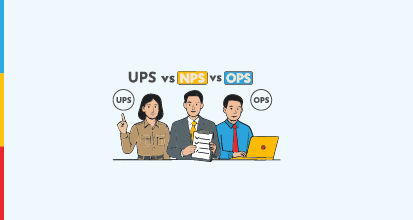
Unified Pension Scheme vs Other Pension Plans

The unified pension scheme can be better understood by comparing it with other retirement benefit options available to government employees, highlighting the distinct advantages and trade-offs of each approach.

AspectUnified Pension Scheme (UPS)National Pension System (NPS)Old Pension Scheme (OPS)

Pension Amount

50% of average basic pay over the last 12 months (25 years of service)

Market-linked returns, no guaranteed amount

50% of the last drawn salary

Employee Contribution

10% of basic salary + DA

10% of basic salary + DA

No employee contribution required

Employer Contribution

18.5% of basic salary + DA

14% of basic salary + DA

Fully funded by the government

Minimum Pension

₹10,000/month (10 years service)

No minimum guarantee

Not applicable

Family Pension

60% of the pension to the spouse

Depends on the corpus and annuity plan

A defined family pension is available

Inflation Protection

Dearness Relief based on AICPI-IW

No automatic inflation adjustment

Dearness Relief provided

Market Exposure

Partial exposure (mainly government debt)

High exposure (equity + debt mix)

No market exposure

Lump Sum at Retirement

1/10th of the monthly pay per 6 months of service

Up to 60% of the corpus as a lump sum

Commutation option available

Reversibility

Irrevocable decision

Can continue with NPS

Not available to post-2004 employees

Conclusion

The Unified Pension Scheme offers Central Government employees assured retirement income through guaranteed pensions, inflation protection, family cover, and higher employer contributions. With added benefits such as gratuity, proportionate pensions, and tax efficiency, it provides stability that market-linked plans often cannot. 

For those seeking predictability, complementing such an assured income with well-structured retirement plans can help build a more balanced and resilient post-retirement strategy.

Glossary

  1. National Pension System: Market-linked contributory pension scheme for government/private employees
  2. Family Pension: 60% of the retiree's pension, which is paid to the spouse upon death
  3. Gratuity: Tax-free lump sum based on service duration at retirement/death
  4. Dearness Relief: Inflation adjustment to pension based on AICPI-IW index 
  5. PRAN: A unique 12-digit identifier for NPS/UPS subscribers to track contributions and manage pension accounts lifelong
glossary-img
Uncertain About Insurance?

FAQs

UPS guarantees central government employees 50% of their average basic pay (over the last 12 months) as a pension after 25 years of service, effective April 1, 2025.​

Central government employees under NPS as of April 1, 2025, with a minimum of 10 years service for a ₹10,000 minimum pension; new recruits are auto-enrolled.

Employees contribute 10% of their basic pay plus DA, while the government contributes 18.5%, which is higher than the 14% under NPS.

Existing NPS subscribers can switch to UPS irrevocably by November 30, 2025, while new employees hired after April 2025 automatically join UPS

Upon the retiree's death, the spouse receives 60% of the pension amount, adjusted with inflation-linked dearness relief.

Disclaimer - This article is issued in the general public interest and meant for general information purposes only. The views expressed in this blog are solely those of the writer and do not necessarily reflect the official policy or position of Canara HSBC Life Insurance Company Limited or any affiliated entity. We make no representations or warranties of any kind, express or implied, about the completeness, accuracy, reliability, suitability, or availability with respect to the blog or the information, products, services, or related graphics contained in the blog for any purpose. Any reliance you place on such information is therefore strictly at your own risk. You should consult with a qualified professional regarding your specific circumstances before taking any action based on the content provided herein.

Recent Blogs

Bucket Strategy for Retirement: Meaning & How It Works
09 Feb '26
616 Views
8 minute read
Understand the bucket strategy for retirement planning and how it helps manage risk, income stability, and long-term wealth growth.
Read More
Retirement Plan
Is a PF Account Enough for Retirement Planning in India?
15 Jan '26
3187 Views
10 minute read
Already have a PF account? Learn why a retirement plan is still essential for complete financial security and stress-free life after retirement.
Read More
Retirement Plan
Difference Between Defined Benefit Plan & Defined Contribution Plan
09 Jan '26
1738 Views
12 minute read
Your retirement will be funded by defined contribution and defined benefit plans. But how should you decide defined benefit vs defined contribution results?
Read More
Retirement Plan
What is Superannuation? Types and Tax Benefits
07 Jan '26
706 Views
9 minute read
A superannuation benefit is a type of benefit that is paid to the employees by their employers as a pension benefit. Learn what superannuation is and how it works.
Read More
Retirement Plan
What is Family Pension? Everything You Need to Know
05 Jan '26
1828 Views
10 minute read
Family Pension is a government scheme for central government employees. Learn its meaning, eligibility criteria, and how it works with Canara HSBC Life Insurance.
Read More
Retirement Plan
Is NPS Tax Benefit Available in New Tax Regime? | NPS Deduction Rules
05 Jan '26
4224 Views
7 minute read
Is NPS tax benefit allowed in the new tax regime? Understand eligibility, Section 80CCD(2) deductions, and how NPS works for taxpayers.
Read More
Retirement Plan
What is Pension? Meaning, Types & Benefits Explained
04 Jan '26
3680 Views
12 minute read
A pension is a retirement fund contributed by the employer, employee, or both, with the employer covering the largest share. Learn more with Canara HSBC Life Insurance!
Read More
Retirement Plan
What is a Pension Payment Order (PPO) Number in Healthcare?
02 Jan '26
887 Views
4 minute read
Learn what a PPO number is and its importance for pensioners. Learn how it helps track and manage your pension payments efficiently.
Read More
Retirement Plan
What Is a Defined Benefit Pension Plan and How Does It Pay?
23 Dec '25
1264 Views
8 minute read
What is a defined benefit pension plan? Learn how it guarantees a fixed retirement income based on salary and years of service, and why it matters for long-term security.
Read More
Retirement Plan

Retirement - Top Selling Plans

We bring you a collection of popular Canara HSBC life insurance plans. Forget the dusty brochures and endless offline visits! Dive into the features of our top-selling online insurance plans and buy the one that meets your goals and requirements. You and your wallet will be thankful in the future as we brighten up your financial future with these plans.