




best-investment-plans-for-5-years

Best Investment Plans for 5 Years

Explore smart 5-year investment plans that balance growth, liquidity, and tax benefits to help you meet key life goals with confidence

Written by : Knowledge Centre Team

2025-12-27

1550 Views

8 minutes read

Investment plans for 5 years are a mainstay of your investment plan, at least in the first 15 years of your financial life. For example, consider the life of Ramesh.

Ramesh is a smart, 23-year-old gentleman who recently graduated in engineering from a reputed University in the South of India. Ramesh hails from a typical, aspirational, middle-class Indian family. Ramesh wants to follow his dad’s advice on financial matters – ‘think 5 years ahead’.

So, now that he is earning a good income which exceeds his monthly expenses, he starts looking for the best investment plans for 5 years.

If everything goes well, he will have a car by 25, be married by 28 and probably become a parent before 35. His lifestyle, responsibilities and expenses are projected to increase multi-fold over the next 5-7 years.

Ramesh has a good education and domain expertise, and his income is likely to grow. However, it may or may not keep pace with the steep rise in expenses because of the addition of new family members. With proper financial planning, investment plans for 5 years could help him channelise his savings to meet future developments.

Also Read - How to Invest Money?

Key Takeaways

  • Five-year investment plans suit mid-term goals, help fund milestones like buying a car, marriage, or skill upgrades, without locking money away for decades.
  • Balanced mix of growth and liquidity offers better return potential than short-term options while still allowing access to funds when needed
  • A wide range of investment choices includes mutual funds, ULIPs, ELSS, NSC, FDs, and FMPs, each catering to different risk profiles
  • Several 5-year plans qualify for deductions under Section 80C and offer favourable capital gains treatment
  • Starting early allows compounding to work while keeping flexibility for evolving life responsibilities

Why Should You Buy an Investment Plan for 5 Years?

There are a few strong factors to influence your conviction to look at investment options that have a 5-year time horizon:

  1. Wealth Creation: Wealth creation should indeed fall under the longer-term scheme of things. But many asset classes, such as ULIPs, allow withdrawals after 5 years. Past performance of ULIP funds has shown that ULIPs can indeed beat inflation and grow wealth within 5 years.
  2. Flexibility: You invest in as many financial assets as you deem fit and still get reasonably good returns. In long-term investments such as real estate, a large chunk of your money is tied to a single asset class.
  3. Spread your Risk: Five-year investment options let you diversify your risk and invest smaller amounts across multiple options. Even if one of the investment decisions goes wrong, you will make up for it elsewhere.
  4. Liquidity: Five-year period is relatively short for major wealth creation. However, this horizon gives you a perfect balance of investment growth plus liquidity. The money you invest will be available to you after just five years, and you can invest it further or use it for your goals.

    Planning and prudent investment are key factors that ensure  Ramesh remains stress-free and enjoys these life-changing moments of becoming someone’s partner and parent. Looking at flexibility, spreading risk and eventually getting solid returns on investment should be high on Ramesh’s agenda. So, which financial investment options match Ramesh’s needs and criteria?

Worried About Emergencies? Start Planning Now

Please enter correct name Please enter the Full name
Please enter valid mobile number Please enter Mobile Number
Please enter valid email Please enter Email

Enter OTP

An OTP has been sent to your mobile number

Didn’t receive OTP?

Application Status

Name

Date of Birth

Plan Name

Status

Unclaimed Amount of the Policyholder as on

Name of the policy holder

Policy Holder Name

Policy No.

Policy Number

Address of the Policyholder as per records

Address

Unclaimed Amount

Unclaimed Amount
Error

Sorry ! No records Found

.  Please use this ID for all future communications regarding this concern.

Request Registered

Thank You for submitting the response, will get back with you.

Types of Investment Plans for 5 Years

A five-year investment horizon, although not very long, gives you several amazing investment options. Some of these options also offer tax-saving benefits. Here’s a list of the most popular 5-year investment options in India:

Mutual FundsNational Savings Certificate (NSC)

Equity Linked Savings Scheme (ELSS)

Fixed Maturity Plans (FMPs)

Unit Linked Insurance Plans (ULIPs)

Bank & Post-Office Fixed Deposits

  1. Mutual Funds: Mutual funds pool money from several sources and invest in equities. These funds are focused on specific industries or segments of companies and are managed by experienced fund managers. You can choose the type of fund depending on your risk appetite and targeted return.

If you are looking for more stable returns, you may explore mutual funds that invest in government securities, corporate debentures and bonds. Types of mutual fund investment options according to investment risk:

Equity FundsDebt FundsHybrid FundsLiquid Funds

Asset Class: Primarily equity stocks


Fund types in declining risk order:

- Thematic Funds

- Sectoral Funds

- Active growth funds

- Mid-cap funds

- Blue-chip funds

- Index Funds

Asset Class: Long-term fixed-income securities


Fund types in declining risk order:

- Credit Opportunities Fund

- Dynamic bond funds

- Fixed Maturity Plans

- Gilt Funds

- Income Funds

Asset Class: Mix of equity, debt, and gold


Fund types in declining risk order:

- Aggressive hybrid funds

- Dynamic asset allocation fund

- Multi-asset allocation fund

- Equity savings fund

- Conservative hybrid funds

Asset Class: Money market securities & bonds maturing within a year


Fund types in declining risk order:

- Ultra-short-term debt funds

- Ultra-short-term debt funds

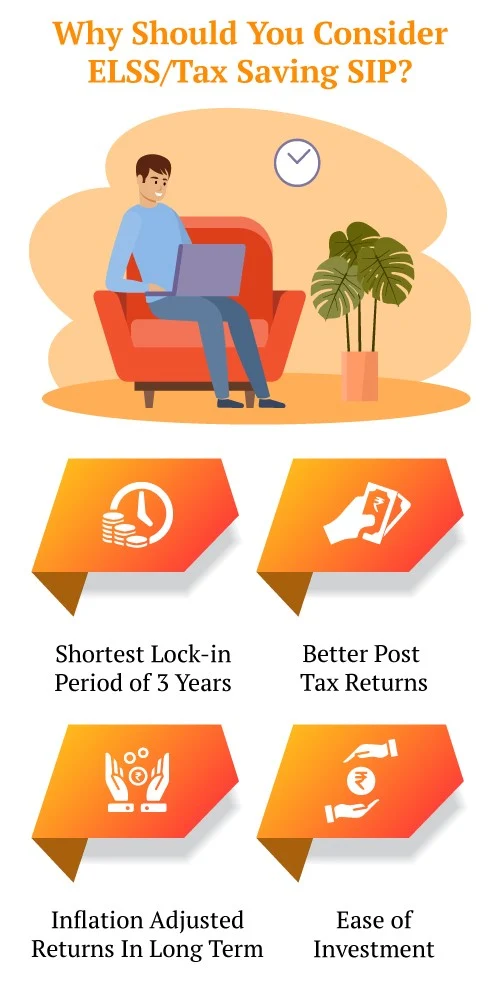
  1. Equity Linked Savings Scheme (ELSS): It is a type of equity mutual fund. Investment of up to Rs 1.5 lakhs in this fund qualifies for tax deduction under Section 80C. The fund has a lock-in period of 3 years. The maturity value from the fund will become taxable as long-term capital gain exceeds Rs 1 lakh.
  2. Unit Linked Insurance Plan (ULIP): ULIPs are life insurance plans with flexible and diversified investment options. ULIPs are phenomenal long-term investments because of equity allocation and tax-exempt status. Here are a few more unique features of ULIPs, including Promise4Growth Plus ULIP by Canara HSBC Life Insurance:
    • 5-year lock-in period and minimum investment period
    • You can invest for a period of up to 99 years of age
    • Invest in a mix of equity and debt funds
    • Manage your equity allocation with automated strategies
    • Premium protection option for safeguarding important goals like a child’s higher education
    • Systematic and milestone withdrawal options
    • Bonus additions for long-term investors
  3. Premium Protection Option of Promise4Growth Plus: So, ULIPs have an insurance component as well as an investment component. In case of the unfortunate demise of the policyholder, the nominee would receive the sum assured or else the policyholder would receive the fund value at the end of the policy term. ULIPs permit partial withdrawals at specific milestones or for a certain number of times in a term. Amounts paid towards premiums are deductible from taxable income, under section 80C, whereas all payouts are exempt from tax under section 10(10D).

  4. National Savings Certificate (NSC): NSC is offered by the Post Office and is very similar to the tax-saving 5-year bank deposit. The rate of interest for an NSC is 6.8%, which is higher than the current rate of interest for bank deposits. The lock-in period is 5 years, and the amount invested is deductible from taxable income under section 80C. Interest is compounded annually, and this annual interest can also be deducted from taxable income. However, the interest amount receivable on maturity is taxable.
  5. Fixed Maturity Plan (FMP): FMPs are close-ended mutual funds that have a number tied to both the tenure as well as the rate of interest. This class of investment is suited for people who want the safety net of a bank deposit but still yearn for higher returns. In the case of bank deposits, the interest earned is directly added to taxable income for tax computation, whereas, in the case of FMPs of longer than 3-year tenures, the interest earned is considered as a long-term capital gain and taxed at 20% of the indexed value.
  6. Bank and Post Office Fixed Deposit (FD): Both bank and post office FDs give almost the same rates of interest. If one is highly risk-averse, FD is the right choice for investment. The interest rate hardly beats inflation, but the person is assured that the money is in safe hands. Unless one is investing in the 5-year tax-saving FDs, one will not get any tax benefits for other FDs.
trivia-img

Did You Know?

Mutual fund investments are regulated to ensure transparency, risk disclosure, and investor protection across equity, debt, and hybrid schemes.


Source: Taxmann

Guaranteed Future 10K

Wrapping up

Ramesh is young and dreaming of a bright future with his yet-to-come family, and hoping to have a brilliant career too. His focus should be on ensuring the family’s happiness at all times, implying that insurance cover is a must. Investing in wealth-generating assets at an early age is important to fulfil his aspirations, as it gives him a chance to build his wealth. At the same time, he can also consider some safer instruments to diversify his risks and overall benefit from different investments.

Glossary

  1. Investment Horizon: The time period an investor plans to hold an investment before using or withdrawing the funds
  2. Liquidity: How quickly an investment can be converted into cash without significantly affecting its value
  3. Capital Gains: Profit earned from selling an investment asset at a price higher than its purchase cost
  4. Lock-in Period: A fixed duration during which invested money cannot be withdrawn, common in tax-saving plans
  5. Risk Appetite: An individual’s ability and willingness to tolerate fluctuations or losses in investment value
glossary-img
Uncertain About Insurance?

FAQs Related to 5-Year Investment Plans

You should allocate your savings to look after your short-term, mid-term and long-term goals. Short-term goals would usually fall within 3 years from now and have a smaller expected outflow.

Mid-term goals like a car purchase and home renovation fall between 5 years to 10 years from now, while long-term goals like retirement will take 20+ years. Since you are allocating to all three you are always investing in less than 3 years, 5 years, 10 years and 20 years plans.

Five-year investment plans allow you great flexibility while offering better returns as well as tax savings. With a 5-year horizon, you enjoy long-term capital gain benefits with debt funds and equity investments. This horizon also allows you to invest in tax-saving investments like – Tax-saving FDs, ULIPs, NSCs, ELSS, etc

You should be a citizen of India and must have attained majority age (18 years+). You will also need a few compulsory documents to invest and avail all the benefits of 5-year investments:

  • PAN Card
  • Adhaar Card
  • Bank Account Passbook or Cheque
  • A Photo ID / Address Proof

With a 5-year investment horizon, you can invest in options with high risk as well as low risk. For example, gilt funds which invest in government securities and top-rated corporate bonds carry very low risk. Pure equity funds like ELSS or sectoral funds can also be a good investment option for 5 years. However, these investments have significant investment risks

The best investment plan for 5 years depends on your risk appetite. Market-linked options like equity mutual funds, ULIPs, or diversified investment plans often offer higher return potential than traditional savings. A balanced 5-year investment plan helps you grow wealth while managing risk effectively.

A five-year investment plan generally offers better growth potential than a traditional savings plan for 5 years or fixed deposits, which focus more on capital safety. While FDs provide predictability, investment plans allow diversification and inflation-adjusted growth, especially when you are planning long-term financial milestones.

Disclaimer - This article is issued in the general public interest and meant for general information purposes only. The views expressed in this blog are solely those of the writer and do not necessarily reflect the official policy or position of Canara HSBC Life Insurance Company Limited or any affiliated entity. We make no representations or warranties of any kind, express or implied, about the completeness, accuracy, reliability, suitability, or availability with respect to the blog or the information, products, services, or related graphics contained in the blog for any purpose. Any reliance you place on such information is therefore strictly at your own risk. You should consult with a qualified professional regarding your specific circumstances before taking any action based on the content provided herein.

Recent Blogs

Why Does Liquidity Matter in Financial Planning?
02 Jan '26
1054 Views
8 minute read
Learn what liquidity means in financial planning, why easy access to funds is important, and how liquidity helps manage emergencies and short-term needs.
Read More
Financial Planning
What Is the Right Way to Start Investing in Your 20s?
28 Dec '25
1082 Views
10 minute read
Learn how to invest in your 20s by balancing risk, building good habits early, choosing the right assets and setting the foundation for long-term wealth.
Read More
Financial Planning
Why Financial Planning Is Important for Long-Term Security?
27 Dec '25
4909 Views
11 minute read
Learn why financial planning is important, how it helps manage income, expenses and risks, and why it is essential for achieving long-term life goals.
Read More
Financial Planning
Net Present Value (NPV): Full Form, Meaning & Formula
26 Dec '25
3900 Views
10 minute read
Net Present Value (NPV) measures an investment's total value and profitability. Learn how NPV helps in investment planning with Canara HSBC Life Insurance.
Read More
Financial Planning
How Can You Calculate SIP Returns in India?
26 Dec '25
886 Views
8 minute read
Learn how to calculate SIP returns, understand expected vs actual returns, use formula or calculators, and plan investments effectively for long-term wealth creation.
Read More
Financial Planning
Internal Rate of Return (IRR): Meaning, Formula and Usage
24 Dec '25
3869 Views
10 minute read
Understand Internal Rate of Return (IRR), its meaning, and calculation formula. Learn how it measures investment performance with Canara HSBC Life Insurance.
Read More
Financial Planning
What is a Fixed Deposit: FD Meaning, Benefits & Types
24 Dec '25
1288 Views
11 minute read
A fixed deposit (FD) is a financial instrument that allows you to invest your funds for a fixed period and earn returns at a fixed rate. Visit this section to understand in detail about FD.
Read More
Financial Planning
What Will Be The Value of Rs 1 Crore After 20 Years?
23 Dec '25
2927 Views
10 minute read
Find the actual value of Rs 1 Crore after 20 years. Why should you save Rs. 1 Crore, and how can you ensure a higher value for your wealth?
Read More
Financial Planning
How Can You Create a ₹1 Crore Corpus in 10 Years?
23 Dec '25
992 Views
8 minute read
Learn how to build a ₹1 crore corpus in 10 years using SIPs, asset allocation, return assumptions, discipline, and goal-based financial planning suited for Indian investors.
Read More
Financial Planning

With a 5-year investment horizon, you can invest in options with high risk as well as low risk. For example, gilt funds which invest in government securities and top-rated corporate bonds carry very low risk. Pure equity funds like ELSS or sectoral funds can also be a good investment option for 5 years. However, these investments have significant investment risks

Financial Planning - Top Selling Plans

We bring you a collection of popular Canara HSBC life insurance plans. Forget the dusty brochures and endless offline visits! Dive into the features of our top-selling online insurance plans and buy the one that meets your goals and requirements. You and your wallet will be thankful in the future as we brighten up your financial future with these plans.