gold-investment-01

Is Investing in Gold a Smart Financial Decision?

Explains whether investing in gold is a smart choice, covering returns, inflation protection, risks, and how gold fits into a balanced financial plan.

Written by : Knowledge Centre Team

2025-11-02

1192 Views

10 minutes read

Gold is regarded by a majority of the Indian populace as one of the top investment possibilities in India. Gold is not only seen as a reliable long-term wealth generator but also as good fortune and an emblem of social rank in this country. Due to the stock market's significant swings this year as a result of the pandemic's financial consequences, several investors felt compelled to discover ways to safeguard their holdings. During this time, one asset, in particular, began to gain momentum: gold.

Interestingly, a few years ago, fixed deposits were thought to be more attractive financial possibilities for Indians in the middle class. However, because the interest generated on Fixed Deposits has decreased significantly in recent years, FDs no longer appear to be a viable wealth-generating alternative as they once were. People are showing a resurgence of interest in gold investment these days.

Gold, on the other hand, is a long-term asset that is not ideal for short-term gains. Furthermore, gold prices move in a cyclical pattern. As a result, one cannot expect gold to perform consistently well.

Must Read - What is Investment?

Six Reasons to Invest in Gold

For centuries, Indians were already dealing in gold, and it has shown to be a sound investment. Here are some of the best reasons to invest in gold:
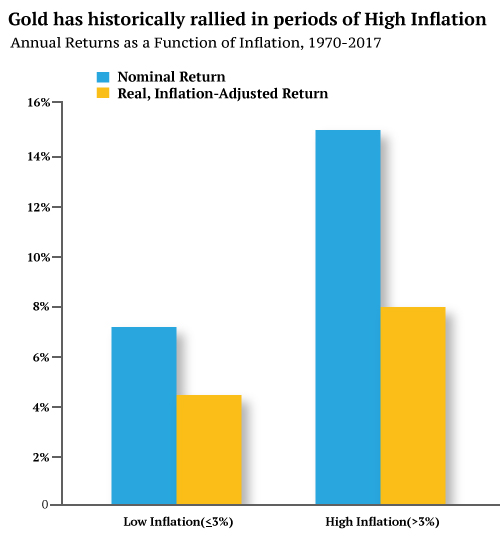
  1. Gold Functions as an Inflation Hedge: In the past, gold has done better than equities or other investment options in high-inflation circumstances. There is no functional link between stock prices and inflation. However, because Gold is a commodity, its price rises when the economy experiences rising inflation.
  2. Investing in Gold won't Break the Bank: Compared to real estate (which demands a larger first investment) or stocks (which involve documentation to open a brokerage account), dealing in gold is simpler for most Indians and does not require a large initial expenditure.
  3. Gold Investment Provides High Cash Flow: If you hold a gold coin or piece of jewelry, you can simply liquidate it by selling it at a nearby jewelry store at any moment. Shares and mutual funds can also be quickly turned into cash. However, it may take a few days for such products to complete the reclamation and the selling cash to be credited to your bank account. Gold, in comparison to these securities, has a higher liquidity.
  4. Gold Investing can help you to Manage your Portfolio's Risk: It is fundamental to vary your assets in an attempt to lessen your investment portfolio. Because gold has a negative relationship with stocks, it might be a practical way to diversify your portfolio. A theoretical loss on your equities portfolio might be sustained by your precious metals anytime your stock account is in a bear market.
  5. No Specialised Knowledge is Required: When purchasing stocks or mutual funds, you must have a basic understanding of the market and economics to make the best selection. Such in-depth knowledge of the market isn't required with gold. It is uncomplicated and simple to invest in, making it suitable for all types of investors.
  6. It will Always be Valuable: An agreement to pay is what money is. Gold, on the other side, does not demand such assurance. It's the only speculative investment that isn't also a liability for someone else. Gold prices have never fallen to zero in its 3000+ year history. As a result, it will always be valuable and robust, even if the market falls apart.

How to Correctly Invest in Gold?


  • Investing in Gold ETFs: You need not buy actual gold here because gold ETFs are a non-physical form of gold investment. However, you can invest in a gold-backed Exchange Traded Fund (ETF) whose value fluctuates with the price of gold. Dealing in gold ETFs is similar to owning gold; the only difference is that investors don’t get to keep the golden metal. It is stored in your Demat account and it is in Demat form.

    Here is everything you need to understand about ETF Investment
  • Gold Mutual Funds: A gold fund is essentially a collection of ETFs. You can then purchase these funds and invest in Gold ETFs indirectly. You won't need a Demat account to participate in ETFs if you do it this way. You'll have to pay the fund manager a management charge. You can invest everything at once or utilise the same reliable SIP method as other mutual funds.
  • Keeping Physical Gold: You could also purchase gold coins or gold bars if you have a strong desire to maintain physical gold. Gold coins and bars can be purchased from banks or a local merchant. Banks usually sell gold coins at a premium and do not repurchase the coins or bars.

So, purchasing from institutions can be a little complicated because when you're about to sell it, you'll have to go to a jeweler, who likes buying from fellow jewelers due to the way gold trading in India is structured.

If you're considering adding gold to your asset base, we hope this article has given you a better understanding of gold investing. Remember to examine your financial goals, investor's risk, and asset allocation before making any investment.

Worried About Emergencies? Start Planning Now

Please enter correct name Please enter the Full name
Please enter valid mobile number Please enter Mobile Number
Please enter valid email Please enter Email

Enter OTP

An OTP has been sent to your mobile number

Didn’t receive OTP?

Application Status

Name

Date of Birth

Plan Name

Status

Unclaimed Amount of the Policyholder as on

Name of the policy holder

Policy Holder Name

Policy No.

Policy Number

Address of the Policyholder as per records

Address

Unclaimed Amount

Unclaimed Amount
Error

Sorry ! No records Found

.  Please use this ID for all future communications regarding this concern.

Request Registered

Thank You for submitting the response, will get back with you.

Disclaimer - This article is issued in the general public interest and meant for general information purposes only. The views expressed in this blog are solely those of the writer and do not necessarily reflect the official policy or position of Canara HSBC Life Insurance Company Limited or any affiliated entity. We make no representations or warranties of any kind, express or implied, about the completeness, accuracy, reliability, suitability, or availability with respect to the blog or the information, products, services, or related graphics contained in the blog for any purpose. Any reliance you place on such information is therefore strictly at your own risk. You should consult with a qualified professional regarding your specific circumstances before taking any action based on the content provided herein.


Recent Blogs

Why Does Liquidity Matter in Financial Planning?
02 Jan '26
1054 Views
8 minute read
Learn what liquidity means in financial planning, why easy access to funds is important, and how liquidity helps manage emergencies and short-term needs.
Read More
Financial Planning
What Is the Right Way to Start Investing in Your 20s?
28 Dec '25
1082 Views
10 minute read
Learn how to invest in your 20s by balancing risk, building good habits early, choosing the right assets and setting the foundation for long-term wealth.
Read More
Financial Planning
Why Financial Planning Is Important for Long-Term Security?
27 Dec '25
4909 Views
11 minute read
Learn why financial planning is important, how it helps manage income, expenses and risks, and why it is essential for achieving long-term life goals.
Read More
Financial Planning
Best Investment Plans for 5 Years in India 2026
27 Dec '25
1550 Views
8 minute read
Explore the best investment plans for 5 years that balance returns and risk, helping you meet medium-term financial goals with stability and smart planning.
Read More
Financial Planning
Net Present Value (NPV): Full Form, Meaning & Formula
26 Dec '25
3900 Views
10 minute read
Net Present Value (NPV) measures an investment's total value and profitability. Learn how NPV helps in investment planning with Canara HSBC Life Insurance.
Read More
Financial Planning
How Can You Calculate SIP Returns in India?
26 Dec '25
886 Views
8 minute read
Learn how to calculate SIP returns, understand expected vs actual returns, use formula or calculators, and plan investments effectively for long-term wealth creation.
Read More
Financial Planning
Internal Rate of Return (IRR): Meaning, Formula and Usage
24 Dec '25
3869 Views
10 minute read
Understand Internal Rate of Return (IRR), its meaning, and calculation formula. Learn how it measures investment performance with Canara HSBC Life Insurance.
Read More
Financial Planning
What is a Fixed Deposit: FD Meaning, Benefits & Types
24 Dec '25
1288 Views
11 minute read
A fixed deposit (FD) is a financial instrument that allows you to invest your funds for a fixed period and earn returns at a fixed rate. Visit this section to understand in detail about FD.
Read More
Financial Planning
What Will Be The Value of Rs 1 Crore After 20 Years?
23 Dec '25
2927 Views
10 minute read
Find the actual value of Rs 1 Crore after 20 years. Why should you save Rs. 1 Crore, and how can you ensure a higher value for your wealth?
Read More
Financial Planning

Financial Planning - Top Selling Plans

We bring you a collection of popular Canara HSBC life insurance plans. Forget the dusty brochures and endless offline visits! Dive into the features of our top-selling online insurance plans and buy the one that meets your goals and requirements. You and your wallet will be thankful in the future as we brighten up your financial future with these plans.