Income Tax Refund

How to Claim a Full Refund of Income Tax?

Get an income tax refund if taxes paid exceed liability. File an accurate ITR to claim it, and receive refunds directly in your bank account.

Written by : Knowledge Centre Team

2025-12-18

1430 Views

8 minutes read

Getting a tax refund always feels like a win, but the real question is, are you getting the full amount you deserve? Every year, countless taxpayers miss out on refunds due to minor filing errors, unverified details, or a lack of clarity about the process. If you’ve paid excess TDS, advance tax, or noticed discrepancies in your income records, you can still claim your complete refund with the right steps. This guide walks you through the process in a simple, practical way so you can avoid delays, resolve issues, and track your refund with confidence. Stay informed, stay proactive, and ensure that every rupee of your hard-earned money comes back to you without hassle.
 

Key Takeaways

  • A tax refund occurs when you have paid more tax than your actual liability, while a tax credit adjustment offsets excess tax against future tax dues
  • A tax refund is directly credited to the taxpayer’s bank account, while in a tax credit adjustment, no cash refund is given; instead, the excess amount is adjusted against future liabilities
  • Overpaid TDS, advance tax, or self-assessment tax leads to a refund, whereas past pending tax dues or carry-forward tax credits result in adjustments
  • Refunds are processed quickly after ITR verification by the Income Tax Department, while tax credit adjustments are automatically applied during tax assessments

How to Claim Your Full Income Tax Refund?

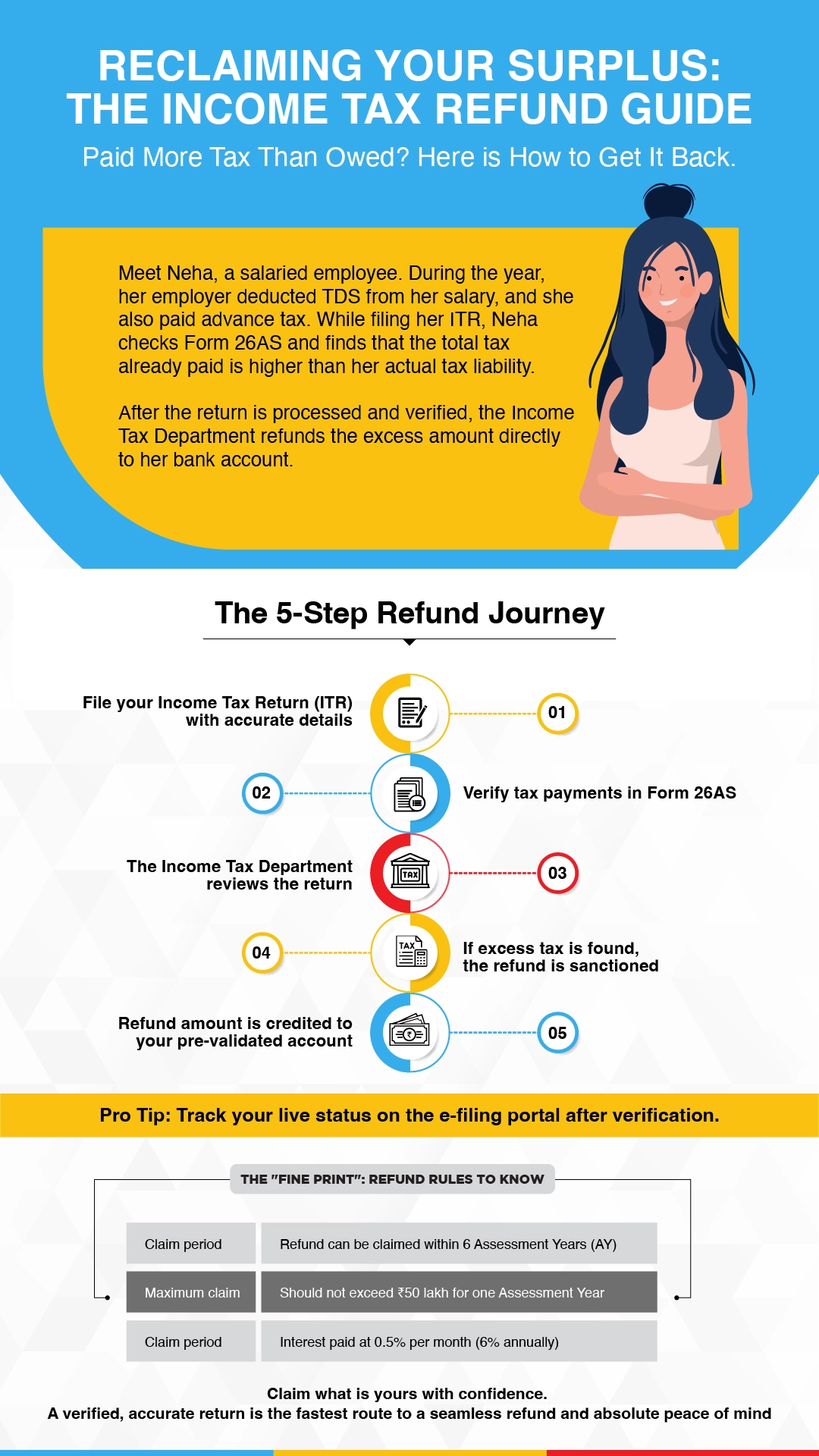
To claim an ITR refund, you need to ensure that the taxes paid during the year exceed your final tax liability. You may realise that you have a tax refund at the time of filing your Income Tax Return (ITR). After you have filed your ITR and the income tax officer assessing the return finds it to be in the  order, he/she may approve your income tax refund.

This is usually seen as a bonus income, as TDS rates are far lower than the income tax slab rates.

Maximize Your Tax Savings - Talk to an Expert

Please enter correct name Please enter the Full name
Please enter valid mobile number Please enter Mobile Number
Please enter valid email Please enter Email

Enter OTP

An OTP has been sent to your mobile number

Didn’t receive OTP?

Application Status

Name

Date of Birth

Plan Name

Status

Unclaimed Amount of the Policyholder as on

Name of the policy holder

Policy Holder Name

Policy No.

Policy Number

Address of the Policyholder as per records

Address

Unclaimed Amount

Unclaimed Amount
Error

Sorry ! No records Found

.  Please use this ID for all future communications regarding this concern.

Request Registered

Thank You for submitting the response, will get back with you.

What is an ITR Refund?

An income tax refund is a state of reimbursement to a taxpayer when they pay a higher tax in the given financial year (FY) than their final assessed liability. Income tax refunds are possible when you have been paying the compulsory advance tax or have TDS deductions on your income.

At the time of filing an income tax return (or ITR), you can estimate the possible tax refund. The excess tax you have paid will be returned to you as a refund under Section 237 of the Income Tax Act, 1961. The income tax department will sanction the tax refund only after thorough verification of the income tax return filed.

The additional tax paid does not attract any interest. Thus, you can avoid paying excess tax and invest the money. You should estimate your possible tax liability for the year in advance and adjust your advance tax payments accordingly.

Eligibility Criteria for Income Tax Refund

You become eligible for the income tax refund if you meet any of the following criteria:

  • Your total advance tax payments are more than 100% of your actual tax liabilities for the financial year
  • Your TDS payments in the financial year exceed your final tax liability after regular assessment
  • If you have made last-minute tax-saving investments
  • You have paid tax on your income in a foreign country that has a double taxation avoidance agreement (DTAA) with India
  • You have paid excess tax under regular assessment due to an error in the assessment

How to Claim an ITR Refund?

The simplest way to claim your income tax refund is by filing an accurate income tax return before the due date. While filing your return, you can check the total advance tax payments under Form 26AS.

After you have filed your income tax return the assessment officer must be satisfied with the income tax calculation on the form. If your balance of advance tax payment under Form 26AS is more than your tax liability under the filed ITR, the officer may approve your tax refund.

You can check the income tax refund status on your e-filing dashboard after filing and verifying the ITR.

Due Date to Claim Income Tax Refund:

You can claim an income tax refund after the end of the relevant assessment year. However, the following conditions will also apply to the tax refund claims:

You can claim a tax refund on the income tax paid within six successive assessment years. 

  • CBDT will not accept tax refund claims older than this period
  • CBT pays simple interest at 0.5% per month (6% per annum) on delayed refunds"
  • The officers may accept delayed tax refund claims if they require verification
  • The total claim amount for one assessment year should not be more than ₹50 lakh

Income Tax Refund in Special Cases

In case a person is unable to claim an income tax refund due to insolvency, death, liquidation, incapacity, or any other cause, their legal representative, guardian, receiver, or trustee can file for an income tax refund on their behalf, under Section 238 of the Income Tax Act, 1961.

Interest Earned on Income Tax Refund

The Income Tax Department mandatorily pays interest if the refund amount is equal to or above 10% of the total tax paid under  Section 244A of the Income Tax Act. Accordingly, simple interest of 0.5%  per month is levied on the amount of tax refund and paid to you.
How Can You Check Your Income Tax Refund Status through an E-Filing Website?

You can file and track your ITR refund status at eportal.incometax.gov.in. If you do not have an account, create it   on the website using your PAN and Aadhaar numbers. Log in to this portal and check your latest ITR status.

If your last ITR is not visible on the dashboard, go to e-File on the menu, then Income Tax Returns, and select ‘View Filed Returns’. This will show you all your historical ITRs and their status. If you have been filing returns in the offline mode, you will need to navigate through ‘View Filed Forms’.

If your last ITR has been processed and a tax refund has been issued, you can check its status here.

How Can You Check the Income Tax Refund Status through the TIN NSDL Website?

You can also check the status of the issued income tax refund through the TIN NSDL portal. Visit https://tin.tin.nsdl.com/oltas/refund-status-pan.html and enter your PAN and select the assessment year you want to check tax refund status for.

The portal will show you one of the following status messages:

  • Not determined if the assessing officer has yet to accept the refund

  • Refund Paid or Credited to Bank if the refund has been processed and paid

  • ITR Proceeds are determined and sent to the refund banker if the refund amount is yet to be transferred (cheque drawn)

How to Apply for a Refund Reissue?

If your refund has been processed but has failed to reach your bank account due to incorrect account details, you can apply for a refund reissue via the e-filing portal.

Steps to apply for a refund reissue:

  • Log in to eportal.incometax.gov.in

  • Go to ‘Services’ > ‘Refund Reissue’

  • Select the relevant Assessment Year and proceed

  • Update your correct bank account details (must be pre-validated)

  • Submit the request and wait for an acknowledgement

Once the bank account is verified and the request is accepted, the refund will be reprocessed quickly and credited to your account.

trivia-img

Did You Know?

Filing your ITR after the due date may result in losing interest on the refund for the delay period


Source: Financial Express

Young Term Plan - 1 Crore

Income Tax Refund vs Tax Credit Adjustment: What’s the Difference?

Both the income tax refund and the tax credit adjustment deal with excess tax payments, but function differently. Here’s a side-by-side comparison to clarify their distinctions:

CriteriaTax RefundTax Credit Adjustment
DefinitionA refund is issued when excess tax has been paidExcess tax is adjusted against future tax liabilities or outstanding dues
When It HappensWhen TDS, advance tax, or self-assessment tax exceeds the actual tax liabilityWhen there are pending tax dues or carry-forward tax credits
Refund IssuedYes, refunded directly to the taxpayer’s bank accountNo, excess tax is adjusted against future liabilities
Common CausesOverpaid TDS, self-assessment tax, or advance taxPending tax dues from previous years, carry-forward tax credits.
Processing TimeProcessed after ITR filing and verification by the Income Tax Department. The ITR refund processing time typically depends on the internal verification checks.”Adjusted automatically

What to Do if Your Income Tax Refund Is Stuck?

Waiting for your tax refund can be frustrating, especially if it has been delayed beyond the expected timeline. There could be several reasons why your refund of tax is stuck, such as incorrect bank details, processing delays, or an issue with your income tax return. If you're facing this problem, here’s what you can do to resolve it.

How to Raise a Complaint with the Income Tax Department?

If your tax refund is delayed and you suspect no issues on your end, the first step is to raise a complaint with the Income Tax Department. You can do this by following these steps:

  • Log in to the e-Filing portal: Visit the official Income Tax e-Filing website (www.incometax.gov.in) and log in using your credentials

  • Navigate to the ‘Grievances’ sectio: Under the ‘Helpdesk’ or ‘Pending Actions’ tab, select ‘Submit Grievance

  • Choose the appropriate category: Select ‘Refund-related issues’ and specify the nature of your complaint, such as ‘Refund not received’ or ‘Refund delayed

  • Submit your grievance: Provide all necessary details and submit your complaint

  • Track the status: You can check the progress of your complaint under the ‘Grievance Status’ section

How to Request a Refund Reissue in Case of a Failed Transaction?

If your refund of tax was processed but the transaction failed due to incorrect bank details or other technical issues, you can request a refund reissue. Here’s how:

  • Log in to the e-Filing portal: Use your PAN and password to access your account

  • Go to ‘My Account’: Click on ‘Service Requests’ and select ‘New Request

  • Select ‘Refund Reissue’: Choose ‘Refund Reissue’ as the request type

  • Update your bank details: Provide the correct bank details, including IFSC code and account number

  • Submit the request: After verification, submit the request and track the progress under ‘Service Request Status

How to Rectify Errors in Bank Account Details?

Incorrect bank details are one of the most common reasons for a tax refund failure. If you realise that the bank details provided in your ITR were incorrect, you can correct them through the following steps:

  • Log in to the e-Filing portal

  • Go to ‘Profile Settings’ Click on ‘Pre-validate Bank Account’ under the profile section

  • Add or modify your bank account: Enter the correct bank details and submit them for validation

  • Reapply for a refund reissue: Once your bank details are updated and validated, follow the refund reissue process mentioned above

What to Do If There’s a Mistake in Your Refund?:

If you believe the refund amount is incorrect due to a miscalculation, missing deductions, or incorrect income reporting, you can address it in the following ways:

  • Revised Return: File a revised ITR under Section 139(5) if you discover an error in the original return. This must be done before the end of the relevant assessment year

  • Rectification Request: If the error is from the department’s side, submit a Rectification Request under Section 154 through the e-filing portal

  • Grievance Redressal: Use the ‘e-Nivaran’ feature on the e-filing website to raise a complaint if you're facing unresolved refund issues

Conclusion

Claiming a full refund of income tax is a straightforward process if you ensure accuracy while filing your ITR and keep track of your refund status. By taking timely action, verifying your bank details, and following up with the Income Tax Department when necessary, you can avoid unnecessary delays and ensure that you receive your refund without hassle. Staying informed and proactive can make the entire process smooth and efficient.

Glossary

  1. Income Tax Refund: A return of excess tax paid, credited directly to the taxpayer’s bank account
  2. Tax Credit Adjustment: When extra tax paid is used to settle future or outstanding tax dues instead of being refunded
  3. Refund Reissue: A process to request repayment if the original refund fails due to incorrect bank details
  4. TDS: It is the tax deducted at the source of income to ensure tax collection in advance
  5. ITR: It is the form used to report your income and taxes paid to the Income Tax Department
glossary-img
Uncertain About Insurance

FAQs

First of all, your gross total income is taken into account, and all applicable deductions/exemptions are deducted from it. The resultant amount is the net income, upon which the Income Tax is calculated, on the basis of income tax slabs that are announced each year in the Union Budget.

The best tax-saving investment would be one that offers flexibility in investments, withdrawals, and asset allocation, aligned with your risk appetite. ULIPs, Guaranteed Saving Plans, ELSS, PPF, etc, are some of the best tax-saving options in India you can invest in.

If the interest earned or maturity value of your investment is tax-free, you may not need to pay tax on your investment. However, many tax-saving investments under Section 80C do not offer tax exemption on accrued interest or maturity. Thus, you can choose tax-saving investments that offer tax-free accrued interest, partial withdrawals, and tax-free maturity.

You can choose investments that are tax-exempt: The list is not exhaustive, but includes Equity Linked Saving Scheme (ELSS), Public Provident Fund (PPF), life insurance plans, Unit Linked Insurance Plans (ULIPs), Sukanya Samriddhi Yojana, Senior Citizens Savings Scheme (SCSS), National Pension Scheme (NPS), Bank Fixed Deposits (only if they are tax-saving FDs with a 5-year lock-in under Section 80C).

You can claim almost any tax deduction under sections 80C and 80D without showing or submitting a receipt. However, you should keep the receipts safe until your income tax return has been accepted by the income tax department. In the case of other tax-saving deductions, you may need to show receipts and other documents with your ITR.

The maximum limit of investment that will reap the benefits of deduction from taxable income under Section 80C is ₹1.5 lakh.

Apart from Section 80C, various deductions and exemptions have been provided under the provisions of the Income Tax Act, 1961, like a deduction under Section 80D, which can be claimed for the payment of health insurance, and a deduction of up to ₹50,000 on home loan interest under Section 80EE. Any donations you make to charitable institutions are also allowed as a deduction under Section 80G, subject to conditions prescribed therein.

You can check your income tax refund status online by visiting the Income Tax Department’s official e-filing portal, entering your PAN and assessment year, and viewing the refund status instantly.

Refund delays occur due to processing time, verification issues, defective returns, or bank details mismatch. Check for department notifications and contact helplines for resolution or submit rectifications if needed.

Typically, income tax refunds are credited within 4-5 weeks after filing and verifying the ITR, but processing delays may occur due to scrutiny, errors, or incomplete verification by the tax department.

To claim a refund for excess TDS deducted, accurately file your ITR with the correct TDS details. The tax department verifies and processes the refund amount after reviewing the return.

Income tax refunds can still be claimed even if you file your ITR after the due date, though interest on delayed refunds may apply depending on when taxes were paid or deducted.

You can claim a tax refund for previous years by filing a revised return or a condonation request, subject to deadlines and conditions. The revised return must be filed by December 31 of the relevant assessment year. 

Disclaimer - This article is issued in the general public interest and meant for general information purposes only. The views expressed in this blog are solely those of the writer and do not necessarily reflect the official policy or position of Canara HSBC Life Insurance Company Limited or any affiliated entity. We make no representations or warranties of any kind, express or implied, about the completeness, accuracy, reliability, suitability, or availability with respect to the blog or the information, products, services, or related graphics contained in the blog for any purpose. Any reliance you place on such information is therefore strictly at your own risk. You should consult with a qualified professional regarding your specific circumstances before taking any action based on the content provided herein.

Recent Blogs

Budget 2026 Expectations: Higher Home Loan Interest Deduction
31 Jan '26
33 Views
6 minute read
Explore Budget 2026 expectations for higher home loan interest deductions, potential tax benefits for homeowners, and how it could ease your financial planning.
Read More
Tax Saving
Section 80C Limit Hike: What It Means for Taxpayers?
31 Jan '26
22 Views
5 minute read
Understand the proposed increase, eligible tax-saving investments, and how it could impact taxpayers and tax planning.
Read More
Tax Saving
Budget 2026 Expectations: Relief on Long-Term Capital Gains
30 Jan '26
94 Views
8 minute read
Understand possible relief on long-term capital gains (LTCG), tax changes investors are hoping for, and what it could mean for your returns.
Read More
Tax Saving
Income Tax 2026: How the New Tax Regime Will Impact Taxpayers?
30 Jan '26
126 Views
8 minute read
Income tax in 2026 explained. Understand the new tax regime, structural changes, slab updates, and how these reforms will impact taxpayers and tax planning decisions.
Read More
Tax Saving
Will Budget 2026 Allow Joint Taxation for Married Couples?
29 Jan '26
9 Views
8 minute read
Find out what Budget 2026 may introduce on joint taxation for married couples, expected benefits, policy outlook, and how it may impact taxpayers in India.
Read More
Tax Saving
What is Income Tax Return (ITR)? Meaning & Filing Process of Filing ITR
21 Jan '26
4897 Views
10 minute read
Learn what an Income Tax Return (ITR) is, why filing your income tax return is important, and how to file your ITR online via the Income Tax Department. Documents, forms, steps, and FY 2026-27 details included.
Read More
Tax Saving
What Is Advance Tax? How to Calculate Advance Tax and Pay It Online
20 Jan '26
2512 Views
9 minute read
Understand advance tax under income tax, who should pay it, how advance tax is calculated, due dates, and online payment steps to avoid penalties.
Read More
Tax Saving
Gross Total Income: How It is Different From Total Income?
15 Jan '26
1710 Views
10 minute read
Confused about gross income vs total income? Learn the difference and explore tax-saving schemes in India, including insights from Canara HSBC Life Insurance.
Read More
Tax Saving
What Is Tax? Understanding the Tax Concept in India (2026 Guide)
15 Jan '26
6381 Views
11 minute read
Discover the tax concept in India, its importance, types, and how it affects your income. Updated for FY 2025–26 with practical examples.
Read More
Tax Saving

Tax Savings - Top Selling Plans

We bring you a collection of popular Canara HSBC life insurance plans. Forget the dusty brochures and endless offline visits! Dive into the features of our top-selling online insurance plans and buy the one that meets your goals and requirements. You and your wallet will be thankful in the future as we brighten up your financial future with these plans.