
- Vesting Age: Age when pension plan matures for withdrawals or annuity purchase, often customizable from 40-85 years in retirement schemes
- Corpus: Accumulated retirement savings from contributions and returns, used for lump-sum or annuity payouts post-vesting
- Annuity: Regular income stream from pension corpus, immediate (post-lump sum) or deferred, ensuring lifelong payments
- Deferred Annuity: Lump-sum investment grows during the deferment period before starting regular lifelong payments, balancing growth and guaranteed income
- Section 80C: Tax deduction up to ₹1.5 lakh on pension premiums; pairs with 10(10D) exemption on qualifying maturitie

Table Of Content:
0
1
1.
What is Retirement Planning?
0
2
2.
How Do Pension Plans Work?
0
3
3.
What Are Retirement and Pension Plans?
0
4
4.
Retirement & Pension Plans in India
0
5
5.
Documents Required to Buy a Plan
0
6
6.
Financial Planning - Top Selling Plans
0
7
7.
Retirement Planning Goals
0
8
8.
Retirement Planning Goals
0
9
9.
Contribute to Your Retirement?
10
10.
3 Reasons You Need to Start Planning
11
11.
Stages of Retirement Planning
12
12.
Six Reasons to Plan for Retirement Today
13
13.
Benefits of Retirement & Pension Plans
14
14.
Retirement and Pension Plan in India?
15
15.
Best Retirement & Pension Plans
16
16.
4 Steps for Retirement Planning
17
17.
6 Steps Best Retirement & Pension Plans
18
18.
How To Use Retirement Calculator?
19
19.
Retirement Planning Guide Working Women
20
20.
FAQs
A comprehensive retirement plan can help you stave off the worries of inflation and living costs during your golden years. The key to a fulfilling retirement is to plan early and use the best retirement plans possible to achieve your goal.
Key Takeaways
|
What is Retirement Planning?
Retirement planning is the process of deciding the goals to pursue after retirement and the roadmap to achieve those goals. You no longer receive a paycheck once you retire, and thus have to rethink a few things. You have to assess where the income willwill the income come from, how you will meet your expenses, etc., and how much your savings are etc. All these things make up the term retirement planning.
Though no time is perfect, you should start planning for retirement as early as you can. The earlier you start planning for your finances, the better it will be for you once you reach the retirement stage.
Secure Your Retirement with Guaranteed Income Plans
Enter OTP
An OTP has been sent to your mobile number
Didn’t receive OTP?
Application Status
Name
Date of Birth
Plan Name
Status
Unclaimed Amount of the Policyholder as on
Name of the policy holder
Policy No.
Address of the Policyholder as per records
Unclaimed Amount

Sorry ! No records Found
Request Registered
Thank You for submitting the response, will get back with you.
Thank you for your interest in our product. Our financial expert will connect with you shortly to help you choose the best plan.
How do Pension Plans Work?
Investing in a pension plan requires you to contribute a certain sum to a fund over time. This can be done either regularly or in a lump sum. These payments which you invest in your pension plan help build your corpus through the years. This corpus is used to provide you with regular payments that you can use to meet your expenses once you retire. Thus, a pension scheme makes sure that your income flow does not stop even after retirement.
Investing in a Pension Plan
A pension plan begins with regular contributions made by an individual or their employer. These contributions can be made either monthly, quarterly, or yearly, depending on the plan type. Investments are made in various financial instruments such as mutual funds, government bonds, or fixed deposits to grow the corpus over time.
- How Corpus is Built Over Time: The accumulated amount in a pension plan grows through compounding returns and market-linked investments. Pension plans often offer different investment strategies (conservative, balanced, or aggressive) based on the risk appetite of the investor. The longer the investment duration, the larger the corpus, ensuring a substantial fund for post-retirement needs.
- Regular Income Post-Retirement: Once the policy matures, the accumulated corpus is used to provide a steady income stream. Depending on the plan, retirees can opt for annuity payments, lump-sum withdrawals, or a combination of both. Annuity payments can be fixed or linked to inflation to ensure sustained financial support.
- Ensuring Financial Stability: Pension plans act as a financial cushion during retirement, covering daily expenses, healthcare costs, and lifestyle needs. Choosing the right pension plan with adequate coverage helps retirees maintain financial independence and avoid reliance on family support. Additionally, tax benefits on contributions and withdrawals add to the plan's overall advantages.
What are Retirement and Pension Plans?
Retirement plan and pension plan are names you will hear commonly for saving plans designed to serve your post-retirement financial needs. However, the meaning of a retirement plan may differ slightly from that of a pension plan.
Pension plans are a type of investment in which an employee is required to allocate a portion of their savings to a fund over a specified period. This saving will help you build a substantial corpus, enabling you to have a secure financial future. Retirement/Pension plans provide financial stability by offering a steady income after retirement, ensuring that you can live comfortably without worrying too much about finances.
A few examples of retirement plans are the Employee Provident Fund (EPF), New Pension Scheme (NPS), Public Provident Fund (PPF), etc. Whereas pension plans would be the annuity plans that will offer a monthly income from the invested money.

Types of Retirement & Pension Plans in India
Retirement and pension plans in India are designed to help individuals build a steady income after retirement by combining long-term savings with financial security.
- Immediate Annuity: An annuity is payable immediately, as per the payment frequency chosen, at a constant rate in arrears. Premium is paid in a lump sum at the beginning of the annuity plan.
These are pension plans more than investment plans for retirement. These plans are best used near or after retirement once you have accumulated your retirement funds.
- Deferred Annuity: An annuity is payable post Deferment Period, as per the payment frequency chosen, at a constant rate in arrears. Premium is paid in a lump sum at the beginning of the annuity plan.
You can invest in multiple such plans to start your pension at or after retirement. Your investment continues to grow while you wait for the annuity to start in the deferment period.
- Pension plan with Life Cover: This pension plan includes insurance coverage that entitles your dependents to a lump sum in case of an unfortunate event. Such plans are best for you if your spouse is financially dependent and is younger than you.
- Pension plan without Life Cover: This plan pays out the corpus built to date to the nominees in case of an unfortunate event. There is no life cover (sum assured) in these plans. Due to the lack of life cover benefit, this plan will only transfer the remaining corpus to your nominees upon your death.
- Unit-linked Pension Plan: Your premiums are invested in a combination of stocks, bonds, & securities depending on your risk appetite to build a corpus that is paid out at maturity. These plans are great for long-term corpus growth. So, if your risk appetite and age allow for equity exposure, use Unit-Linked Pension Plans to build your retirement funds faster.
- National Pension Scheme (NPS): The NPS is a government-backed retirement savings plan designed to provide financial security after retirement. It is a voluntary, long-term investment plan regulated by the Pension Fund Regulatory and Development Authority (PFRDA).
Under NPS, individuals contribute regularly to their pension accounts, and the funds are invested in a mix of equities, corporate bonds, and government securities based on their chosen asset allocation. Upon retirement, a portion of the corpus can be withdrawn as a lump sum, while the remaining amount is used to purchase an annuity, ensuring a steady income. NPS offers tax benefits under Section 80C and 80CCD(1B), making it an attractive option for retirement planning.
Documents Required to Buy a Retirement Plan
You need to have the following documents for buying a Retirement Plan.
- Age proof document like a passport, a voting card, etc
- Identity proof like Aadhar, PAN Card, etc
- Address proof like a driving license, a passport, a voting card, etc
- Income proof like a bank statement, salary slip, etc
Retirement - Top Selling Plans
We bring you a collection of popular Canara HSBC life insurance plans. Forget the dusty brochures and endless offline visits! Dive into the features of our top-selling online insurance plans and buy the one that meets your goals and requirements. You and your wallet will be thankful in the future as we brighten up your financial future with these plans.
Fixed Returns, Zero Risks & Worries
iSelect Guaranteed Future Plus
- 4 Plan options
- Life cover + Guaranteed benefits
- Accidental death benefit
- Premium protection cover
Retire Grand with Flexi Benefits
Smart Guaranteed Pension
- Guaranteed Lifelong Income
- Limited premium payment term
- Multiple annuity options
- Option to defer the annuity payments
Save, Dream, Plan. Live Peacefully
iSelect Guaranteed Future
- 4 Plan options
- Option to choose premium payment term
- Get Tax benefits
- Premium protection cover
Retirement Planning Goals
Your retirement goal will differ from others depending on several factors involving your lifestyle and income during your employment years. Another factor which you should account for in your retirement goal is inflation.
Inflation is a crucial factor in retirement planning because it steadily reduces purchasing power and can significantly impact your lifestyle and expenses in your later years. you progress in your retirement, your chances of earning from employment reduce, and so do your chances of correcting the investment mistakes.
Thus, the earlier you factor in inflation in your retirement goal the better.
Other factors which will define your retirement goal are:
| Factors | Impact |
|---|---|
 Your expected retirement age Your expected retirement age | A higher retirement age gives you more time to invest and grow your corpus. However, early retirement will give you less time to accumulate sufficient money. Also, you will need more money to sustain your extended post-retirement life. |
 Life-expectancy Life-expectancy | A higher life expectancy extends your retirement period. Thus, you will need a bigger corpus to sustain your living costs. Also, inflation will have a bigger impact. |
 Health condition Health condition | Health conditions and lifestyle affect your medical expenses at a later age or in post-retirement life. Poor health and unhealthy habits may increase your medical expenses post-retirement. |
 Current income Current income | Current income affects your lifestyle and overall living costs; it also defines the amount you can save now to meet your retirement goal. |
 Current age Current age | The current age is the factor that will define how much time you have until retirement and how much of your income today should be your retirement goal. |
Process of Planning for Your Retirement Goal
Retirement goal planning is a simple process. Retirement consists of two distinct financial phases – accumulation and distribution. The accumulation phase is when you are earning from employment and building your retirement pool.
In the distribution phase, you use the accumulated funds to replace your income from employment.
If you are 30 years of age and earning ₹ 10 lakhs per year at the age of 60, your first year’s monthly income will look as following:
| At 10% of your income | At 20% of your income | At 25% of your income |
|---|---|---|
| ₹ 92,457 | ₹ 1,84,915 | ₹ 2,31,144 |
*Disclaimer: Rate of return for the retirement funds has been assumed at 8% p.a.
This assumes that your annual income grows by 5% every year during your employment years. You will also withdraw your pension at a growing rate of 5% per year to account for inflation, until the age of 90.
You can also, look at these amounts as, “you can contribute a higher percentage of your annual income towards retirement to retire earlier.”
So, for the accumulation phase, your retirement goal may not account for your actual expenses but only your rate of contribution.
Step-by-Step Planning Guide
By following these steps, you can ensure a financially secure and stress-free retirement.
- Step 1: Set Your Retirement Goals- Determine your desired retirement age and estimate your post-retirement expenses. The expenses can include daily living costs, medical needs, travel, and lifestyle choices. Consider inflation while calculating future expenses.
- Step 2: Assess Your Current Financial Position- Evaluate your existing savings, investments, and retirement funds such as EPF, PPF, NPS, or pension plans. Identify any gaps between your current savings and your required retirement corpus.
- Step 3: Choose the Right Retirement Plan- Select a retirement investment plan that aligns with your risk appetite and financial goals. Options include National Pension Scheme (NPS), annuity plans, mutual funds, and other pension schemes.
- Step 4: Start Investing Early- The earlier you start investing, the more you benefit from compounding returns. Set up systematic contributions to your retirement funds through SIPs, fixed deposits, or pension plans.
- Step 5: Diversify Your Investments- Build a balanced portfolio with a mix of equity, debt, and fixed-income assets to reduce risk and maximise returns. Adjust allocations based on your age and risk tolerance.
- Step 6: Review and Adjust Your Plan Regularly- Monitor your retirement investments periodically and make necessary adjustments based on changes in market conditions, lifestyle, or financial goals.
- Step 7: Create an Emergency Fund- Keep at least 6-12 months' worth of expenses in an easily accessible emergency fund to cover unexpected costs without dipping into your retirement savings.
- Step 8: Secure a Steady Income Post-Retirement- Decide how to withdraw your corpus as a lump sum or through annuities. Consider investment options that generate regular income, such as rental properties, fixed deposits, or dividend-yielding stocks.
How Much Should You Contribute to Your Retirement?
The answer depends on your current age, expected retirement age and your contributions so far. Simply put, you can follow the chart below to decide the ideal contribution for your financially healthy retirement:
Saving an adequate amount is essential to your happiness after retirement. But what is that adequate amount?
The answer to this question depends on your current age as well as the contributions you have made so far. The retirement age is generally 60. So, if you decide to start contributing when you have 30 years left to retire, that is you are 30, then putting aside 10-12% of your annual income will be good enough.
But as you grow older and don’t invest, your contribution will increase. If you now have only 20 years to retire, then the amount you have to contribute each year will increase to 20% of your salary.
This cycle goes due to the compounding returns. This is why you are advised to start investing early.
| Years to Retire | Min. Contribution to Retirement Funds |
|---|---|
| 30 or more | 10% of annual income |
| 20 to less than 30 | 20% of annual income |
| Less than 20 | 35% or more |
| Less than 10 | 90% or more |
Assuming an ROI of 8% p.a. on retirement investments and the expected retirement age of 60
The less time you have, the higher your contribution has to be towards retirement. That is unless you already have a pool of funds available.
Retirement Calculator
A retirement planning calculator is a simple tool that gives you an idea of the corpus you can accumulate with a regular monthly investment for your golden years.
1
My Retirement Age
2
Amount Invested
3
Additional Details
4
Our Recommendation
My Retirement Age
Amount Invested
Additional Details
Our Recommendation
Your Current Expenses are
Rs 50,000/month
Inflationary Expenses you will need post retirement
Rs 1,00,000/month
Hi {customerName}
We recommend to start Investing
Disclaimer-
The above calculation and illustration of figures are indicative only and not on actual basis.
How To Use the Retirement Calculator?
A retirement calculator helps you estimate how much you need to save for a comfortable retirement by factoring in income, expenses, and inflation over time.
- Submit Personal Information: Choose your current age and expected retirement age. The calculator gives you a conservative option for selecting retirement age up to 60 years only. If you plan to extend your employment beyond this age, this investment plan will only leave you in a better position.
- Enter Present Expenses & Savings: Your present monthly expenses will define the amount of money you will need as a pension after retirement. If you have already started investing in your retirement or want to allocate an existing asset to this goal, enter the value of it in the current savings for retirement option. Lastly, you can select an expected rate of return on this asset.
- Calculate the Goal & Required Investment Amount: After the expense and existing asset information, you can press the calculate button to estimate:
- Your monthly expenses at the time of retirement
- The retirement corpus you will need
- The amount you need to invest every month to achieve these goals
3 Reasons You Need to Start Planning for Your Retirement Today
People often delay planning for their retirement owing to a false sense of having abundant time. However, the earlier you start retirement planning, the better!
Here are a few reasons you need to start planning right away:
- Cheaper when Younger: Retirement plans offer dual benefits of insurance and investment. When you are young, your body is less prone to diseases which reduces the risk for the insurer. Since insurance is a business of risk assessment, the premiums are lower for young policy buyers.
- Compounding: When you leave an investment to accumulate for a long time, the interest earned on the original investment also starts to generate returns. This leads to rapid accumulation and the corpus grows exponentially. When you start investing early, compounding helps multiply the investment rapidly.
- Course Correction: All market-linked investments are inevitably risky. When you start investing early, you have ample time to monitor the performance of the investment and make necessary portfolio adjustments.
Stages of Retirement Planning
Retirement planning is not a task of a few weeks, or even months. A satisfying and fulfilling life post-retirement requires several years of planning and implementation. Depending on your age, retirement planning can be divided into three stages.

- Accumulation: In the first stage of retirement planning, you have to contribute regularly to the pension plan. The premiums have to be carved out from your monthly income. The corpus available at your disposal after retirement will depend solely on the number of contributions made to a pension plan during the accumulation phase.
- Preservation Phase: Your expenses will change dramatically with age. The change in lifestyle fuels an increase in expenses as one nears retirement. The preservation phase kicks in 10-15 years before retirement. In the preservation stage, you can make a better analysis of your post-retirement requirements. Taking the required funds into account, conduct a thorough review of existing investments.
- Distribution Phase: The distribution phase starts when your regular income stops. This is the final phase of retirement planning when the fruits of the decades-long labour ripen. In this phase, you begin receiving monthly income from the pension plan to support your post-retirement expenses.
Six Reasons to Plan for Retirement Today
Planning for retirement early helps you stay financially independent and prepared for future expenses while giving your savings more time to grow.
- Retire Richer: The more time you can give your money to grow, the better corpus you will have at retirement. Since you cannot move your retirement date too much, it’s better to start investing as soon as possible. Give maximum time to your money for maximum compounding to take effect.
- Save More Tax: Investments in retirement plans and life insurance pension plans help you save tax every year under Section 80C. With new regulations in place limiting the amount of investment into individual retirement plans to ₹ 2.5 lakhs, starting early is even more important. You can still build a formidable corpus without exceeding your tax-exemption limits.
- Avoid Last-Moment Rush: Correcting the gaps in your retirement corpus becomes difficult as you progress. If you avoid investing adequately in your retirement early on, you are likely to encounter gaps in your retirement fund goal. This gap will be difficult to fill when you are close to retiring, due to insufficient time. You can avoid this by starting now.
- Offer Better Growth to Your Investments: All market-linked investments are inevitably risky. When you start investing early you have ample time to monitor the performance of the investment and make necessary portfolio adjustments.
- Cheaper When Younger: Retirement plans offer dual benefits of insurance and investment. When you are young your body is less prone to diseases, which reduces the risk for the insurer. Since insurance is a business of risk assessment, the premiums are lower for young policy buyers.
- Counter Inflation Shock Post-Retirement: Investing early on keeps your retirement fund pool account for inflation and your income growth more efficiently. This in turn adds to the growth rate of your retirement portfolio, leading you to have sufficient funds at the time of retirement. You can start your pension without having to compromise on your lifestyle.
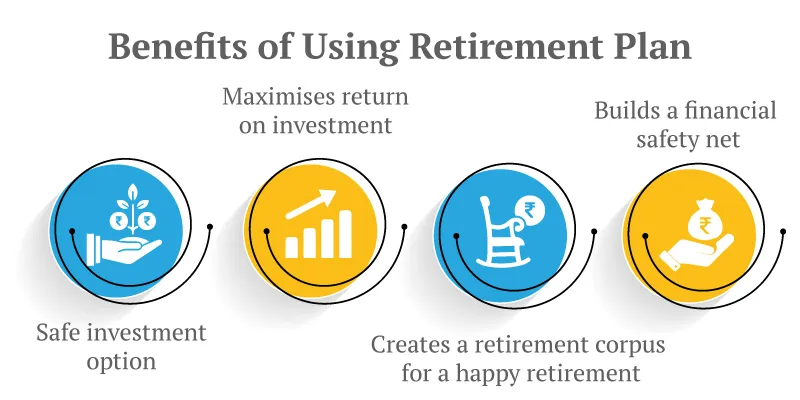
- Safe & Reliable Income: Life insurance pension plans can offer the safest and most reliable long-term pension income.
- Wealth Boosters: Retirement plans add bonus units and return to long-term investors portfolios.
- Loyalty Additions: Another form of bonus addition to your portfolio if you stay invested for more than 10 years.
- Automated Portfolio Strategies: Use automated portfolio management to benefit from equity funds while you are busy at work.
- Tax-Savings U/S 80C & 10(10D): Investment of up to ₹ 1.5 lakhs to life insurance pension plans is tax-deductible under section 80C. Maturity value or partial withdrawals are exempt u/s 10(10D)
- High Liquidity: You can withdraw funds without breaking or surrendering your pension plan in need
How to Choose the Right Retirement and Pension Plan in India?
Choosing the right retirement and pension plan requires evaluating your financial goals, risk appetite, income stability, and retirement timeline to ensure long-term security.
- Start Early: The earlier you start investing in ULIPs, the better as it gives ample time to the investment to multiply. As soon as you start working, start putting aside small amounts for retirement. Keep on increasing the contributions with the increase in income.
- Equity Investment options: Even though equities are volatile when compared to other asset classes, they generate relatively better returns. Studies have proved that equities tend to outperform other assets in the long run. Retirement plans being long-term investment products, even a small exposure to equity markets has the potential to generate significant returns.
- Diversification Flexibility: When you are saving for something as important as retirement, it would be foolish to have disproportionately high exposure to a particular asset class. Equities generate decent returns but are also risky. Choose a plan that allows you to have exposure across asset classes.
- Understanding Vesting Age: Choose a retirement plan with a vesting age that matches your requirements. If you plan to retire early, there are plans with a vesting age starting at 40 years. On the other hand, there are plans with a vesting age of 85 years.
Factors to Consider while Buying the Best Retirement & Pension Plans
Before selecting a retirement or pension plan, it’s important to assess key factors that influence your long-term income, financial security, and ability to meet post-retirement expenses comfortably.
- Investment Portfolio: There are many types of pension plans available in India. If you are starting early enough, you should look at the asset options offered by the plan to maximise your return within the time available to you.
- Options to Invest in Equity Funds: Saving plans let you choose the type of asset you want to invest your savings into. However, if you want, you can choose a pension plan with automatic allocation to equity funds. This allocation will diminish as you near retirement age.
- Portfolio Management Options: Those pension or retirement schemes which offer equity exposure to your retirement savings should give you the option to manage the portfolio automatically. So that your money doesn’t miss the market opportunities while you are busy working.
- Maximum Maturity Age: The maximum maturity age limits your ability to keep the funds in one place for a long time. You should not have to make investment choices regularly, especially close to or after your retirement.
- Bonus Additions: The best retirement and pension plans provide bonus additions to the investors stick with the plan longer. These boosters help your retirement portfolio growth, especially when you are investing only in safe portfolios. Pension plans will generally offer loyalty additions and wealth booster bonuses.
- Pension Plan Expenses: There are several expenses related to ULIPs such as fund management charges. Choose a plan that has lower administrative charges as the expenses are generally deducted from your investment. The lower the expenses; the higher the fund value.
- Annuity Option: An annuity option ensures that your corpus lasts till you live. It is important to choose a plan that has an annuity option best suited for you. There are pension plans that guarantee annuity for a certain number of years regardless of whether the policyholder survives or not.
4 Steps for Retirement Planning
Retirement is the simplest goal to plan for if you follow the correct approach. Investing for a prosperous retirement is the only challenge with this goal. So, here’s how you can go about it to keep it simple and rewarding:
Step 1: Start By Saving At Least 10% of Your Income
Remember your pension income and the success of retiring at your desired age depend on how much of your present income you save for your a retirement goal. If you have 30 years to spare the best you can do under Indian economic conditions is to invest at least 10% of your take-home income towards retirement goal.
This should be a safe investment in long-term pension or retirement plans.
Step 2: Start Investing Small Amounts in Equity Funds
If you have more than 10 years before you retire, start investing small additional amounts in equity funds. The best way to allocate your money to equity is through unit-linked plans, as you not only get the tax benefits, but you can also manage your portfolio risk automatically.
You should aim to increase this contribution to at least 5% of your annual take-home income.
Step 3: Add Long-Term Assets to Your Portfolio
Adding inflation-linked assets like house property for rental purposes and gold will help you continue to enjoy the inflation-adjusted income, even after retirement. Although such investments may be less liquid, they are useful in a post-retirement emergency such as low pension corpus.
Step 4: Minimise Post-Retirement Tax
A monthly pension from a pension plan is taxable as salary income. Thus, you should add more retirement plans which allow tax-free partial withdrawals, such as unit-linked insurance plans. This will help you reduce your tax burden post-retirement.
Diversifying your savings to multiple assets is essential to achieve an important long-term goal such as retirement.
6 Steps to Find the Best Retirement & Pension Plans in India
Finding the right retirement and pension plan involves a systematic approach to evaluating your financial needs, future goals, and available investment options.
- Vesting Age: Choose a retirement plan with a vesting age that matches your requirements. If you plan to retire early, there are plans with a vesting age starting at 40 years. On the other hand, there are plans with a vesting age of 85 years.
- Equity Option: Even though equities are volatile when compared to other asset classes, they can generate relatively better returns over the long term. Studies have proved that equities tend to outperform other assets in the long run. Retirement plans being long-term investments have the potential to generate significant returns even with a small allocation to equity funds.
- Option to Diversify: When you are saving for something as important as retirement, it would be foolish to have disproportionately high exposure to a particular asset class. Equities generate decent returns but are also risky. Choose a plan that allows you to have exposure across asset classes.
- Option for Additional Bonuses: Bonus units or funds added to your long-term portfolio can propel your portfolio to grow faster. The best pension plans offer loyalty additions and wealth booster benefits to investors who invest in a plan for more than 5 to 10 years. The longer you invest, the better your benefits become.
- Option for Automatic Portfolio Management: If you are investing in portfolios with elements of equity, you need automated portfolio management to check the risk on your behalf. This will allow you to benefit from market movement safely even when you are not paying attention to the investment.
- Policy Surrender Charges & Valuation: Pension and retirement plans are investment policies with good cash values close to their vesting or maturity age. Also, often you need a lump sum of money close to retirement for paying off any expensive debt or buying a necessary asset like a house.
Lower surrender charges will help you recover the maximum amount from the investment in emergencies. Although, you do not need to surrender the policy as you can borrow against it at much lower rates. However the borrowing value is directly related to the surrender value.
Retirement Planning Guide for Working Women
You are wearing multiple hats during a single day, and almost all of these hats are very important in your life. So, the best way for you to plan your retirement goal is this:
- Keep it simple: Whether you can achieve your retirement goal or not, depends majorly on one factor and that is what portion of your income are you saving for retirement. If you have 20 to 30 years at hand before your retirement age, saving 10 - 20% of your annual income towards this goal would take you a long way.
- Use Diversified Portfolio: Retirement is one of those goals where your satisfaction with your fund pool is directly proportional to the diversity of your investments. This also helps you to maximise your retirement savings.
- Automate Everything: The second important step is to delegate regular things so that you don’t have to spend time on them. Use auto-debit facility to automate investing function. If you invest in unit-linked plans you can also use one of the automated portfolio management options to control your investment risk at all times.
- Keep Your Money Invested: Retirement is not just a long-term goal; it’s a lifetime goal, as you will need to ensure that your retirement funds last at least your lifetime. So, for the best results make sure your unused money is earning adequate interest at all times.
- Use Life Insurance Plans: You have two types of life insurance plans. Although both will give you the benefit of section 80C savings, few plans will also give you a tax-exempt partial withdrawal option.
Retirement planning secures your future through early, diversified pension investments like NPS, ULIPs, and annuities that combat inflation and ensure steady income. Start with 10-20% of income, leverage tax benefits under 80C/10(10D), and progress through accumulation, preservation, and distribution phases for financial freedom.
Glossary


FAQs for Retirement Plans
The premium is one of the most important factors to consider before buying a policy. Many people buy a life insurance policy with a high sum assured but are unable to pay the premiums for the entire premium payment tenure. You can get a better idea of the premium outgo with the premium calculator available in the ‘Tools and Calculator’ section of www.canarahsbclife.com.
The Invest 4G plan offers three benefit options to choose from. If you have opted for the Life Option or Whole Life Option, the insurer will pay the nominee(s) the death benefit if the policyholder meets with an unfortunate incident. However, in the Life Option with Premium Funding, the policy continues even after the death of the policyholder. The company pays the remaining premiums until the policy matures.
Life is unpredictable and so it is important to prepare for all eventualities. If you regularly save a substantial amount of your income for retirement, the corpus may expand to a comfortable level before retirement. In case you become disabled and are unable to contribute to the retirement plans, most plans will continue to multiply your savings. The amount already accumulated will continue to grow and besides the existing plans you can also choose to invest in pension schemes specifically designed for people with disability.
Investment in ULIPs like Promise4Growth Plus plan qualifies for tax deductions under Section 80C of the income tax law. The maturity benefits of ULIPs are also tax-exempt under section 10 (10D) of the Income Tax Act, 1961. However, if the premium paid during the policy term is more than 10% of the sum assured, the maturity proceeds will be taxable.
The concept of early retirement is catching up fast in India, but there are no specified ages for early retirement. While in some Western countries the age between 35 and 45 is considered favourable for early retirement, in India the ideal age is 45-50 years. With the right planning and investments, it is not very difficult to retire early.
t the age of 35-40, people generally have several responsibilities such as children’s education and various EMIs. It is difficult to spare a substantial amount of income for retirement. Depending upon the needs of the household and the lifestyle, one should aim to save around 40-50% of his/her income. Around 10% of the income should exclusively be allocated for retirement planning. Here are some tips to choose the best retirement plan.
- Focus on your needs: It is easier to formulate a strategy when the goal is clear. Make an estimate of the amount required to sustain your life. Take inflation into account and zero in on the targeted corpus.
- Research thoroughly: Conduct thorough research before investing in any financial product. Read the term and conditions properly and try to understand how an investment product fits your needs.
- Consider different products: The market is awash with all kinds of investment products. Do not follow conventional advice as the need of every person is different. Take into consideration all the suitable products, conduct an objective analysis and then invest.
Owning a house is a cherished dream for many. There are several ways to save for a new house, but in urgent cases, people may be tempted to withdraw from their retirement fund. There are various financial products for retirement planning, and all have different withdrawal rules. In the case of the National Pension Scheme, partial withdrawals for special purposes like buying a house are allowed only thrice during the policy tenure. However, to avail the withdrawal facility, you should be an NPS investor for at least 10 years and you are permitted to withdraw only 25% of your contribution. If you have a PPF account, you can withdraw 50% of the accumulated amount, but only after staying invested for at least 6 years. The Invest 4G plan also allows partial withdrawals after five years of investment.
The quantum of monthly savings depends on the specific needs of the buyer. Financial advisors, however, suggest people save around 15% of the monthly income for retirement.
Retirement plans such as NPS have a very low entry threshold. It is also open to all and anyone can open an NPS account and start saving. A small business can also invest in Invest 4G plan from Canara HSBC for as low as Rs 5000 every month.
The choice between paying off a student loan or start a retirement account is not a difficult one. Starting early for retirement planning has its own advantages but extending the student loan will increase the interest burden. You will have to find a balance between the two. Try to pay off the student loan as soon as possible, but do not hold back on investing in a retirement account.
Most people nominate their spouse to receive retirement benefits in their absence. But a spouse is not automatically entitled to be the beneficiary of a retirement account owned by the other spouse.
Gold is a safe investment asset and investors often flock to the yellow metal to stabilise their portfolios. Holding a small quantity of gold can be considered as the intrinsic value of gold remains intact. You can also choose to have an exposure to gold through ULIPs. ULIP funds invest in a variety of asset classes and some fund options also have a small exposure to gold. You can choose fund options with gold to have a small and indirect investment in gold.
While there are no explicit rules barring the use of retirement account to finance real estate, it may not be advisable to do so. For instance, you are allowed to avail loan from the PPF account from the third financial year. The loan can be used to finance real estate, but it would defeat the purpose of having a dedicated retirement account.
While there are no explicit rules barring the use of retirement account to finance real estate, it may not be advisable to do so. For instance, you are allowed to avail loan from the PPF account from the third financial year. The loan can be used to finance real estate, but it would defeat the purpose of having a dedicated retirement account.
The government has allowed all central government pensioners to open a joint account with their spouses.
Vesting date or age signifies when your pension plan’s accumulation phase is over and the distribution phase can begin. For example, in a deferred annuity plan, you may have a vesting date which is 10 to 30 years away depending on your age at entry. You will continue to invest or stay invested till the vesting date. After the vesting date or age, you can start receiving the pension or withdraw the money from the plan.
The steps may differ from plan to plan. However, you can buy the online retirement plans following the steps below:
- Retirement Calculator: Use a retirement calculator to estimate your corpus need and expected monthly investment amount to achieve it
- Choose Plan: Select the online retirement plan you want to start investing in
- Contact Information: Fill in the personal details including the contact information. Make sure to put the correct e-mail ID which you can access since all future communication about the policy will take place via e-mail.
- Define Your Investment: Select the goal, investment term, investment frequency and amount you want to invest (based on the calculator estimate)
- Select Fund Allocation: Online retirement plans give you the option to invest in multiple assets including equity funds. You can select the ratio in which your premium will be allocated to these funds as per your risk appetite. Then select one of the portfolio rebalancing strategies.
- Select Withdrawal Plan: You can withdraw money based on set milestone or systematically from the plan after the lock-in period. Select the options for withdrawal as per your plan.
- Review Plan & Investment Details & Complete the Application Form
You can pay the premium amount before or after completing the application form to start investing.
The best time to plan your retirement is when you are planning your career. However, this may not be the time when you really start investing money for your retirement. You must start investing in your retirement plan as soon as you start earning.
Retirement is the only financial goal you cannot repair with other means of funding like a loan. Thus, developing the habit of investing with every income you have is the best way to have a comfortable retired life.
Insurance allows your family, especially your dependent spouse to continue living without financial worries if anything happens to you. Also, insurance may help you save enough for retirement in case of permanent disabilities. Additionally, life insurance retirement plans allow you to build a good retirement corpus with bonus additions.
Yes, you can change the nominee of the policy anytime you need. If you are using an Electronic Insurance Account (EIA) to manage your policies, you can change the nominees anytime from this account. Otherwise, you can contact the customer care to update the nominations on your policy.
You can opt for auto-debit of the premiums from your savings account. You can also pay the premiums online using your debit card, credit card or a payment wallet.
You can get Rs. 1 Core pension plan using the online retirement calculator. The calculator will assess your eligibility and provide you with the probable monthly or annual investment to achieve the goal. If the amount seems feasible you can complete the purchase online or set an appointment for a qualified advisor to help you in the process.
A pension is a type of fund created to assist you after retirement. Here you are required to invest a certain sum regularly or in a lump sum during your working years. You then receive a regular stream of income from the fund you created to meet your expenses after retirement.
An annuity is a type of contract between you and the insurance company. In the contract, you agree to make payments, either in a lump sum or regular to the insurance company. In return, you receive regular payments from the insurance company for a specific term. This makes policyholders financially secure.
Yes, you can invest in multiple pension plans. Though there are limits prescribed to the amount you can invest yearly in the chosen pension schemes if you are looking to get relief from taxes.
If you surrender your pension plan before maturity, the surrender value gets added to your taxable income. This income is subject to a charge under the appropriate tax bracket. Also, any tax exemptions you may have received and the outstanding premiums need to be paid back by you.
New Pension Scheme or NPS is a government-created pension plan aimed at protecting the financial future of individuals, once they retire. Also called the National Pension scheme, it is regulated by the Pension Fund Regulatory Development Authority of India (PFRDA). People falling between the age bracket of 18-60 years can invest in NPS.
New Pension Scheme offers, varied investment opportunities, tax benefits and is cost-effective as well.
There is no one ‘best’ retirement plan. Every investor looks for something different in a retirement plan than the other. Insurance companies offer a variety of retirement plans with different features. You should choose the plan which best suits your lifestyle, risk factors, etc.
In a participating pension plan, you are entitled to receive the profits earned by the insurance companies, as a bonus or dividend. Non-participating pension plans, on the other hand, do not involve bonuses as the profits are not shared with you in this plan. Both plans however provide guaranteed life cover.
You can choose from a range of options to pay your retirement plan’s premiums. Some of the ways are Cheque deposits, net banking, credit/debit cards, e-wallets, electronic clearing service (ECS) wallets, etc.
Related Blogs
How EPF Pension is Calculated? Formula, Eligibility & Examples
03 Apr '26
39 Views
9 minute read
Learn how EPF pension is calculated using the EPS formula, average salary, and service years. Includes eligibility rules and simple examples.
Read More
Retirement Plan

How to Reactivate a Frozen NPS Account in India?
03 Apr '26
47 Views
8 minute read
A complete guide to unfreeze your NPS account in India. Know the minimum contribution, KYC fixes, and online or offline reactivation steps.
Read More
Retirement Plan

How to Check EPF Balance Using Missed Call? | Easy EPF Balance Check
02 Apr '26
111 Views
6 minute read
Learn how to check your EPF balance using a missed call. Follow simple steps, eligibility criteria, and tips for a quick EPF balance check.
Read More
Retirement Plan

How to Reset EPFO Passbook Password? EPFO Member Passbook Guide
02 Apr '26
113 Views
6 minute read
Learn how to complete an EPFO passbook password reset using UAN and OTP. Follow simple steps to regain access to your EPFO member passbook online.
Read More
Retirement Plan

National Pension Scheme (NPS): How to Invest & Maximise Returns
31 Mar '26
923 Views
8 minute read
Discover how to invest in the National Pension Scheme (NPS) in India. Learn about tax benefits, investment options, and how it compares to private pension plans.
Read More
Retirement Plan

Employee Pension Scheme (EPS-95): Eligibility, Benefits & How It Works
31 Mar '26
1235 Views
9 minute read
With EPS-95 minimum pension up to ₹7,500, private-sector employees may need to rethink VRS plans. Know the impact and retirement benefits in 2025.
Read More
Retirement Plan

How to Withdraw from Your Retirement Plan Before Maturity?
13 Mar '26
505 Views
5 minute read
Thinking of early withdrawals from your retirement plan? Learn when it is allowed and how to avoid costly mistakes with smart planning.
Read More
Retirement Plan

Senior Citizen Card: How to Apply for it Online?
12 Mar '26
13613 Views
10 minute read
Learn the step-by-step process to apply for a Senior Citizen Card in India. Discover eligibility criteria, required documents, and benefits that come with the card for senior citizens.
Read More
Retirement Plan

Is Pension Taxable in India? Rules, Exemptions & Types
27 Feb '26
2000 Views
7 minute read
Know which types of pension are taxable in India, what exemptions apply, how commuted and uncommuted pension are treated, and how to plan your tax liability.
Read More
Retirement Plan
Popular Searches
- Retirement Calculator
- Best Retirement Plan
- Senior Citizen Card
- Saral Pension Plan
- NPS Withdrawal
- Pension4Life Plan
- Retirement Planning
- 5 Retirement Tips
- National Pension Scheme
- NPS Pension Calculator
- Types of Pension Plan
- Guaranteed Pension Plan
- Is Pension Taxable
- How to Check Old Age Pension Status
- Benefits of Pension Plan
- How GST Applies to Pension Plan?
- Tax Planning for Retirement
- Types of Retirement Plans
- Guaranteed Pension Plans
- Retirement Income Plans