Written by : Knowledge Centre Team
Last published : 2025-10-02
11 minutes read
Share

You would have come across recommendations to invest based on the tenure or timeline. The goals for the short-term vs long-term can vary considerably. So does the asset class to help you reach the goals. What exactly are short-term and long-term investments?
The length of time that one plans to stay invested determines the types of investment instruments to be considered. For short-term investments spanning less than 3 years, you will typically seek stable assets with predictable returns. However, when you explore investments in equities, you must have sufficient time in hand to reap rich returns. In short, equities look at a long-term horizon spanning, say, more than 10 years.
Riskier investments are always considered for longer terms because time mitigates the risk of loss to a great degree.
So, if you have more time in hand, you can invest aggressively and look at building a riskier portfolio. On the contrary, if your time horizon is short, become risk verse and park your money in safer instruments even if they give comparatively lesser returns so that your wealth is protected.
Must Read - How to Manage Your Money?
Short-term investments refer to any investment made with a time horizon of 3-5 years at best. This is best suited for people approaching retirement or needing a sizeable amount of money in the near future. Short-term investments are liquid and are less risky as compared to long-term investments. The priority in short-term investments is safety and liquidity. A few examples of short-term investments:
A savings account is convenient to use and therefore a popular choice. You earn interest on the funds parked there and you are free to withdraw any amount, anytime and from any branch or ATM. Most banks specify a minimum balance that you should maintain at any point in time. This amount varies amongst banks and account types.
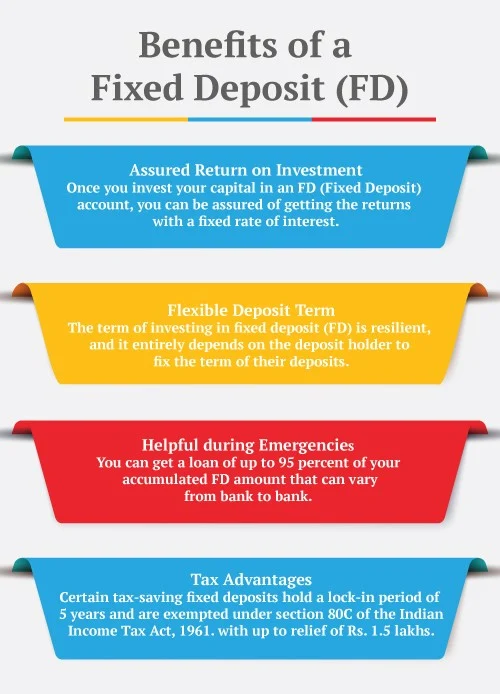
Fixed deposits (FDs) offer guaranteed returns and are therefore considered a safe investment. The returns on FDs are not market-linked, implying predictable, pre-fixed returns and tenures. Senior citizens earn a little more than others on bank fixed deposits. You can open a fixed deposit for a tenure of anywhere between 7 days to 10 years. You can prematurely withdraw from a fixed deposit unless it is a 5-year tax-saving fixed deposit.
Recurring deposits are also fixed/term deposits, offered by banks, but with flexibility. You can invest monthly and still avail benefits such as guaranteed returns and liquidity. Recurring deposits are also safe just like fixed deposits and the tenure ranges from 6 months to 10 years. But please note that recurring deposits have a lock-in period of 30 days.
Recommended Reading - What is Liquidity?
NSC is a sovereign-backed instrument and pays 6.8% interest per annum which is higher than the prevailing bank FD rates. Although the lock-in period is 5 years, you can avail of a bank loan against an NSC. You must invest a minimum of Rs. 1000 in an NSC.
Long-term investments don’t come with a pre-defined outcome like fixed income instruments that are typically used for short-term investments. Long-term investments are “long-term” for a reason. You must stay invested to complete a full economic cycle from bust to boom.
Equities are the best-known examples of long-term investing that have proven to give better than average returns and help in wealth creation. An asset is a long-term one when it consistently generates positive returns for many years. Some specific examples are listed below:
Holding shares or investing in mutual funds and staying invested for many years anticipating the businesses to continue being profitable and such profits reflect in the growth in stock prices.
Investing in mutual funds gives you the advantage of benefiting from the overall growth of an industry or index. These active funds strive to beat the underlying index. The fund manager may pick only 20 stocks out of the NIFTY 50 but will ensure that these 20 have the strongest prospects.
The criteria for selection depend on the purpose and objective of the fund.
ULIPs are versatile long-term investments which let you choose your asset allocation. You can invest in equity or debt funds within the same ULIP plan. You can also switch between funds. The insurance component makes ULIPs the best investment option for children’s future. Other than that a few more features you should know about:
Canara HSBC Life Insurance allows you to stay invested for 99 years. With such a plan you can build a good corpus up to the age of 60 and then draw a tax-free pension from the same.
Also Read - How to Invest Money?
NPS is a useful retirement saving option, especially for younger investors. NPS gives you the option to invest in a mix of equity and debt, the allocation of which depends on your age and risk appetite:
PPF is a safe long-term investment plan with fixed returns and a sovereign guarantee. PPF features are as follows:
You must consider both aspects of taxation when exploring short- or long-term investments. Is the amount you invest, deductible from your taxable income? For example, any investment into a 5-year tax saving bank FD is deductible under section 80C of the Indian Income Tax Act. However, the interest earned is added to your taxable income every year. But a five-year NSC gets to postpone the tax liability on interest until maturity. Similarly, PPF and ULIP also help you save tax on invested money but have a completely tax-free value after five years.
Short-term versus long-term investments are more of a choice based on financial goals rather than competition. Both are required to maintain a balanced and healthy investment portfolio. Take a judicious decision and invest money depending on your financial goals, milestones, and aspirations. Set aside some money for emergencies. Long-term investments will help you generate wealth whereas term plans will ensure you have the money within your reach.
An OTP has been sent to your mobile number

Sorry ! No records Found
Thank You for submitting the response, will get back with you.
Thank you for your interest in our product. Our financial expert will connect with you shortly to help you choose the best plan.
Disclaimer - This article is issued in the general public interest and meant for general information purposes only. The views expressed in this blog are solely those of the writer and do not necessarily reflect the official policy or position of Canara HSBC Life Insurance Company Limited or any affiliated entity. We make no representations or warranties of any kind, express or implied, about the completeness, accuracy, reliability, suitability, or availability with respect to the blog or the information, products, services, or related graphics contained in the blog for any purpose. Any reliance you place on such information is therefore strictly at your own risk. You should consult with a qualified professional regarding your specific circumstances before taking any action based on the content provided herein.





We bring you a collection of popular Canara HSBC life insurance plans. Forget the dusty brochures and endless offline visits! Dive into the features of our top-selling online insurance plans and buy the one that meets your goals and requirements. You and your wallet will be thankful in the future as we brighten up your financial future with these plans.