
- Child Insurance Plan: A policy combining life cover and investment to secure a child’s education and life goals
- Premium Waiver Benefit: A feature where future premiums are waived if the policyholder dies or becomes disabled
- Maturity Benefit: The lump sum or payouts received at policy end to fund education, marriage, or milestones
- Child ULIP: A market-linked child plan offering life cover with investment in equity or debt funds
- Money-Back Child Plan: A child plan that provides periodic payouts along with life insurance coverage

Table Of Content:
0
1
1.
What is a Child Insurance Plan?
0
2
2.
Child Insurance - Top Selling Plans
0
3
3.
How Does a Child Insurance Plan Work?
0
4
4.
Types of Child Insurance Plans
0
5
5.
Features of Child Insurance Plans
0
6
6.
Benefits of a Child Insurance Plan
0
7
7.
How to Buy the Best Child Insurance Plan
0
8
8.
You Should Invest Child Insurance plan?
0
9
9.
Covered in a Child Education Plan?
10
10.
How to Buy a Child Insurance Plan?
11
11.
Child’s Financial Future planning?
12
12.
Why Do You Need to Buy a Child Plan?
13
13.
FAQs
Planning for your child’s future is one of the most important responsibilities as a parent. From education to long-term life goals, financial needs grow over time. A child insurance plan helps you prepare for these expenses in a structured way while offering financial protection. In this blog, we explain how child insurance plans work, their types, benefits, and who should consider investing in them.
Key Takeaways
|
What is a Child Insurance Plan?
A child insurance plan combines the features of a long-term investment option and life insurance. This combination offers financial safety to your child’s future through:
- Investment growth when you are alive and
- Insurance if you suffer a mishap on the way
Upon maturity, the child plan pays a lump sum amount, which can be used for the child’s higher education fees and marriage expenses. It offers the needed safety for a child’s future in case of your untimely demise or suffering a terminal illness.
While you are building the corpus to fulfil these goals for your child, the insurance plan provides a safety cushion to the corpus in case of your untimely demise. In the unfortunate event of your passing away before fulfilling the goal, the plan can invest the money on your behalf and give the maturity amount you originally aimed for your child.
We, at Canara HSBC Life Insurance, offer Child insurance plans that also offer periodic payouts of the corpus you have built to align with your child’s financial needs. These periodic payments can coincide with the crucial milestones of your child’s life, like education, marriage, etc.
Child Insurance - Top Selling Plans
We bring you a collection of popular Canara HSBC life insurance plans. Forget the dusty brochures and endless offline visits! Dive into the features of our top-selling online insurance plans and buy the one that meets your goals and requirements. You and your wallet will be thankful in the future as we brighten up your financial future with these plans.
Fixed Returns, Zero Risks & Worries
iSelect Guaranteed Future Plus
- 4 Plan options
- Life cover + Guaranteed benefits
- Accidental death benefit
- Premium protection cover
Don't Just Survive, Thrive
Guaranteed Assured INcome
- 3 Plan options
- Life cover + Guaranteed income
- Get Total Premiums at maturity
- Early income from 2nd policy year
Save, Dream, Plan. Live Peacefully
iSelect Guaranteed Future
- 5 Plan options
- Option to choose PPT
- Get Tax benefits
- Premium protection cover
How Does a Child Insurance Plan Work?
A child insurance plan helps you to secure the future of your child by ensuring that his goals are met even if you are not there.
Just like any other insurance plan, a child plan also requires you to pay regular premiums. The premiums you pay are allocated to your chosen funds in the child investment plan. You can choose various modes available to pay your premiums for the child policy. These are:
- Limited Pay Pay for a limited time and enjoy the benefits of the policy
- Single Premium Pay for a lump-sum premium for the whole policy at once.
- Regular Pay Pay regularly depending on periods such as monthly, quarterly, and yearly.
For instance, Ajeet is starting to save for his 5-year-old daughter’s higher education and marriage. He plans to invest ₹ 10,000 monthly in a child savings plan with a life cover of ₹ 12 lakhs, for the next 15 years.
Case 1: If Ajeet survives the policy term
Ajeet will be entitled to receive the maturity benefit from the child savings plan. This is the fund value of the investments he has made into the child plan and any bonuses. Depending on the type of child insurance plan, Ajeet can either receive the lump sum or convert the sum into a regular payout.
Case 2: If Ajeet dies during the policy
If Ajeet does not survive the policy term, then his daughter will receive the death benefit. This will be higher than the sum assured or the fund value at the time of death. If Ajeet had opted for the premium protection benefit, the child investment plan would continue after paying the death benefit. His daughter will receive the maturity value upon the expiry of the plan.
Secure Your Child’s Education and Future Milestones
Enter OTP
An OTP has been sent to your mobile number
Didn’t receive OTP?
Application Status
Name
Date of Birth
Plan Name
Status
Unclaimed Amount of the Policyholder
Name of the policy holder
Policy Holder NamePolicy No.
Policy NumberAddress of the Policyholder as per records
AddressUnclaimed Amount
Unclaimed Amount
Sorry! No records Found
Request Registered
Thank You for submitting the response, will get back with you.
Complaint Registered
. Please use this ID for all future communications regarding this concern.Request Registered
Thank You for submitting the response, will get back with you.
Thank you for your interest in our product. Our financial expert will connect with you shortly to help you choose the best plan.
Sorry
Types of Child Insurance Plans
A child insurance plan is a widely available financial product and most insurers offer it with different riders to appeal to a wide variety of customers.
- Child Endowment Plans: Child Endowment Plans offer a safe investment option for your money by offering guaranteed maturity benefits. These child investment plans are best when you know the amount that you will need for the goal.
Also, with guaranteed benefits and goal protection options, you can be sure to achieve your goal even if you cannot be there for your family.
Child Endowment plans offer a savings avenue along with a life cover that ensures your financial goals are well-protected even in your absence.
- Child Money-back Plans: Child money-back plans offer a long-term, safe investment option for your child’s future. These plans are ideal for long-term financial goals, such as funding a four-year undergraduate degree.
Child Money-back plans also offer bonuses to aid the growth of your investment. These bonuses add to your plan’s maturity value.
These are some of the best child plans, as you enjoy the benefit of a life cover while getting a portion of the sum assured at regular intervals.
- Child Savings Plan: Child savings plans are generally ULIPs that give you more freedom as an investor. You can choose the amount of risk you want to take on the invested money. You can also use one or more automated portfolio strategies to benefit from market movements.
Some child plans also offer additional bonuses for long-term investors. You can withdraw money from the accumulated corpus after completing five policy years. Withdrawals are tax-free, so you can at any time after the lock-in period.
Features of Child Insurance Plans
Child insurance plans are designed to combine financial protection with long-term savings to support your child’s future goals. They offer structured benefits and flexibility to help parents plan confidently for key milestones.
- Life Cover: Life cover is an integral part of most investment plans. A child saving plan also includes a cover on the life of the policyholder. This will protect the child’s dream in case anything happens to the policyholder during the term of the child's policy.
- Goal Protection in case Death or Disability: The child investment plan will continue to invest the due premiums in your child’s goal after your untimely demise. This option ensures that your child can achieve their goal even after your death without having to pay any extra premiums.
- Systematic Withdrawals: Child education plan and endowment plans offer the option of systematic withdrawal or automatic payments from the plan in the final few policy years. This allows your child to meet the financial needs which may arise gradually.
- Bonus Additions: Participating child plans and Unit-Linked Plans offer rewards for staying invested for the long term. While ULIP will add units as loyalty additions and wealth boosters, endowment and money-back child plans accrue annual bonuses. These bonuses are payable with the maturity value of the child's policy.
- Loans & Partial Withdrawals: Child endowment and money-back plans acquire cash value after two years of investment. Thus, in case of emergencies, you can take a loan against the policy without having to break the investment. Child ULIPs, on the other hand, offer partial withdrawals after the five-year lock-in period.
- Riders: Child insurance plans come with a variety of riders. The most prominent add-ons offered with child investment plans are critical illness cover, accidental death cover and the premium waiver option. Some insurers offer the premium waiver option as an in-built feature of the child policy. The critical illness cover protects against a set of terminal diseases, while the accidental death cover provides an additional sum in case of accidental death.
- Choice of Funds: A part of the premium paid for a child investment policy is invested in market-linked assets. The insurance company provides the policyholder with an option to choose from different funds. The funds under the child saving plan invest in equity, debt or money market instruments.
- Premium Waiver Benefit: An important feature of a child insurance plan is the premium waiver benefit. In case the policyholder dies within the stipulated duration, the beneficiary gets the sum assured, and the insurance company continues to pay the remaining premiums till the maturity date.
- Lump Sum Benefit: After your death, the death benefit is provided in a lump sum, i.e., the whole amount in a single payment.
- Tax Benefits: Child insurance plans offer significant tax benefits under the Indian Income Tax Act, making them a smart financial investment. Premiums paid qualify for deductions up to ₹1.5 lakh under Section 80C, while maturity and death benefits remain tax-free under Section 10(10D). Partial withdrawals from ULIPs, loans against policies, and premium waiver benefits also do not attract taxes. Additionally, riders such as critical illness and accidental death cover may provide deductions under Section 80D. These benefits help secure a child’s future while offering tax savings, ensuring both financial growth and protection.
Benefits of Buying the Best Insurance Plan for a Child
Buying the right child insurance plan helps you build a secure financial foundation for your child while protecting their future against uncertainties. It ensures that important goals remain achievable through disciplined savings and long-term planning.
Corpus for Child's Education
The schools and the education system have been getting more and more advanced. Due to this, their fees are constantly rising. For higher education, the cost is even higher. So, it becomes important to plan the education of your child, keeping in mind the future costs.
That’s where a child education plan can help you. The premiums you pay over time are invested and can help create a corpus that will be sufficient to meet your child’s education goals, such as post-graduation and studying abroad.
Takes Care of your Child’s Medical Expenses
The primary focus of a child's insurance policy is to safeguard your child's future. But this is not the only way a child investment plan can help you.
It allows you to withdraw from your corpus from the child plan only after five years of starting the investment. The withdrawals are tax-free.
Financial Support to the Child in the Absence of a Parent
Even if you think that you will have enough to fulfil your child’s goals, life is unpredictable, and preparation is better. You can ensure that your child’s goals are financially protected, even if you are not there.
Child education plans come with life cover and premium protection. Your family is provided with a lump sum death benefit. Also, the premium protection feature of the best child investment plan ensures that your family doesn’t worry about the premiums, as they will be waived off and paid by the company.
Income Protection Cover for the Child
Lump-sum money will help you take care of the larger expenses. But other regular expenses happen more frequently. When you die, your income also stops. This can affect you family even more when you are the only breadwinner for the family.
Many child insurance plans offer regular payouts as well. After your death, your child will receive a monthly sum. This can help replace your income and make sure your child doesn’t suffer.
Acts as Collateral for Higher Education
Child insurance plans are an asset with a value which continues to increase until maturity. You can also use your child policies, especially child endowment plans, as collateral for a low-cost loan. This will help you secure a loan for your child for his education or even for their marriage later on.
Modification in Sum Assured
Some insurers allow the insured to increase the sum assured mid-way through the policy term without any change in the premium. Adjusting the sum assured of your child's investment plan as per your life stages and financial milestones can help you stay aligned with your goals.
Returns that can Beat Inflation
Child investment plans that we offer have portfolio investment options. You can invest in diversified portfolios of equity and debt securities through these plans.
Thus, your investments in a child plan can earn inflation-beating returns through market securities over the long investment period.
How a Child Insurance Plan Will Secure Your Child’s Future?
A child insurance plan secures your child’s future by ensuring that funds for important goals remain available, even during unforeseen circumstances. It helps parents stay financially prepared while supporting long-term aspirations like education and career growth.
- Endowment plans: A child insurance plan helps you create a corpus for your child’s needs. Having adequate funds in times of need is critical for your child’s growth. With a premium funding option, your child’s future will be secure even if you meet with an unfortunate incident. Buy an endowment policy as soon as possible to cater to the needs of your child. The best time to buy an endowment plan is now. Child Endowment Plans offer a savings avenue along with a life cover that ensures your financial goals are well-protected even in your absence.
- Money-back plans:- If you have to save ₹ 12,000 in a year, it is better to save ₹ 1,000 every month rather than ₹ 6,000 in the last two months. A child insurance plan helps you maintain discipline while saving for your child’s future.
- Unit-linked insurance plans:-Children are delicate and often fall ill. Child insurance plans provide an option for partial withdrawal of funds without surrendering the policy. The partial withdrawal facility can be used for the medical treatment of the child.
A ULIP can help you stay prepared for the unforeseen future in case something happens to you. So, it can be said that ULIP is a good form of investment if you have a resilient financial plan.
How to Get the Best Child Insurance Plan?
The best child education plan for you should be the one that can solve your purpose in the most optimal way possible. Some factors should be considered before you decide to buy a child plan.
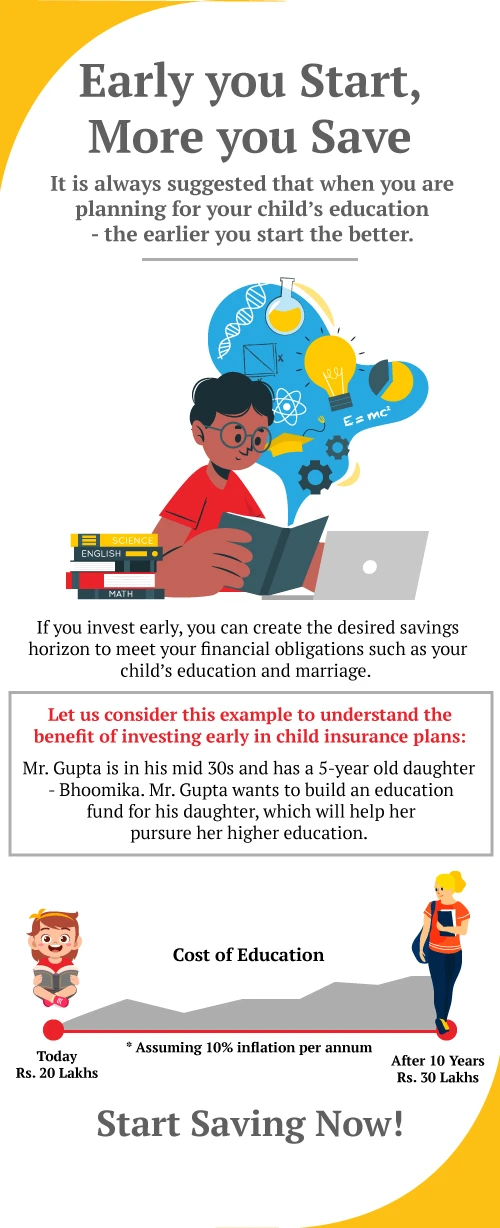
- Start Investing Early: Starting early gives your child's savings plan ample time to grow your money. You also get more time to make adjustments and achieve a bigger goal than you initially intended.
- Consider Inflation & High Education Cost: Inflation keeps shifting your goalpost for the child’s plans. However, planning your child plan investments with after-inflation costs would let you catch up to it in the long run.
- Look for Premium Waiver Benefit: The premium waiver benefit allows your child's investment plan to continue without the need for additional premiums. This option comes into force if you suffer from a critical illness or accidental disability which affects your income
Such emergencies do not allow for death benefits, but they can affect your plans. However, with the premium waiver benefit, you can rest easy, as the child will receive the intended maturity value.
- Consider the Premium Protection Option: If this feature is available in the plan, then the premiums will be taken care of even after you die. The company funds all the premiums that remain to be paid after your death under this option. Thus, the policy continues even after your death, and your child will get the maturity benefit as promised by the company.
This feature ensures your family does not have to worry about the premiums.
- Check for Partial Withdrawal Option: A partial withdrawal facility allows you to withdraw money from your fund. This comes in handy in the times of emergencies when you are in need of quick cash.
You should look for a policy that provides you whit the option of partial withdrawals.
- Option to Add Riders: Riders are the additional benefits offered over and above the policy, which enhance the scope of your existing policy. Riders cover those things that are not covered by the base policy. Some of the most popular riders include the following:
- Critical illness rider
- Accidental death benefits rider
- Accidental total & permanent disability rider
Though some riders are added by default in some policies, some add to the cost of your premium. You should choose the policy with the most available rider options to get the best from your policy.
- Frequency of Premium Payment: There should be multiple options to pay your premium. You must be able to pay as you like. Many policies have the option of limited payment. This means you pay your premiums for a limited time and enjoy the benefits of the policy for a long time.
- Check for Regular Payout Option: The purpose of the child insurance policy is to provide your child with the money, which will help in his education or other goals. This money should be present when needed.
- Consider the Associated Charges in the Policy: This is also an essential factor to consider before buying a policy. The insurance provider levies charges for the maintenance of the policy. Some of the charges associated are:
- Fund management charges
- Premium allocation charges
- Administration charges
- Switching charges
Choose the policy that has the lowest charges involved.
- Terms & Conditions of the Child Insurance Policy: Understanding the benefits and exclusions of your child's policy allows you to ensure that the policy will be useful in every situation. For example, how much is the regular payment from the plan, which events are covered under the policy, etc?
How Much Should You Invest in a Child Insurance Plan?
Before buying a child insurance plan, you must be sure of how much you should invest. Education, as we know, is getting costlier with each passing year. School fees are rising constantly. Also, if you want your child to go for higher education in the field of engineering or medicine etc, then the cost is even more.
Thus, to make sure your child can pursue what they want, your income may not be enough, and you need to invest in a child education plan as well. But how much should you invest?
Well, this depends on the educational course and institution you are targeting. You can plan your monthly savings into the child education plan accordingly.
Here are the steps you should follow to know how much to invest:
- Ascertain the goal you want to achieve
- Estimate the inflation rate at the time the child will attain education age
- Estimate the expected rate of return of the policy.
Education is one area with one of the highest inflation rates. Thus, it becomes even more important to plan for your child’s education as early as you can.
Child Education Calculator
A smart online tool that helps you easily navigate the costs of your child's future education, ensuring their dreams come true.
1
About my Child
2
My Child’s Dream and Needs
3
Additional Details
4
Our Recommendation
About my Child
My Child’s Dream and Needs
Additional Details
Our Recommendation



For example, suppose, you are planning for an MBA for your child, 10-15 years from now. Here’s what your child saving plan can look like:
| Institution | Current Cost | Cost in 15 Years* | Monthly Savings Needed* |
|---|---|---|---|
| Premier A | ₹ 25 Lakhs | ₹ 52 Lakhs | ₹15,000 |
| Premier B | ₹ 20 Lakhs | ₹ 41.5 Lakhs | ₹12,000 |
| Premier C | ₹ 15 Lakhs | ₹ 31.2 Lakhs | ₹9,000 |
* Assuming an inflation rate of 5% p.a. and CAGR on the child investment plan of 8% p.a.
What is Not Covered in a Child Insurance Plan?
There are certain things in the child insurance policy that are excluded from the policy. This means that these things are not covered and the insurance company will not provide any benefit if death is due to anything that is excluded.
- Suicide Exclusion: If the death is due to suicide or self-harm. If the death is due to suicide within 12 months of the commencement of the policy, then 80% of the premium paid or surrender value is paid.
- Death Due To Drug Overdose: If you die due to the consumption of drugs that are not prescribed or excessive intake of alcohol, then no death benefit is payable.
- Death Due to War: If you die due to war (declared or not) or any type of civil commotion, your family will not receive the death benefit.
- Hazardous Activities: There are certain adventure sports that pose a risk to life such as sky diving, mountaineering, scuba diving, etc. If you die due to participating in these games then your coverage ceases to exist.
- Taking Part in Criminal Activity: If you die while indulging in any activity that is considered criminal or illegal, then this will also not be covered in your child insurance plan.
How to Buy a Child Insurance Plan?
Buying a child insurance plan is a crucial financial decision that ensures your child’s future is secure, even in your absence. It requires thorough research and careful planning to select a policy that aligns with your long-term goals. Here’s a step-by-step guide to help you make an informed choice:
- Assess Your Financial Goals: Before selecting a plan, determine the financial milestones you want to secure for your child. Common goals include funding their higher education, covering medical emergencies, and ensuring financial stability in case of unforeseen circumstances. Estimate the future costs of these expenses, considering inflation, to get a realistic idea of how much coverage you need.
- Compare Different Plans: Child insurance plans come in various types, including traditional endowment plans, unit-linked insurance plans (ULIPs), and money-back policies. Compare policies based on:
- Coverage: Look at what financial risks are covered, including death benefits and maturity benefits.
- Premiums: Assess affordability and premium payment flexibility (monthly, quarterly, or annually).
- Maturity Benefits: Check how and when the policy pays out benefits, such as lump sums or periodic payouts.
- Waiver of Premium: Choose a plan that continues even if the policyholder (parent) passes away, ensuring the child still receives the benefits.
- Consider Flexibility and Investment Options: Some child insurance plans offer investment components that help grow your savings over time. Plans like ULIPs allow you to invest in equity or debt funds based on your risk appetite, while traditional plans provide guaranteed returns. Select a plan that offers flexibility in terms of switching funds, withdrawing funds when needed, and modifying coverage as per changing needs.
- Understand the Policy Terms and Exclusions: Before making a purchase, read the policy documents carefully to understand all terms and conditions. Pay special attention to exclusions, waiting periods, and conditions for claim settlements. This will help you avoid surprises in the future.
- Consult a Financial Advisor: If you are unsure which plan is best for your needs, seek professional advice. A financial advisor can help you assess different policies, compare investment returns, and choose the most suitable plan based on your financial situation and future goals.
- Finalise and Purchase the Policy: Once you have selected the right child insurance plan, complete the paperwork and ensure all details are accurate. Keep a copy of the policy documents and inform a trusted family member about it to facilitate easy access when needed.
By following these steps, you can select a child insurance plan that provides financial protection and security for your child, ensuring their dreams and aspirations are never compromised.
How to Ensure Your Child’s Financial Future with Early Planning?
Starting early ensures greater financial stability for your child’s future. By investing in child insurance plans, education savings schemes, and other long-term financial instruments, you can build a strong financial foundation. Early planning provides higher returns, better investment options, and protection against unforeseen circumstances.
- More Savings Over Time: The earlier you start, the more you can save through compounding benefits and disciplined investments. Early investments allow you to accumulate a significant corpus over time, reducing financial burdens in the future.
- Increased Investment Options and Flexibility: Starting early provides access to a wider range of investment options, from mutual funds to unit-linked insurance plans (ULIPs). It also gives you the flexibility to adjust investments based on market conditions and changing financial goals.
- Secures Your Child’s Future and Reduces Your Stress: A well-planned financial strategy ensures your child’s future needs, such as higher education and healthcare, are covered. This proactive approach reduces financial stress and gives you peace of mind, knowing your child’s future is protected.
Why Do You Need to Buy a Child Insurance Plan?
A child insurance plan is an investment option designed to serve as a wallet for major life goals of a child. Be it higher education, hobby, or marriage a child insurance plan gives you the benefit of investing, growing and using your money as per your child’s needs.
If you mean to provide for your child’s education goals the plans can work as child education insurance. The plan will help your child achieve the goal even if you cannot be there.
A few more important reasons to get going with a child insurance plan at the earliest are:
- Beat the inflation in higher education costs with investment as per your risk appetite using automated portfolio management options
- Prepare for an unexpected expense with an additional corpus for your child’s goal with bonuses and additional units
- Stop the unfortunate events like death and disability from harming your child’s future and plans
- Face financial emergencies or change of plans with partial withdrawal and loan facility from the plan
- Keep your child’s investment corpus safe from taxes with tax savings while investing and withdrawals
Glossary


Related Blogs

Can We Transfer a Child Insurance Plan to Another Child?
16 Feb '26
1137 Views
5 minute read
Learn the rules for transferring child insurance plans. Use a child plan calculator to manage costs and secure your child’s future across key milestones.
Read More
Child Plan

A Guide to Financial Planning for Your Child’s Education Goals
16 Feb '26
845 Views
5 minute read
Early financial education helps children build smart money habits. Learn how a child savings plan can secure your child's education and future financial stability.
Read More
Child Plan

How to Open a Joint Investment Account with Your Teenager?
16 Feb '26
1083 Views
5 minute read
Learn how to open a joint investment account with your teenager, teach money management, and build long-term wealth together with practical, simple steps.
Read More
Child Plan

How Can You Build a Strong Overseas Education Fund for Your Child?
16 Feb '26
1297 Views
8 minute read
Learn practical tips to build a strong overseas education corpus for your child, manage rising foreign education costs, and plan early with the right investments.
Read More
Child Plan

Can Your Child Provide you Relief from Tax Saving?
11 Jan '26
1047 Views
8 minute read
Buying a child insurance plan can help you save tax. You can build the education corpus of your child while saving tax. Explore these 4 child plans you may consider investing in.
Read More
Child Plan
Sukanya Samriddhi Yojana (SSY): Rate, Tax & How to Apply in 2026
01 Jan '26
6857 Views
15 minute read
Explore Sukanya Samriddhi Yojana 2026: interest rate, tax benefits under 80C, eligibility, deposit rules & how to open an SSY account step-by-step.
Read More
Child Plan

Planning Your First Child: Financial Steps to Prepare in 2026
30 Dec '25
903 Views
8 minute read
Learn how to plan for your first child by preparing finances, managing expenses, choosing insurance and building savings for a secure future.
Read More
Child Plan

Using Whole Life Insurance to Secure Your Child’s Future
27 Dec '25
2206 Views
12 minute read
Learn how whole life insurance helps secure your child’s future by offering lifelong coverage, financial stability and long-term support for education and goals.
Read More
Child Plan

4 Ways a Life Insurance Policy Benefits Your Child’s Future
26 Dec '25
2478 Views
7 minute read
Discover four key ways a life insurance policy supports your child’s future, from education planning and financial security to long-term savings and protection.
Read More
Child Plan
Frequently Asked Questions (FAQs) for Child Insurance Plans
A child education plan is an insurance plan for children and an investment asset to meet their educational goals. A small part of the child education plan is used to provide the financial security of insurance, while a bigger part is invested in market-linked instruments. This combination of insurance and market-linked portfolio investments ensures adequate safety for your child’s future.
Any parent with a child between 0-15 years should buy a child insurance plan. It gives inflation-beating returns for various needs of the child as they grow up. As a child grows up, their financial needs increase substantially.
Child plans are meant to build a financial buffer for your child’s future needs, so, it is important to have a fail-proof plan. A few things to consider while buying child plans are:
- Goal: It is pertinent to have a clear goal in mind as it determines the type and tenure of the policy. You should invest in a child plan as soon as the child is born. Starting early gives your investment a chance to grow and helps you prepare better for your child’s needs. Similarly, selecting a long-term policy protects your child for a longer term.
- Premium waiver: While buying a child plan, it is mandatory to check if the premium waiver facility is available or not. Not having a premium waiver option can leave your child vulnerable in your absence.
- Inflation: When you are investing for the long term, external factors like inflation cannot be ignored. Invest in ULIPs to generate inflation-beating returns.
- Bonus component: Along with the basic benefits of a child plan, insurance companies also offer additional benefits. Even though these benefits are small, they could add value considerably in the long run.
Eligibility for a child education plan varies by insurer. Typically, the parent must be 18 to 65 years old, with flexible maturity based on the chosen term. Generally, the maximum age of a child to buy a child plan may go up to 18-25 years of age, depending on the company policies. Premiums often start from ₹5,000 per month or ₹50,000 per year, and policy tenures usually range from 5 to 30 years.
You need the following:
- Policy Form: Contains policy details.
- Proof of Address: Government-issued document (e.g., passport, Aadhaar).
- Proof of Income: Income verification.
- Proof of Identity: Government-issued document (e.g., PAN card, Aadhaar).
- Proof of Age: Birth certificate or educational documents.
Tax-Deductible Investment
Child insurance and education plans are life insurance plans. Thus, the money you invest in these plans is deductible from your taxable income under section 80C of the Income Tax Act. Every year you can claim a deduction of up to Rs. 1.5 lakhs by investing in these plans.
Tax-Exempt Partial Withdrawals
After the respective lock-in periods (for different types of child insurance plans) the ULIPs may allow partial withdrawals while other plans acquire cash value. So, in case of an emergency, you can withdraw money from the child plan without stopping your investment. Also, any payments made by the plan before maturity, as in endowment and moneyback child plans, are exempt from tax.
Tax-Free Maturity Value
Maturity proceeds from child education plans are also tax-free under section 10(10D) of the income tax act. Only two of the following conditions may apply after the Union Budget of 2021:
- The annual investment should not exceed 10% of the life cover in the plan
- In the case of ULIP child plan, the total investment (including other ULIPs) should not exceed Rs. 2.5 lakhs in a year (only applicable to plans starting after 1st Feb 2021)
While the cost of insurance depends on a host of factors such as tenure, coverage and the mode of payment. You can use the ‘child education planning calculator’ to get an idea of the cost of child education plans. The amount you will need to invest in your child’s education now depends on your child’s current age, the targeted institution and course fees. Also, before you start investing make sure to account for inflation in the higher education cost. For example, if your intended course costs Rs 25 lakhs now, it may cost close to Rs 50 lakhs 15 years later. You will need to save about Rs 15,000 p.m. for 15 years to meet this goal.
The right time to buy child plans depends on the financial goal and the type of policy. Child insurance policies are long-term instruments and to generate decent returns it is advisable to invest as early as possible. You can invest in child insurance policies even before the child is born. Child education policies are relatively short-term policies. Child education policies can be chosen according to the financial goal. You can invest in child education policy as soon as the child is born if you plan to fund their primary and secondary education through the policy. If the aim is to accumulate funds for the higher education of the child, then you can invest at a later stage. In any case, it is not advisable to invest after the child has turned 15.
A child insurance plan is the best investment option to provide for your child’s future under every circumstance. Child investment plans can offer you a market-linked return on investment along with a safety umbrella of a life insurance cover. Thus, they are the best investment modes to invest in your child’s higher education and marriage goals.
One of the defining features of child education policies is the partial withdrawal facility. Most insurance companies allow partial withdrawal from child education plans to take care of liquidity needs.
The policy for premature closure of child education plan deposit differs from insurer to insurer. Some insurers allow premature closure of child education plan deposit. If the account is closed before the lock-in period expires, the fund’s value minus the surrender charges id deposited in the discontinued policy fund. The amount earns a minimum of 4% interest and will be paid to you after the lock-in period gets over. It the policy is surrendered after the lock-in period, the total fund value minus the surrender charges will be given to you. But premature closure of child education plan can be fraught with risks and you may not achieve the stated aim.
If you have opted for the premium protection option, your policy will pay the minimum guaranteed sum assured to the nominees upon your death. But the investments in the policy will continue, where the insurer will bear all remaining future premiums.
However, if you have not opted for the premium protection benefit, the policy will pay the higher sum assured or the fund value upon your death. The policy terminates after paying the benefit.
Popular Searches
- Child Education
- Child Insurance Plan
- Children Money Back Policy
- Insurance Policy For Newborn
- Child Protection Rider
- How Child Insurance Works?
- Sukanya Samriddhi Yojana
- Child Insurance Calculator
- Buy Best Child insurance Plan
- Best Investment Plan for Girl Child
- Child Education Insurance Plan
- Best Fixed Deposit for Child
- Types of Child Insurance
- Child Education Insurance